
 |
Peagle |
|
He is not recognized by the F.C.I. |
Origin |
China <> Great Britain -> U.S.A. | |
Translation |
Francis Vandersteen |
A brief presentation of the Peagle |
| The Peagle is a hybrid dog breed. Its parent breeds are the Pekingese and the Beagle. This adorable little fellow is a gentle, affectionate dog whose popularity has recently soared. He's friendly and intelligent. He loves his family, even small children. In fact, he loves most people and is considered quite social. He gets along with other pets, including cats. He can live in an apartment or a house with a fenced-in yard. He's incredibly loyal to his family, and it's worth bearing in mind that he can be a rather inquisitive little dog. They are low-maintenance dogs. |
History of the Peagle |
| The Peagle dog breed originated in the United States. Its exact year of origin is unknown. Although we know some things about the origin of the Peagle, more information can be obtained by studying the history of its parent breeds. |
A little of the Pekingese |
||
| The Pekingese has its origins in the Orient. According to legend, a lion fell in love with a marmoset. In order to marry, the lion asked Buddha to reduce his size, while allowing him to retain his bravery. Buddha gave his blessing to the marriage and the couple became the parents of Fu Lin, China's lion-dogs. Although their origins don't actually follow mythological history, we do know that the Pekingese is one of the oldest dog breeds of all time. The breed is named after the capital, Peking, and Pekingese dogs belonged exclusively to the imperial family. During the Opium War of 1860, British troops acquired the dog after storming the imperial palace. Five dogs were taken to England, one of which became Queen Victoria's dog. In the early 1900s, Pekingese made their way to the United States. It was accepted by the American Kennel Club in 1904. | ||
 |
||
| Standard of the Pekingese | ||
A little of the Beagle |
||
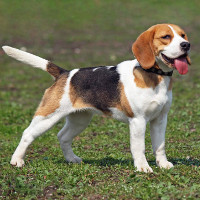
| The Beagle as we know it only really came into being in the 19th century. Although some Greek artifacts describe a dog similar to the Beagle, no one knows exactly where or how the Beagle originated. Most believe that William the Conqueror brought Talbot dogs to England in 1066. Talbot dogs are thought to be the direct ancestor of the Beagle. Because of their excellent hunting skills, the Beagle became very popular with the nobility. Edward II and Elizabeth I had variants of the modern Beagle. In the mid-1800s, the Reverend Phillip Honeywood bred and developed a group of hunting dogs. Around the same time, Americans began importing Beagles. The Beagle was recognized by the American Kennel Club in 1884. | ||
 |
||
| Standard of the Beagle |
Appearance of the Peagle |
| The Peagle is an adorable little dog. They generally weigh between 6 and 8 kilos and measure just over 30.5 centimeters at the shoulder when fully grown. He's generally a cream or tan dog, though his actual coat color will depend on the dominant parent breed. It may have short hair like the parent dog breed Beagle, or it may have long, silky hair like the parent breed Pekingese. Some Peagles are brachycephalic and may have a short nose. This will give him a blocked face look. He will have long, floppy ears. His tail is likely to be long and may curl at the end. Depending on the dominant parental breed, he may have feathers on his ears and tail. |
Temperament of the Peagle |
| The Peagle is a gentle, playful dog. They are also very affectionate. It can be very inquisitive, but is also confident and friendly. He's good with children of all ages and is also very protective of his family. Expect the Peagle to be very social, both with other animals and with people he may or may not know. He's good with all types of pets, especially if he's allowed to socialize with pets from an early age. When training the dog, which is easy enough with the Peagle, use positive reinforcement to reward behavior rather than punishing it for unacceptable actions. Consistency is the key to training a Peagle. He wants more than anything to please his owners. He also likes to entertain those around him. All in all, the Peagle is a sweet, funny little dog that promises to give his family years of entertainment and affection. |
Needs and activities of the Peagle |
| The Peagle is a rather active breed of dog. It will need a moderate amount of exercise every day. It's also essential to remember that the Peagle is highly intelligent, so providing him with toys that stimulate mental activity will prevent him from getting bored and getting into mischief. He'll benefit from a trip to the dog park where he'll enjoy interaction with other canines, and their owners, of course. Short brisk walks around the neighborhood or time in an enclosed space in the backyard also offer Peagle plenty of opportunities for exercise. He loves to play, but remember that he should never be left outside for long periods. He belongs inside the house with his family. In addition, he may inherit brachycephalic problems from the parent breed Pekingese. This means he absolutely must not be allowed to overheat or overexert himself. Keep water on hand, as he's active whatever the time of year. |
Maintenance of the Peagle |
| The Peagle's level of maintenance depends largely on the traits it inherits from its parent breeds. Most Peagles are short-haired, but they also need to be prepared for medium-length coats. Experts indicate that Peagle owners can expect moderate to high levels of grooming. Regardless of coat length, he'll need daily brushing to rid his coat of excess hair. Only bathe him when necessary. The natural oils in his coat will keep it shiny and healthy. Because the Peagle is prone to tear stains under the eyes, you'll need to wipe this area regularly to eliminate any discharge from his eyes. Expect the Peagle to shed a lot. Brush his teeth two or three times a week to prevent tartar build-up and bad breath. However, if you want to prevent tooth decay, brush his teeth daily. Trim his nails if they don't wear down on their own every two or three weeks. As a general rule, if you hear his nails clicking on the floor, it's time to trim them. |



 English (United Kingdom)

Comments