 |
Patton Terrier |
|
He is not recognized by the F.C.I. |
Origin |
Great Britain <> U.S.A. -> U.S.A. | |
Translation |
Francis Vandersteen |
A brief presentation of the Patton Terrier |
| The Patton Terrier is a mixed breed dog. Its parent breeds are the Boston Terrier and the Pattendale Terrier. The Patton Terrier won't grow up to be a very big dog; in fact, for the Patton Terrier, 13.5 kilos is about its maximum mature weight. He'll have a short, stiff, low-maintenance coat, but will shed quite heavily in spring and autumn. Patton Terriers are great with children. He's energetic, cheerful and affectionate. They make excellent watchdogs. Expect him to follow you around the house while you do chores. He wants to be where you are at all times. The Patton Terrier needs plenty of exercise, and may not be good for apartment dwellers who can't provide him with adequate activity levels. |
History of the Patton Terrier |
| The Patton Terrier is a hybrid breed. Its parent breeds are the Patterdale Terrier and the Boston Terrier. It's a fairly rare hybrid breed, so to learn more about the origins of the Patton Terrier, it's important to study the parent breeds. |
A little of the Patterdale Terrier |
||
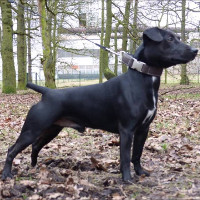
| The Patterdale Terrier first appeared around the 1960s, bred by Brian Nuttall from dogs given to him by his grandfather. The breed has been hailed as one of the best in the country. Developed in the Lake District where foxes were a problem in a harsh environment, farmers needed a robust dog capable of hunting prey and even attacking it if it turned to fight. These were fast, tough and reliable dogs. They have a unique ability to compress their chest, enabling them to penetrate small burrows and holes. They can also lie completely flat on their stomachs with their legs fully extended, helping them to reach prey that has fallen to the ground. Considered “tough as nails”, these dogs excelled at their job and made formidable hunting dogs. Today, the Patterdale Terrier is a companion dog, and its temperament has softened thanks to recent breeding. Their good looks, gentle, devoted nature and lively, alert manner make them a popular companion and friend. | ||
 |
||
| Presentation of the Patterdale Terrier | ||
A little of the Boston Terrier |
||
| The Boston Terrier is truly an American gentleman. They were born and raised in America, and in Boston in particular. It is generally accepted that the first Boston Terrier was born in the late 1800s. Although this has not been fully verified, we do know that a dog named Judge is the direct ancestor of the Boston Terrier. Judge weighed around 14.5 kilos, was dark brindle with a white blaze on his face and had a square head. The Judge was bred to a white dog weighing no more than 9 kilos. Kate, or Burnett's Gyp, gave birth to just one puppy, named Well's Eph. Eph was widely crossed, but mainly with a female named Tobin's Kate, who had a distinctly short head and weighed no more than 9 kilos. It is thought that Eph and Kate's offspring were later crossed with a French Bulldog. At some point, the Boston was referred to the Boston Bull Terrier, and in 1889, the American Bull Terrier Club was founded. In 1893, the American Kennel Club recognized the breed. | ||
 |
||
| Standard of the Boston Terrier |
Appearance of the Patton Terrier |
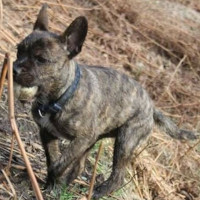
| The Patton Terrier is a medium-sized dog, but even so, it's still quite small. Many describe the Patterdale Terrier as a miniature Labrador Retriever, and the Patton Terrier will also have many of the Labrador's physical traits. His body will be robust and muscular. His color is often brindle. Occasionally, he may have white markings, especially on his chest. He may also have a white blaze on his face. This is determined by the dominant parental breed. Often, he won't have the characteristic apple head of a Boston Terrier, his muzzle is longer and his ears may even be floppy. His coat may be smooth or broken, depending on the dominant parent breed. His hair will be short and stiff, resting close to his body. His tail will be a little long and may appear broken if he inherits the corkscrew tail of the parent Boston Terrier breed. |
Temperament of the Patton Terrier |
| The Patton Terrier is a gentle, affectionate and energetic dog. He's good with children, but loves everyone in his family. He's certainly an excellent watchdog. He'll let you know whenever something doesn't seem quite right to him. However, he's actually very friendly with strangers, even after barking incessantly at a new person. He's very tough and can sometimes be stubborn. However, he is quite easy to train. Obedience classes are always a good idea. Your Patton Terrier strives to please you, and he may do better with a reward system rather than avoiding bad behavior for fear of punishment. He can sometimes be independent, and some owners warn that he doesn't get on well with non-dog pets such as cats, pet rabbits, etc. He may need to live in a house with a fenced-in yard to release some of his pent-up energy. |
Needs and activities of the Patton Terrier |
| The Patton Terrier is a fairly active dog. In fact, it's advisable to give the Patton not only physical activity, but also mentally stimulating play. The Patton Terrier can be prone to mischief if left alone for long periods or if not properly exercised. He'll enjoy a trip to the dog park for a change of scenery. Keep in mind that the Patton has a brachycephalic parent breed, so your Patton may inherit the short muzzle of the Boston Terrier parent breed. The Patton should never be allowed to run free, as it is a hunter at heart and may be inclined to chase cars. One last thing to remember, the Patton is known to become inactive when kept indoors. He needs sufficient exercise to maintain his health. |
Maintenance of the Patton Terrier |
| The Patton Terrier won't require much maintenance. It can have one of two coat types: smooth or broken. The smooth coat is coarse and dense. The broken coat is known as the intermediate coat, and will have slightly longer guard hairs than the smooth coat does. These hairs may be stiff and somewhat wavy. It may also appear to have a beard, mustache and eyebrows. Again, this depends on the dominant parent breed. Although the Patton Terrier is not likely to shed all year round, you can expect more shedding in spring and autumn. To avoid getting hair on your furniture and clothes, brush your Patton Terrier once a week with a wire brush. Bathe him only when necessary, as his natural oils will keep his coat shiny and healthy. Brush his teeth two or three times a week to prevent tartar build-up and bad breath. However, to prevent tooth decay, brush daily. Trim his nails every two weeks if they don't wear down on their own. As a general rule, if you hear his nails clicking on the floor, it's time to trim them. |



 English (United Kingdom)

Comments