
 |
Peke-A-Tese |
|
He is not recognized by the F.C.I. |
Origin |
China <> Central Mediterranean Basin -> U.S.A. | |
Translation |
Francis Vandersteen |
A brief presentation of the Peke-A-Tese |
| The Peke-A-Tese is a fun, confident hybrid descended from two ancient, royal breeds: the Maltese and the Pekingese. It's easy to train and maintain, weighing just 2.5 to 5 kilos and measuring 20.5 to 28 centimeters. This entertaining puppy doesn't mind being the center of attention, but can get tired of strangers and attached to its owner's hip or foot. Nevertheless, the Peke-A-Tese is a beloved hybrid that is well established and very popular in the U.S.A. Yet it is not recognized by the American Kennel Club and can still vary to some extent in temperament and appearance. |
History of the Peke-A-Tese |
| The Peke-A-Tese's parent breeds, the Pekingese and the Maltese, both originated in ancient times and were isolated as companions for a significant period. However, both dogs also have their own unique evolutionary paths that eventually crossed in 19th century America. The Peke-A-Tese was probably bred arbitrarily throughout the 20th century. It is now an established designer breed with a significant fan base in North America. Even so, it is not yet recognized by the American Kennel Club. |
A little of the Pekingese |
||
| Pekingese originated in ancient China and were named after the capital Beijing. A popular legend states that in ancient times, a lion fell in love with a marmoset and asked the gods to make him small enough to marry his girlfriend. The gods agreed, and the result was the Pekingese, a small dog with the courage of a much larger animal. In fact, these dogs are often referred to as “The Lion Dog of China”. Records of Pekingese are rare, but they have been cherished pets in their homeland for centuries. When China began to open its doors to the outside world during the reign of the Empress Dowager (1861-1908), Pekingese were given as gifts to foreign diplomats. The breed quickly gained in popularity, particularly in the United States, and was recognized by the AKC in 1909. | ||
 |
||
| Standard of the Pekingese | ||
A little of the Maltese |
||
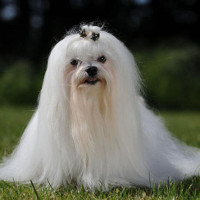
| The Maltese, as its name suggests, comes from ancient Maltese civilizations. In fact, there are written accounts and works of art dating back to the 5th century that present the breed as a beloved pocket dog on the island. In the 14th century, however, with holy wars sweeping the region, invading forces seized these little dogs and brought them home, mainly to Western Europe. In England, in particular, the Maltese breed became a favorite of the ruling class. Americans also began to show an interest in the breed in the late 1800s. In 1888, the Maltese was recognized by the AKC and became a world-renowned breed. | ||
 |
||
| Standard of the Maltese |
Appearance of the Peke-A-Tese |
| The little Peke-A-Tese retains the physical qualities of both its parent breeds. It has a compact body supported by small, round paws, balanced by a medium length but with a well-coated tail. He has dark brown eyes and a black nose like his two parent breeds. And although it's not as big as the Pekingese, it retains some of the Lion Dog's notable facial features, such as a shorter muzzle, wide eyes and a flat crown. However, the Peke-A-Tese has small, pendulous ears and is generally lighter in color, though varied, like the Maltese. The coat is long, dense and soft. |
Temperament of the Peke-A-Tese |
| The Peke-A-Tese is an undeniably majestic toy breed with the courage of a hound and the poise of a small dog. The breed is known for having a “big dog” personality and isn't afraid to approach others, demand attention or sound the alarm. On the other hand, it is also known for staying by its owners' side, being affectionate and fun-loving. Peke-A-Tese are also very obedient and respond well to training at home. However, they need a lot of individual attention from their owners and tend to become attached to only one person in a household. For this reason, separation anxiety is a concern for his breed. Owners with frequent absences or irregular schedules should think twice before adding a Peke-A-Tese to their family. Apart from that, Peke-A-Tese do very well in all indoor environments. Because of their size and energy level, they can be a particularly good choice for homeowners living in urban environments or apartments. |
Needs and activities of the Peke-A-Tese |
| Peke-A-Tese are alert dogs, but don't need a lot of organized exercise. A short walk or light indoor play for about 20 minutes a day will satisfy their activity needs. Apart from that, Peke-A-Tese simply enjoy trotting around the house alongside their owners and relaxing on various towers and soft surfaces around the house. They tend to be gentle dogs who get on well with children, who are excellent buddies for providing Peke-A-Tese with the right amount of activity and mental stimulation. The Peke-A-Tese needs to be socialized from an early age, however, to ensure that new people and animals don't upset its generally laid-back temperament. |
Maintenance of the Peke-A-Tese |
| The Peke-A-Tese abundant coat requires light daily grooming, such as brushing with a pin brush or comb, and occasional heavier grooming with a detangler. Some owners even choose to use scissors or clippers to trim their dog's longer hair. This dog is not completely hypoallergenic, but it can carry less pollen and dander due to the characteristics it inherits from the hair-like coat of its Maltese parent. Beyond that, a Peke-A-Tese should have its teeth brushed daily and its nails trimmed regularly. He should also be bathed once a month, paying particular attention to cleaning his soft, heavily coated ears. |



 English (United Kingdom)

Comments