Puggit

He is not recognized by the F.C.I.

Origin
China <> Italy -> U.S.A.
Translation
Francis Vandersteen

A brief presentation of the Puggit

The Puggit is a specific crossbreed of two pets that have each been popular companions of royalty for hundreds of years, the Pug and the Italian Sighthound. It's a gentle, playful dog with a generally dignified air, but it can sometimes develop anxious, destructive behaviors. Positive, unobtrusive socialization and training efforts will go a long way to ensuring that this dog maintains a cheerful, stable attitude. Their short coat is easy to care for and comes in many different colors, but it can make them more sensitive than most dogs to very hot or very cold temperatures.

History of the Puggit

The Puggit is an intentional cross between the Pug and the Italian Sighthound, two ancient dog breeds that have sat at the feet of kings, queens and emperors for hundreds, if not thousands, of years.


A little of the Pug

        
The Pug is an ancient breed, recorded in Chinese history as the companion of the royal families of the Shang dynasty, which ruled China from around 1600 to 1046 BC. China's ruling class held these little dogs in such high esteem that they gave them as gifts to visiting dignitaries and royal families from other countries, allowing them to be distributed throughout the known world. Both breeds have been featured in portraits of royalty and nobles throughout history, including two well-known portraits rendered in Russia in the 1700s, a portrait of Princess Ekaterina Dmitrievna Golitsyna and her Pug, and a portrait of Catherine II, Empress of Russia and her Italian Sighthound, as well as numerous photographs of Queen Victoria with her many Carlins and a photograph of her great-granddaughter, Princess Mary, with her Italian Sighthound on her lap. In 1885, the Pug became one of the first 15 dog breeds to be recognized by the American Kennel Club.
Standard of the Pug


A little of the Italian Sighthound

Miniature sighthounds like the Italian Sighthound have been found in Mediterranean art dating back thousands of years, and although these little dogs spread throughout southern Europe, they were most popular with and associated with the Italian nobility. In the 1800s, breeders began to focus on reducing the size of these already small dogs, to the detriment of the breed, and dogs of unhealthy structure and temperament became more common. Towards the end of the century, enthusiasts were able to bring the breed back from the brink of destruction by implementing selective, well-managed breeding programs focused on the dog's health and well-being. The Italian Sighthound was recognized by the American Kennel Club in 1886.
Standard of the Italian Sighthound

Appearance of the Puggit

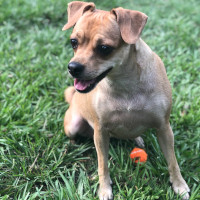
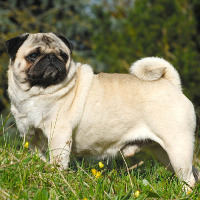
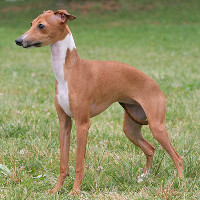
Like its two parent breeds, the Pug is a small companion dog, although the structure of the Pug and the Italian Sighthound is very different. The Italian Sighthound, like the Pug from which it is derived, is a dog built for speed and, as such, is a long-legged dog with a narrower, more aerodynamic build and a long, tapering muzzle, while the Pug has a larger, more solidly built structure, with a very short, square muzzle. Although the Puggit hybrid may closely resemble either of the parent breeds, most fall somewhere in between, with a moderate build that gives the dog more freedom of movement than the Pug and reduces the fragility of the Italian Sighthound. The head is also mostly moderate in size, with a slightly square muzzle that can range from slightly shorter than average to slightly longer than average, and may show some taper. They have large, round eyes and small to medium-sized ears that can either sit close to the head or sit semi-erect, folding to the sides and back. This crossbreed has a short, soft, single-coat coat that is easy to care for, often with a glossy sheen.

Temperament of the Puggit

The combination of the good-natured Pug and the comfort-loving Italian Sighthound results in a gentle dog that can display dignity and elegance, but can also be playful, with a definite clownish streak. While this crossbreed is likely to be fairly tolerant of children and generally less nervous than the Italian Sighthound, interactions with this sometimes fragile little canine must be closely supervised, for the protection of both dog and child. With socialization, the Puggit should get on quite well with other cats and dogs, although a large prey base for the Italian Sighthound means they are likely to chase and kill small animals that scurry or float if given the opportunity. These dogs respond to gentle, consistent training, but can be sensitive to excessive correction and will sometimes exhibit an obstinate sequence. It's important not to abuse these dogs, as they can become clingy, overly dependent and even bossy when spoiled. Although the Pug is generally a calm dog around the house, the Puggit can also inherit the Italian Sighthound's bursts of energy and strong prey drive, and this dog can sometimes decide to run around the house for no apparent reason. Fortunately, these periods of exuberance usually last only a few minutes and are usually followed by long naps in the coziest place they can find.

Needs and activities of the Puggit

The high activity level of the Italian Sighthound is usually somewhat toned down in the Puggit, due to the slightly more placid nature of the Pug, and this hybrid is usually content with only around 45 minutes of vigorous exercise, divided into several small portions throughout the day. Those who lean towards their Italian Sighthound heritage may be happier with an hour or two. Because of its short, single-coat coat, this dog can be more sensitive to extremes of heat and cold than other dogs, and the weather must be taken into account when exercising this dog outdoors. In addition to retrieving games and walks in the park, some Puggit dogs can enjoy and even excel in activities such as competitive Frisbee or agility training. These dogs make excellent housemates in small apartments due to their calm nature and small size, but because of their small size and high prey count, they should never be left alone outdoors, even in a fenced yard.

Maintenance of the Puggit

This dog has relatively simple grooming requirements, bathing is only necessary every few months and weekly brushing sessions can be completed in a few minutes using a smoother brush or grooming glove. Both parent breeds are known to develop dental disorders, so it's particularly important that Puggit dental hygiene is started when the dog is young and occurs regularly. It's also important to check the skin for any swelling or redness when brushing your dog, and to ensure that his ears are kept clean and dry, as these dogs can be more prone than most to allergies and skin disorders.

Comments

Latest page updates

  • Telomian

    Telomian He is not recognized by the F.C.I. Origin Malaysia Translation Francis Vandersteen A brief presentation of the Telomian The Telomian is a very rare breed of dog, and the only one native to Malaysia to have been bred outside the country. They were originally bred by the indigenous people of Malaysia to combat parasites such as snakes, rats,...
  • King Wheaten -- Cavalier King Charles Spaniel X Irish Soft Coated Wheaten Terrier

    King Wheaten He is not recognized by the F.C.I. Origin Great Britain <> Ireland -> U.S.A. Translation Francis Vandersteen A brief presentation of the King Wheaten The King Wheaten is a small dog with a heart this big and a playful disposition. Borrowing the energy and soft-coated waves of the Irish Soft Coated Wheaten Terrier and the size and...
  • Spanierd -- English Springer Spaniel X German Shepherd

    Spanierd He is not recognized by the F.C.I. Origin Great Britain <> Germany -> U.S.A. Translation Francis Vandersteen A brief presentation of the Spanierd The Spanierd is a hybrid dog. Its parent breeds are the English Springer Spaniel and the German Shepherd. They have an affable personality. He's known for entertaining family and friends with his...
  • Alaskan Goldenmute -- Alaskan Malamute X Golden Retriever

    Alaskan Goldenmute He is not recognized by the F.C.I. Origin U.S.A. <> Great Britain -> U.S.A. Translation Francis Vandersteen This breed is also known as Alaskan GoldenGoldenmuteAlaskan Gold Retriever     A brief presentation of the Alaskan Goldenmute The Alaskan Goldenmute is a descendant of two great dog breeds: the Alaskan Malamute and the Golden...
  • French pointing dog Pyrenean type

    French pointing dog Pyrenean type FCI standard Nº 134 Origin France Translation Mrs. Peggy Davis Group Group 7 Pointing Dogs Section Section 1.1 Continental Pointing Dogs « Braque » Type Working With working trial Acceptance on a definitive basis by the FCI Tuesday 18 January 1955 Publication of the official valid standard Tuesday 01 August 2023 Last...
  • French pointing dog Gascogne type

    French pointing dog Gascogne type FCI standard Nº 133 Origin France Translation Mrs. Peggy Davis Group Group 7 Pointing Dogs Section Section 1.1 Continental Pointing Dogs « Braque » Type Working With working trial Acceptance on a definitive basis by the FCI Monday 17 January 1955 Publication of the official valid standard Tuesday 01 August 2023 Last...
  • Vucciriscu

    Vucciriscu He is not recognized by the F.C.I. Origin Sicily Translation Francis Vandersteen En français, cette race se dit Vucciriscu Diese Norm ist in deutscher Sprache sichtbar Vucciriscu En español, esta raza se dice Vucciriscu In het Nederlands, wordt dit ras gezegd Vucciriscu This breed is also known as Sicilian Vucciriscu Sicilian Butcher...

© 2026 Groupe Milouchouchou ASBL. Tous droits réservés. En savoir plus

Protected by Copyright01
We use cookies

We use cookies on our website. Some of them are essential for the operation of the site, while others help us to improve this site and the user experience (tracking cookies). You can decide for yourself whether you want to allow cookies or not. Please note that if you reject them, you may not be able to use all the functionalities of the site.

Ok