 |
Pugillon |
|
He is not recognized by the F.C.I. |
Origin |
China <> France and Belgium -> U.S.A. | |
Translation |
Francis Vandersteen | |
This breed is also known as |
Pugion |
A brief presentation of the Pugillon |
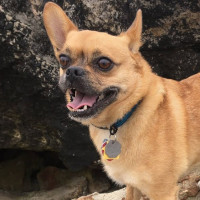
| The Pugillon is a specific cross between a purebred Pug and a purebred Continental Toy Spaniel. Although both parent breeds were bred as pocket dogs, they are affectionate, energetic and outgoing, and the Pugillon is the same. They make excellent pets and get on well with children. But as with all small breeds, supervision is necessary with young children handling the dog. They get on very well with other dogs and even cats if socialized from an early age. Like many short-nosed, flat-faced breeds, the Pugillon can fight in the heat. These dogs thrive on human companionship and are not suitable for people rarely at home. Common colors can include black, white, silver, apricot, red and sable. Their coat is fine and silky and can be short or long. |
History of the Pugillon |
| The Pugillon is a hybrid breed created by crossing a Pug and a Continental Toy Spaniel. |
A little of the Pug |
||
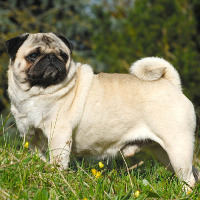
| Pugs were the prized pets of China's ruling families, so much so that they were guarded by soldiers. These dogs with their wrinkled faces, short muzzles and curved tails were also kept in Tibet by Buddhist monks. The modern breed is descended from dogs imported from China to Europe in the 16th century. They were also popular in European courts and became the official dog of the House of Orange in 1572 when a small Pug alerted the Prince of Orange that assassins were fast approaching. They were also featured in the work of artists such as Goya and William Hogarth, who adored Pugs and made a self-portrait of himself and his favorite Pug named Trump in the mid-1730s. Pugs of this era had longer legs, but this changed when a number of dogs were imported from China in 1860 with shorter legs and flatter faces. The breed arrived in the USA after the Civil War and was recognized by the American Kennel Club in 1885. | ||
 |
||
| Standard of the Pug |
A little of the Continental Toy Spaniel |
| Tiny Spaniels called Continental Toy Spaniels and Dwarf Spaniels, which had floppy ears, were well established in Europe by the 1200s. The Continental Toy Spaniel is the modern version of these little dogs, and was given this name because of its straight, fringed ears that unfurl like butterflies. Those that still have floppy ears are called Phalène, meaning moth. Despite their strong French connection, it's in Spain and Italy that they've become the most popular. It is said that Italian breeders had the dogs mounted on the backs of mules to bring them to the court of Louis XIV. These dogs were painted by master artists such as Rubens, Van Dyke and Rembrandt, and were popular companions of court ladies throughout Europe. Marie Antoinette was also a fan and owner of the breed. |
 |
| Standard of the Continental Toy Spaniel |
Appearance of the Pugillon |
| The Pugillon is a hybrid breed and is a cross between a Pug and a Continental Toy Spaniel. Common colors include black, white, silver, apricot, red and sable. Their coat is fine and silky, and can be short or long. Depending on the most dominant parental breed, your puppy may have prominent eyes on the Pug side and deep wrinkles on the face. Pugs have a short, black muzzle and underbite. They have a broad chest, short legs and a curly tail. Continental Toy Spaniels have fine, delicate bones with large, erect ears that have long, fringed hair growing out, creating the Continental Toy Spaniel appearance for which the breed is known. The tail is carried curled over the back. |
Temperament of the Pugillon |
| The Pugillon is an alert, outgoing and playful dog, affectionate and loyal to its family. They are generally very friendly with children, but as they are small dogs, care must be taken with young children to ensure they play gently with them. These dogs are ideal for new owners and are considered fairly easy to train. They are intelligent dogs, although they can be a little strong-willed on the Pug side, but with lots of praise and positive reinforcement, they will eventually learn canine manners. Although a Pugillon is an energetic little dog, he'll be perfectly happy to snuggle in your lap and won't appreciate being left alone for any length of time. These dogs are friendly with everyone, including strangers. They make good watchdogs as they are very alert and may bark to warn you, but are not considered aggressive. |
Needs and activities of the Pugillon |
| The Pugillon is an energetic little dog that will love walks around the neighborhood or to the dog park to socialize with other dogs. They'll enjoy trips to the beach, but not when it's too hot, as they can overheat. Always take water when you go out with your pet. They don't need intense exercise, but they'll behave better when they're burning off energy. These dogs are very playful and will enjoy interactive games with you. Mental stimulation will also keep them from getting bored. These dogs adapt well to life in an apartment, as long as they go outside every day. They sense the cold and are particularly sensitive to heat. |
Maintenance of the Pugillon |
| If your Pugillon has the long, flowing coat of its parent breed, the Continental Toy Spaniel, it should be brushed and combed once or twice a week. A dog with a shorter coat will only need weekly brushing. Pugillons don't shed much, and they're not strong-smelling dogs, so bathing can only be done when necessary. When they are bathed or wet, make sure the folds and wrinkles of the skin are well dried to avoid any skin infection. Ears should also be wiped if necessary, and try to brush your dog's teeth regularly with pet toothpaste. Nails can be trimmed if necessary. |



 English (United Kingdom)

Comments