
 |
Scobo Terrier |
|
He is not recognized by the F.C.I. |
Origin |
Great Britain <> U.S.A. -> U.S.A. | |
Translation |
Francis Vandersteen |
A brief presentation of the Scobo Terrier |
| The Scobo Terrier is a hybrid dog. Its parent breeds are the Scottish Terrier and the Boston Terrier. They are fairly small dogs, weighing no more than 11.5 kilos when fully grown. It's a dog that loves all members of its family, but is particularly gentle with children. This is not an overly active dog, needing only a minimum of daily activity to stay healthy. However, regular activity will prevent the Scobo Terrier from becoming bored and possibly getting into mischief. Scobo Terriers are highly intelligent and fairly easy to train. Depending on the type of coat it inherits, the Scobo Terrier doesn't require much maintenance either. They are an affectionate companion for any family. |
History of the Scobo Terrier |
| The Scobo Terrier is a hybrid dog. Although not a rare hybrid, little is known about the origins of this mixed breed. However, we can study the origins of the parent breeds to understand the story behind the hybrid. |
A little of the Scottish Terrier |
||
| The Scottish Terrier as we know it originated in Scotland, but its exact origins are unknown. Pliny the Elder described a dog similar to the Scottie in 55 BC. The Scotch Terrier, thought to be an ancestor of the breed, was an instinctive hunter. Don Leslie also wrote about a small dog similar to the modern Scottish Terrier in his book A History of Scotland. The Scotch Terrier was low-legged and often used to work in the country's quarries. James I of England sent several dogs to French monarchs, hoping to impress them. It is thought that the dogs he sent were eventually bred to develop what we know as the modern Scottish Terrier. | ||
 |
||
| Standard of the Scottish Terrier |
A little of the Boston Terrier |
| The Boston Terrier is truly an American dog. It is itself the result of breeding Bulldogs with the now extinct White English Terrier. Owned by Bostonian Robert C. Hooper, their offspring, known as Judge, is considered the father of the breed. Judge was larger than today's Boston Terrier, weighing around 14.5 kilos. He was bred just once to a 9-kilo white bitch named Kate. This produced only one puppy, and although he wasn't very attractive, he had other characteristics that dog breeders wanted to reproduce. So he was widely reproduced. One of his descendants was Tobin's Kate, and it is thought that Kate was crossed with French Bulldogs to produce a smaller dog. At one time, the Boston Terrier was called the Bullethead or Boston Bulldog. In 1899, the Boston Terrier Club was formed, and in 1893, the breed was recognized by the American Kennel Club for the first time. |
 |
| Standard of the Boston Terrier |
Appearance of the Scobo Terrier |
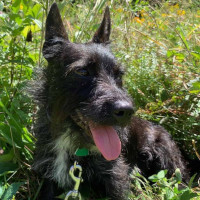
| The Scobo Terrier is a small dog. When fully grown, they weigh no more than 11.5 kilos. They have short, compact legs. Their body is small but stocky. His dark eyes may appear exorbited, like those of the Boston Terrier's parent breed. His ears are likely to be erect. He is likely to be dark in color - either black all over, black with brown markings, brown or brindle. He may have a few white markings on his face, although this is rare. The texture of his coat, however, is another story. Depending on the breed of the dominant parent, his coat may be short and straight, or longer and rougher. It can also have what looks like a beard, like the parent Scottie breed. Of course, it all depends on genetics. |
Temperament of the Scobo Terrier |
| The Scobo Terrier is a gentle, affectionate dog. They are highly intelligent and can even be a little mischievous at times. His antics will keep you entertained at all times. They never meet strangers. He may bark and try to look aggressive if visitors come to the door; however, he's more likely to greet them warmly as soon as they enter. He's great with children and all other family members. In fact, he can be very protective of children. He's very easy to train, but persistence is the key. When you get him used to the house, take him out at the same time every day. Soon, he'll know what you expect of him. He's very eager to please, which makes his training easier. He can be prone to separation anxiety, so the Scobo Terrier may not be suitable for those who are often away from home. Again, he's a good watchdog - he'll certainly alert you to any trouble on his territory - but he's more likely to befriend a stranger than scare off a potential intruder. |
Needs and activities of the Scobo Terrier |
| The Scobo Terrier is not a dog that needs a lot of activity to stay happy. However, to keep him healthy, you must allow him to have several short periods of activity during the day. Don't forget that giving him these opportunities to be active prevents him from getting bored. When bored, Scobo Terriers often become destructive, chewing on shoes and other valuables. He'll also enjoy outings to the dog park and, once perfectly trained, will have no problem getting off the leash and back on your command. He'll also enjoy playing outdoors, under your supervision. Don't forget that the Boston Terrier's parent breed often suffers from brachycephalic syndrome. If you allow him to overheat or overexert himself, your Scobo Terrier could suffer serious health consequences. Keep water handy if you go out on hot days, and give him time to rest if necessary. |
Maintenance of the Scobo Terrier |
| The Scobo Terrier will probably require little maintenance, whatever coat type he inherits. Brush him once a week to remove excess hair. He's likely to shed more in spring and autumn. At these times of year, brush him two or three times a week to prevent excess hair from accumulating on your clothes and furniture. Only bathe him when necessary. The natural oils in his coat will keep him shiny and clean. Brush his teeth two or three times a week to prevent tartar build-up and bad breath. To prevent tooth decay, brush his teeth every day. Trim his nails every two or three weeks, provided he doesn't wear them down naturally. As a general rule, if you hear his nails clicking on the tiles, it's time to trim them. |



 English (United Kingdom)

Comments