
 |
Sheepadoodle |
|
He is not recognized by the F.C.I. |
Origin |
Great Britain <> France -> U.S.A. | |
Translation |
Francis Vandersteen | |
This breed is also known as |
Sheepdoodle
|
A brief presentation of the Sheepadoodle |
| The Sheepadoodle is the product of a deliberate cross between the Old English Sheepdog (Bobtail), an outgoing, pleasant livestock herder developed in England, and the Poodle, an intelligent, adaptable dog originally developed as a hunting dog in Germany. It's a very popular crossbreed because of its friendly, enthusiastic attitude, despite its grooming requirements. So it's important to do your due diligence when choosing a breeder if you decide to adopt a puppy. These dogs make excellent family pets and watchdogs, but because of their energy levels and large size, they don't fit easily into an apartment. Although this dog goes by many different names, it should not be confused with the Shepadoodle, a hybrid of German Shepherd and Poodle, which goes by almost the same name. |
History of the Sheepadoodle |
| The Sheepadoodle is a popular dog design, intentionally bred to combine the Old English Sheepdog (Bobtail), a large, shaggy dog used to help herd cattle and drive sheep and cows to market, and the Poodle, a versatile canine that was originally developed in Germany to retrieve waterfowl for hunters. |
A little of the Old English Sheepdog (Bobtail) |
||
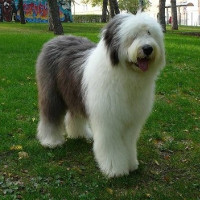
| The Old English Sheepdog (Bobtail) was developed fairly recently, towards the end of the 18th century, as a herding dog for sheep and cattle in England, and although many experts speculate that they are derived from Bearded Collies or the Russian Ovcharka breed, their true ancestry remains a mystery. They became very popular in the United States in the late 1800s and early 1900s, particularly among the extremely wealthy, and English Sheepdogs could be found in the homes of the Goulds, Vanderbilts and Guggenheims, among others. | ||
 |
||
| Standard of the Old English Sheepdog (Bobtail) |
A little of the Poodle |
| The Poodle is equally at home in lush surroundings, and Poodles have accompanied such esteemed individuals as Robin Williams, Winston Churchill, Lucille Ball and Elvis Presley. Although Tony Curtis didn't own a Poodle himself, he did work alongside a white Standard Poodle who played Monsieur Cognac in the film Wild and Wonderful (1964). Despite their ability to blend into extravagant surroundings, these dogs were actually developed as durable retrievers of waterfowl in Germany, to help hunters retrieve their catches, and are still often used for this purpose. As well as being a charming companion and excellent retriever, the breed's adaptability has enabled it to take on many different roles, and they have performed admirably as actors, circus dogs, truffle hunters and therapy dogs. Although the standard-sized Poodle is the logical choice for this hybrid, some breeders may try to crossbreed with Miniature Poodles and perhaps even Toy Poodles, which would have an obvious effect on size, as well as on the animal's temperament and general health problems. |
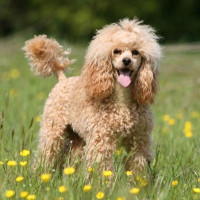 |
| Standard of the Poodle |
Appearance of the Sheepadoodle |
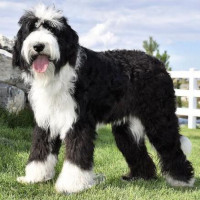
| Under its abundant double- or single-coated coat, the Sheepadoodle is a medium to large hybrid with an athletic build that can range from thick to thin, and a head that can be either square like that of the Old English Sheepdog (Bobtail), or slightly domed like that of the Poodle. They also have a long muzzle which, like the rest of the dog, can be thick, thin or intermediate. Their oval eyes are generally dark brown, but some Sheepdoodles can inherit one or two bright blue eyes from the Old English Sheepdog (Bobtail) breed. The ears are usually set just at or below eye level, and hang flat on the side of the head. They can come in many colors, but white with large black, brown or gray patches seems to be the most common configuration. |
Temperament of the Sheepadoodle |
| This is generally a very good-natured, sociable animal that is very attentive without being particularly needy. Although all interactions between young children and dogs must be carefully supervised to avoid unexpected incidents, these dogs are generally calm, trustworthy and protective with children, making them a suitable pet even for young families. Sheepadoodles are also fairly easy to live with other animals, but while most gregarious instincts have been eliminated from many Old English Sheepdog (Bobtail) bloodlines, some dogs may try to herd children and other animals by circling them, prodding them with their noses and sometimes even biting their heels. These dogs are highly intelligent, but their trainability can vary somewhat. The Poodle's parent breed is renowned for its trainability, but the Old English Sheepdog (Bobtail) is very independent and, although it is likely to understand what you want, it may be more difficult to persuade it to follow your instructions. |
Needs and activities of the Sheepadoodle |
| These dogs were bred to be athletic working dogs and, although they're generally gentle and won't nag you to walk them, they'll be much happier and healthier if they can get at least an hour of vigorous activity a day. Fortunately, Sheepadoodles are versatile, and there are many activities you can do with this dog depending on the traits he inherited, including herding exercises, advanced obedience and trick training, agility training or Frisbee and flyball. Hybrids that receive the thick, insulating coat of the Old English Sheepdog (Bobtail) can even enjoy winter sports like dog sledding and ski joëring. |
Maintenance of the Sheepadoodle |
| This canine requires a fair amount of grooming effort, due to its abundant curly or wavy coat. Sheepdoodles that have inherited the coat of the Old English Sheepdog (Bobtail) require daily grooming, as they are prone to matting and shedding. Even if they don't need frequent bathing, it can be difficult to ensure that all the fur is both clean and dry. Those who have inherited the Poodle's characteristic single layer of ever-growing curly hair will need to be bathed and clipped more frequently, every three weeks to a month, but they tend to shed very little and are less likely to drag debris around the house. If you're looking for a hypoallergenic dog, it may be wise to consider an adult Sheepadoodle rather than a puppy, as the quantity and quality of the dog's coat can change considerably between puppy and adult. |



 English (United Kingdom)

Comments