
 |
Shelillion |
|
He is not recognized by the F.C.I. |
Origin |
Great Britain <> France and Belgium -> U.S.A. | |
Translation |
Francis Vandersteen |
A brief presentation of the Shelillion |
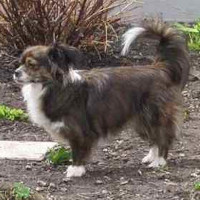
| The Shelillion is an intentional hybrid between the Shetland Sheepdog, an active little dog with a distinctive coat that was developed on the Shetland Islands, and an extremely bright and popular European pet known as the Continental Papillon Miniature Spaniel. They require slightly more brushing than average due to their long coats, although those who have inherited the Papillon's silky, single-layer coat will need less maintenance than those with the Sheltie's copious, two-layer coat. They are generally lively with people and animals of all ages if properly socialized and trained, although some may tend to be shy and aloof with strangers. These small dogs are quite versatile and can thrive in a large house with a garden or in an apartment if their barking tendency can be contained. |
History of the Shelillion |
| The Shelillion is a very small designer dog, the result of a deliberate cross between the Shetland Sheepdog, a small, sturdy farm dog native to the Shetland Islands off the coast of Scotland, and the Papillon Continental Toy Spaniel, one of Europe's oldest toy breeds, which has accompanied countless royals and noblemen through the ages. |
A little of the Shetland Sheepdog |
||
| The Shetland Sheepdog is a small dog of uncertain ancestry that developed in a part of Scotland known as the Shetland Islands. Although this breed of dog resembles the wire-haired Collies we know enough to have been called both the Dwarf Collie and the Shetland Collie, the Shetland Sheepdog is a distinct breed that was developed by combining several different dog breeds. Experts believe that many of the breeds that contributed to the creation of the Shetland Sheepdog still exist today, including the Scotch Collie, Border Collie, Spaniel King Charles and Icelandic Sheepdog, but that at least one ancestor, the mysterious Greenland Yakki, has become extinct. In the 1800s, increased tourism sparked interest in these small dogs as pets, and to reduce their size, islanders introduced additional genes, including Corgis, Pomeranians and Papillons, but when their overall size became too small, breeders reintroduced the Shetland Sheepdog with Collie genes. | ||
 |
||
| Standard of the Shetland Sheepdog |
A little of the Continental Toy Spaniel |
| Although the Papillon Continental Toy Spaniel has been a popular pet in Europe since at least the 1300s, its past is just as mysterious. Various experts place its origins in different countries, most often Belgium, France, Italy and Spain. For most of their history, these little Spaniels were known by many names, including Continental Spaniels, Little Squirrel Dogs and Belgian Spaniels, and were characterized by floppy ears. At some point in the 1800s, they developed the large, upright ears we frequently see today, and were given the name Papillon, the French word for butterfly, and those that retained the floppy ears were labeled Epagneul nain continental Phalène, another French word, this time meaning moth, although they are still considered the same breed in the US and UK. |
 |
| Standard of the Continental Toy Spaniel |
Appearance of the Shelillion |
| The Shelillion is a very small canine, with a back slightly longer than the dog's waist, and a fine bone structure. Continental Papillon Miniature Spaniel dogs generally have a fairly round skull with a fox-like face and a fine muzzle that is slightly shorter than average, while Shetland Sheepdogs tend to have a flat, wedge-shaped head with a longer, more substantial muzzle. Although these crossbred dogs may closely resemble either of their parent breeds, they generally fall somewhere in between, with a slightly rounded head and a well-balanced but slightly narrow muzzle. Their eyes can be round or almond-shaped and are most often dark brown, although blue or parti-colored eyes are sometimes found. Their ears are medium to large, well furred and generally erect, although some Shelillion ears are only three-quarters carried, and a few have inherited the floppy ears of the Phalene variety of Continental Toy Spaniel. |
Temperament of the Shelillion |
| The Shelillon is descended from two breeds known for being feisty, friendly and outgoing, and is likely to inherit these characteristics too, although it can be prone to separation anxiety and become destructive if left alone for long periods or not given enough mental stimulation to keep it occupied. They are quite good with children and make excellent family pets, tolerant even with young children, but some can be hyper-reactive to touch, loud sounds or rapid movement, making supervision very important, and they can be prone to chasing or herding other animals. Socialization and training are extremely important for this small canine to prevent the development of negative traits such as shyness and obsessive barking, and to encourage positive mental growth. This hybrid is generally very intelligent and extremely easy to train, often learning tricks easily and excelling in obedience trials, although it can sometimes show a rebellious side due to its Papillon heritage and those who take after the Sheltie can become defensive if treated too harshly. |
Needs and activities of the Shelillion |
| This cross-breed needs a moderate amount of exercise a day, and will generally settle for 45 minutes a day of vigorous activity, divided into two or three shorter sessions. However, if you're looking for a partner for slightly longer walks, the Shelillon is likely to come along happily and do a perfectly respectable job of keeping up the pace. These dogs can also enjoy other activities, such as agility training, herding exercises, puzzles and ball games, indoors or out. It's important to take weather conditions into account when exercising outdoors, especially with dogs that have the thick double coat most often seen in the Shetland Sheepdog, as they may be slightly more sensitive to high temperatures. |
Maintenance of the Shelillion |
| The coat of this hybrid is universally quite long, but can vary considerably from dog to dog in terms of density, texture and amount of shedding. The Sheltie has a thick, double-layered coat. Neither coat requires frequent bathing, as they are naturally dirt-resistant and low-odour, but both need brushing at least several times a week. Shelillons that have inherited the Papillon's single-layer silky coat are not generally prone to shedding or matting, but brushing is necessary to remove dirt and debris from the coat and to avoid small tangles, while those with the double-layered coat of the Shetland Sheepdog shed more and are more likely to form mats, which can be particularly troublesome when they develop close to the skin in the undercoat and may require more frequent brushing. |



 English (United Kingdom)

Comments