 |
Berger de Crau |
|
He is not recognized by the F.C.I. |
Origin |
France, in the Crau region, an alluvial plain in the Rhone delta | |
Translation |
Francis Vandersteen | |
Group |
Group 1 Sheepdogs and Cattle Dogs (except Swiss Cattle Dogs) | |
En français, cette race se dit |
 |
Berger de Crau |
Diese Norm ist in deutscher Sprache sichtbar |
 |
Berger de Crau |
En español, esta raza se dice |
 |
Berger de Crau |
In het Nederlands, wordt dit ras gezegd |
 |
Berger de Crau |
General appearance |
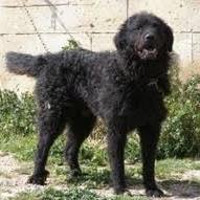
| The dog's appearance is rustic, dry, solid and well-proportioned, barely taller than it is long. |
Behaviour / temperament |
| Despite a temperament that can be rather harsh, the dog should be approachable. It's acceptable for him to be wary at first, especially if his socialization with humans has been imperfect. With animals, he needs to assert himself, without being too hard-nosed. |
Head |
||
Cranial region |
||
Head |
Appears fairly long and rather bony. | |
Skull |
Not too narrow, however. | |
Stop |
Slight. | |
Facial region |
||
Nose |
Fairly broad. | |
Muzzle |
Long but less than the skull, fairly narrow and tapering. | |
Lips |
Slightly pendulous. | |
Jaws and teeth |
Preferably scissor bite, but pincer bite accepted. | |
Eyes |
Quite small, orange-brown to yellow, not dark brown. The eyes appear piercing. | |
Ears |
Drop or semi-drop. | |
Body |
||
Body |
Solid in appearance. Too narrow is better than too broad. Dogs in normal body condition may appear a little bony, but never round. Muscles are solid. | |
Tail |
| Anourie, brachyourie or full tail are accepted. |
Limbs |
Forequarters |
||
Generality |
Straight front legs. | |
Hindquarters |
||
Generality |
Hindlegs may be slightly plumb, but this should never be a handicap to the dog. | |
Feet |
| Rather large, oval feet. |
Gait and movement |
| Regular and supple. |
Coat |
||
Hair |
Dru, rough or a little woolly, can felt. Short or medium-length, wavy or curly. The face may be shaved. | |
Colour |
Black is the most common. It may be gray or fawn, fawn charcoal. Fawn markings may be present. Limited variegation is accepted. Mucous membranes are black. | |
Size and weight |
||
Height at withers |
For males, height at withers is in the order of 55 to 60 cm, and for females 50 to 55 cm. Smaller or larger sizes are acceptable. |
|
Faults |
| • Any departure from the foregoing points should be considered a fault and the seriousness with which the fault should be regarded should be in exact proportion to its degree and its effect upon the health and welfare of the dog and its ability to perform its traditional work. • Faults listed should be in degree of seriousness. |
NB : |
| • Any dog clearly showing physical or behavioural abnormalities shall be disqualified. • The above mentioned faults when occurring to a highly marked degree or frequently are disqualifying. • Male animals should have two apparently normal testicles fully descended into the scrotum. • Only functionally and clinically healthy dogs, with breed typical conformation should be used for breeding. |
Additional information from visitors |
| The Crau shepherd at work by Pierre Trolliet For many years, Crau Sheepdogs were the unrivalled working dogs of the transhumant herds of southern France. This dog has always guarded large herds and traveled on foot for centuries. He had to hold his own against thousands of sheep, with crops all along the way. He's a very hardy dog with a temper that can be cantankerous, resistant to fatigue and bad weather. A little rough around the edges, but with a keen instinct and a natural way of herding, the Crau dog is quick to train and work close to the animals. A bit of a barker, he can be counted on to impose himself firmly on rational pastures such as alfalfa or soupade. In these situations, where the shepherd only gives part of the meadow to graze, the dog must act as a barrier to prevent the animals from overstepping the limit. |
Detailed history |
| The Berger de Crau was once very much a part of the large transhumant herds of Provence. A hardy dog with an assertive character, it was notably used to "make the road" to the Alps during summer transhumance. It has since been largely replaced by other breeds, such as the Beauceron or more recently the Border-collie. However, the breed is still present on farms in the PACA region, with a handful of passionate shepherds and breeders handing it down from generation to generation. For two years now, the Maison de la Transhumance and the Société Centrale Canine have been working to have this working dog recognized as a breed. Such recognition will ensure the support of official structures and give this population a greater chance of survival. Creation of an association On November 30, 2010, the General Meeting held in Saint-Martin-de-Crau led to the creation of the Association de Sauvegarde du chien "Berger de Crau", on the initiative of the Maison de la Transhumance and the Société Centrale Canine. The main aims of this association are to bring together dog owners, to establish a standard for the breed as a working dog, to safeguard and promote it, and to carry out an inventory of existing stock and genetic monitoring. It is made up of breeders and salaried shepherds, who are the active members; all other members are associate members. Indeed, the association's main concern is to maintain the Crau as a driving dog, corresponding to the needs of breeders and professional shepherds, with working criteria clearly identified in the breed standard. Today, the association has 30 members, with an annual fee of €10. Development of a primitive standard Even if it's very simple, it needs to be drawn up right away, so that we can present the main characteristics of the Berger de Crau to all concerned. There is unanimous agreement that this standard should include a section on working qualities, as these characterize the Berger de Crau at least as much as morphology. A first gathering of dogs was organized in 2009 during the Saint Valentin fair in Saint-Martin-de-Crau. It enabled us to count 11 adult females and 12 adult males, and to draft the first criteria for the breed standard. Inventory of existing stock Breeders and shepherds will also be asked to inform the association of any dogs they know of. A census form will be drawn up, modelled on the one used for guard dogs, for example. Collected at association level, a copy of the forms will then be sent to the Société Centrale Canine, where a special file will be created as the starting point for a herd book. Genetic monitoring This follow-up will enable us to identify the genetic diversity in the current herd and the kinship relationships between the dogs; this will help in the genetic management of the population, for example, to avoid inbreeding problems. The genetic identification of each dog will be used to verify parentage, so as to avoid errors when integrating dogs into the genealogical file. If Crau dogs show good genetic originality, it will also be possible to check that individuals with no known origins and a "Crau Shepherd" morphology are indeed Crau Shepherds and not "mongrels". To this end, a second gathering took place at the St Martin de Crau fair on February 9, 2011. The aim was to gather together as many "Berger de Crau" dogs as possible, so that they could be identified on the spot with a microchip, and their genetic fingerprint taken by mouth sampling. Painless and very quick, the latter enables us to issue each owner with a genetic identity card for their dog(s). This operation, which is free for owners as it is paid for by the Société Centrale Canine, is essential for breed recognition. It provides information on the genetic diversity of the population, kinship relationships between dogs, and compares the genetic typology of the population with that of breeds suspected of having played a part in its creation. The operation identified 23 dogs .... Building on this success, further gatherings of this type will be scheduled in the near future. Courtesy of Maison de la transhumance |



 English (United Kingdom)

Comments