
 |
Savoy Shepherd |
|
He is not recognized by the F.C.I. |
Origin |
France | |
Translation |
Francis Vandersteen | |
En français, cette race se dit |
 |
Berger de Savoie |
Diese Norm ist in deutscher Sprache sichtbar |
 |
Savoyischer Schäferhund |
En español, esta raza se dice |
 |
Perro pastor de Saboya |
In het Nederlands, wordt dit ras gezegd |
 |
Savooie Herdershond |
This breed is also known as |
French Alpine Mastiff
|
Brief historical summary |
| Line Perrier, Ph.D. in ethnolinguistics, was asked by the Savoie departmental archives to take stock of Savoy ruminant breeds, some of which are in danger of extinction. On this occasion, as an accomplished cynophile, she became interested in herding dogs and found in several places an old type of shepherd's dog once widely used on dairy farms, and whose range did not extend beyond historic Savoie. It became clear that this was a local breed that needed to be reconstituted. In early 2002, breeders, farmers and veterinarians joined forces to form the "Société du Berger de Savoie ou Berger Savoyard". A search is underway to find subjects that correspond to the definition of this local dog (to date around one hundred) and to draw up a standard. |
General appearance |
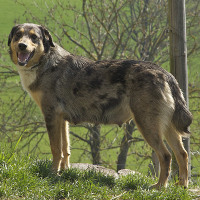
| The Berger de Savoie is a hardy, powerful, robust and harmonious dog. Medium-sized, stocky, compact, proud and very muscular, they have elegant gaits and regular legs. These are working dogs. Although breeders are demanding recognition as a sheepdog, the Savoy Shepherd is a cowdog, also used on sheep and goats, two species raised in the Savoy region. Some drive poultry; in summer, they bring them in or prevent them from entering the house. In winter, this dog used to turn into a tractor. He pulled milk sledges, sledges and carts. The standard also defines him as a ratter and even a hunting dog. They are renowned for finding lost animals. |
Behaviour / temperament |
| Lively, quick, inquisitive, always on the move and enthusiastic. He's a barker, but can become calm when there's nothing to do, as he knows how to rest. Untiring, he works long hours and recovers quickly. "Very very obedient" is a characteristic of this home-loving dog. Savoyard Shepherds are not runaways; they stay around the house all day. Traditionally, Savoyard farmers don't tie up their dogs. Savoyard Shepherds love children and protect them, just as they defend their homes and flocks from intruders. |
Head |
||
Cranial region |
||
Head |
Powerful, well proportioned to the rest of the body, clean, thickly drawn and carried high. | |
Skull |
Flat. | |
Stop |
Marked but not excessive. | |
Facial region |
||
Nose |
Dry, with wide nostrils. | |
Muzzle |
Strong, rather square. | |
Jaws and teeth |
Strong, healthy teeth with scissor bite. | |
Eyes |
Round, fairly small, sometimes minty, most often blue or brown; quiet, courageous but not shy expression. | |
Ears |
Hanging, medium-sized, broad at the base, set high and turned back near the root. | |
Neck |
| Clean neck of reasonable length, powerful and without dewlap. |
Body |
||
Body |
Stocky trunk. | |
Back |
Firm and straight. | |
Loin |
Strong. | |
Croup |
Relatively short and slightly curved. | |
Chest |
Broad brisket. Round rather than flat ribs. | |
Tail |
| Medium length, well furnished, carried high or curled over the back when the dog is alert. |
Limbs |
Forequarters |
||
Generality |
Must not give the impression of lightness or weakness. Tight pasterns. | |
Shoulders |
Well placed. | |
Hindquarters |
||
Generality |
Powerful and muscular. | |
Upper thigh |
Firm. | |
Hock |
Firm. | |
Coat |
||
Hair |
Coarse texture. Short on the head around the mask, a little longer on the neck, trunk, pelvis and thighs. The coat is thick, composed of undercoat and jars. | |
Colour |
Harlequin, i.e. light or dark gray with tan, blue or dark brown patches and discreet markings. | |
Size and weight |
||
Height at withers |
45 to 50 cm. | |
Weight |
15 to 25 kg. | |
Faults |
| • Any departure from the foregoing points should be considered a fault and the seriousness with which the fault should be regarded should be in exact proportion to its degree and its effect upon the health and welfare of the dog and its ability to perform its traditional work. • Faults listed should be in degree of seriousness. |
NB : |
| • Any dog clearly showing physical or behavioural abnormalities shall be disqualified. • The above mentioned faults when occurring to a highly marked degree or frequently are disqualifying. • Male animals should have two apparently normal testicles fully descended into the scrotum. • Only functionally and clinically healthy dogs, with breed typical conformation should be used for breeding. |
Additional information from visitors |
| The hardy Savoy Sheepdog comes from the Alpine region of South-East France, where it can still be found as a prized sheep herder and protector, as well as a common farmdog. Strong, lean and quick, this highly intelligent worker might find its place in the world of dog sports such as Agility, but for now it is still a rare breed outside its home region. Some theories suggest the existence of another now-extinct mountain dog under this name which was supposedly much larger and more ferocious, but it is unclear whether this French Alpine Mastiff was just a different type of the Savoy Sheepdog or a separate breed. It is most likely that the large variety in question was related to the Italian Patua, if not being the same dog. The modern Berger de Savoie is smaller than its ancestors and is an even-tempered and trainable breed. A tireless herder and watchdog, this rugged working dog is valued for its resilience and stamina. The body is strongly boned, muscled and deep-chested, with a powerful head and sturdy legs. The medium-length coat is common in merle shades of grey with small patches of black, brown or blue, but other colourings exist, such as black-n-tan and tricolour. Lighter and not as tall as some of its Molosser cousins, the average height for the modern French Alpine Sheepdog is around 21 inches. |



 English (United Kingdom)

Comments