
 |
Scotch Collie |
|
He is not recognized by the F.C.I. |
Origin |
Scotland, now U.S.A. | |
Translation |
Francis Vandersteen |
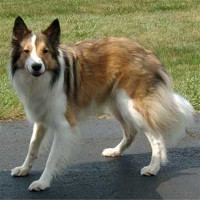
| The Scotch Collie is a local breed of dog that originated in the mountainous regions of Scotland. The breed consisted of both the long-haired collie (now known as the Rough) and the short-haired collie (now known as the Smooth). It is generally believed to have descended from a variety of ancient sheepdogs, some dating back to the Roman occupation, which could include Roman cattle dogs, native Celtic dogs and Viking breeding spitzes. Other ancestors include Gordon and Irish Setters. In Scotland, this dog was called "cooley", "coaly" and "collie". The name "Collie" comes from the Old English word for "black" or "coal" (coll) and may have referred to a type of sheep (Coaley) they used to herd. However, "Collie" could also derive from the Gaelic càilean and cóilean for "dog" or "young puppy", or from the Celtic word for "useful" which is "colie". Due to its popularity, it was imported to other countries, including the USA, where it simply became known as the Scotch Collie. In their native country, Scotch Collies were used to raise sheep and other farm animals, as well as for farm guarding and hunting. In the 1800s and early 1900s, large numbers of these dogs were imported to America to help families maintain their farms. As their numbers and popularity grew, Scotch Collies began to be widely used as pets and eventually shown at conformation events in England (Birmingham 1860) and America (New York, circa 1878). In 1885, the Scotch Collie Club was formed and the breed was accepted into the AKC (American Kennel Club). A year later, the Collie Club of America was formed. The name Scotch Collie was initially used by the AKC for this new breed. However, "Scotch" was eventually dropped as the AKC chose to use the terms "Rough" and "Smooth" to designate these collies. It is generally believed that this occurred in an attempt to differentiate show dogs from common, or working, Scotch Collies. Following the continued popularity of this breed and their increased appearance in conformation shows, the rough and smooth Collies began to change shape, developing the flat skull and long, narrow head familiar to today's Collies, as well as the more pronounced mane. the rough Colley. The changes occurred as a result of cross-pollination with other dog breeds, perhaps the Borzoi but more likely the Greyhound. These physical changes also separated the original Scotch Collie from the Collies that evolved from it. The Scotch Collie was at one time registrable by the United Kennel Club as well as the National Kennel Club (like the Old Time Farm Shepherd) but, at some point, lost recognition and began to be absorbed by other breeds, including the English Shepherd, which opened its registry to the breed. Scotch Collies not only contributed to the development of the Collie Rough and Smooth, but also the Australian Shepherd, and may have contributed to the development of other breeds, including, but not limited to, English Shepherds, Border Collies and Shetland Sheepdogs. Although no longer recognized as a distinct breed by American breed clubs, Scotch Collies continued to be popular with families and farmers as useful companions and helpers on small and family farms in the 1950s and 1960s. However, as the American farm began to decline, the Scotch Collie as a breed began to lose not only numbers but even their name, as the breed became known as "Farm Collies", "Farm Shepherds" and "Old-Fashioned Collies". In the 1990s, there was renewed interest in the breed, and the remains of the last known Scotch Collies in the USA were located in Tennessee and North Carolina (by Richard McDuffie), as well as in Canada (by Erika DuBois). These dogs were referred to as Old-Fashioned Farm Shepherds, as opposed to Scotch Collies, mainly to avoid confusion with the more popular and widely recognized collie breeds. In the 2000s, the Scotch Collie still remained small in numbers and a group was formed to further promote the breed (OTSCA), this time calling it "Old Time Scotch Collie". The group maintains an open registry for Scotch Collies as well as any collie-type dog. As of May 2017, the pedigree database contained just 174 registered Old Time Scotch Collies. |



 English (United Kingdom)

Comments