 |
Kuchi |
|
He is not recognized by the F.C.I. |
Origin |
Afghanistan and Pakistan | |
Translation |
Francis Vandersteen | |
This breed is also known as |
Sage Rama
|
A brief presentation of the Kuchi |
| The Kuchi is a rare breed bred to be guardians and protectors. They are athletic, fast and agile. This breed is also known for its relentless endurance. Although the Kuchi is not recognized as a breed by any kennel club in the Western Hemisphere, it is beloved in its native Afghanistan and Pakistan. This breed is extremely wary of strangers and it takes a long time before you begin to accept someone as a friend. Don't expect them to greet people readily. Early socialization is a must for Kuchis to prevent them from becoming aggressive towards strangers. |
History of the Kuchi |
| The Kuchi was named after the Afghan Kochi people, who are said to have first discovered these Molosser-type dogs. The breed is thought to have been developed by the nomads of Afghanistan as a working breed to protect caravans and livestock from predators and thieves. As there is very little written about the Kuchi, the date of origin is unknown and their ancestry is still something of a mystery. This leads historians to believe that they are a primitive race who were hidden from the world as they traveled with their masters across Pakistan and Afghanistan. It is known that they are considered Molosser-type dogs and are genetically close to the Central Asian Ovcharka. Some researchers claim that the Kuchi is simply a variant of the Central Asian Ovcharka. They are able to adapt quickly to their native environment, making them ideal for all Middle Eastern climates. The Kuchi has three different classifications: mountain type, steppe type and desert type. Some breed enthusiasts have even further classified them as tiger or lion type. The Kuchi is a large breed with the ability to fend for itself after centuries of traveling with nomadic groups over all types of terrain and climates. They had to have the means to catch their own food to survive, as the nomads didn't always have the capacity to provide them with food. Many breed enthusiasts are beginning to promote responsible breeding practices and develop an acceptable breed standard. There is a higher population of Kuchi in Pakistan and Afghanistan, but it is considered a rare breed elsewhere in the world. It seems likely that the so-called "Ghor dogs" should be included among these "Kuchi dogs" : Ghor dogs are mentioned in the earliest descriptions of the province and have always been considered particularly special. According to 11th-century Seljuk chronicles, there was a remarkably fine breed of dog in Ghor, so powerful that in frame and strength each of them is a match for a lion. The king of Turquoise Mountain had two Ghor dogs, one named after him and the other after the chief of Ghazni, who wanted them to fight, and it was dangerous to be around him on days when his namesake disappeared. From the Ghorids to the Seljuks became such proverbial parts of Islamic culture that a medieval scholar is recorded as saying that "Avicenna could not fight a Ghor dog. |
Appearance of the Kuchi |
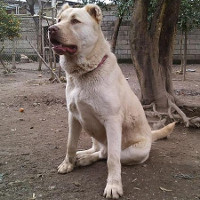
| Three main regional types are recognized, belonging to one of the two dog types : the lion type and the tiger type. These are determined by the construction and characteristics of the engine. Kuchi dogs can be roughly divided into three types : mountain, steppe and desert : - Mountain-type dogs form a very large, heavily coated variety, well adapted to life in the mountainous regions of the Pamir range. They are generally found at higher altitudes, where there is greater humidity and cooler, more extreme temperatures. - Steppe-type dogs are much lighter in build, with medium to long hair. They are faster and more agile on expansive apartments than the mountain variety. They can be characterized as having a mastiff-like build combined with a greyhound appearance. - Desert-type dogs represent a variant most often found on large desert plains, with little vegetation and a warmer climate. They are medium-sized, with a short to medium-length coat supported by a very thick underwool during the cold season. They may possess characteristics of both types, particularly when it comes to head structure. Another way of classifying the Kuchi dog could be according to a lion type (Djence Sheri), or a tiger type (Djence Palangi). This division applies mainly to desert-type dogs, but it's important to bear in mind that each of the regional variants may also display characteristics found in other types : - Lion-type dogs are heavier in build, with larger heads and deeper chests. Their coats are generally thicker, and they are medium-sized with a larger, bear-like head. - Tiger-type dogs are the most athletic, with a long, deep habitus, a brick or wedge-shaped head, and a shorter coat. They are more often associated with Steppe-type dogs. The difference between the two can also be seen in the way they move. Lion-type dogs are more majestic on the move, seeming very proud to keep their heads up as they walk. Tiger-type dogs show more lateral, cat-like movement, with the head generally level with the body, and the front legs swinging inwards to walk, run or jump. Both types are extremely agile, possessing tremendous speed and tenacity when running or attacking. |
Temperament of the Kuchi |
| This is a fiercely independent breed that has been bred to be vigilant and tough. They are also highly intelligent and extremely trustworthy. The Kuchi is surprisingly agile for its size and has great stamina. When confronted with a predator trying to attack their herd, Kuchi will fight fearlessly and to the death if need be. They are very territorial and don't get on well with other dogs in their area. Therefore, it's advisable to be the only dog in the house. Kuchis have close bonds with their families and will become very protective of them. Don't walk them around other people or dogs they might perceive as a threat. These dogs are very wary of strangers and it takes them a long time to accept new people. Generally, the Kuchi does not cope well with having to be re-homed and bond with another family. They are not recommended simply as a family companion, as their temperament does not allow them to be content with being a pet. |
Needs and activities of the Kuchi |
| The Kuchi is a moderately active dog that requires regular exercise. Coming from a nomadic background, they enjoy long hikes over varied terrain. They will need a sturdy leash when walking around other people and dogs. These dogs can become aggressive if they perceive that someone or something is threatening them or their owner. Don't let them run in a dog park, however, they do occasionally need to run in a large yard with a solid fence. Provide plenty of toys that they can't easily destroy with their powerful jaws. They need a job to do; without a clear goal, they'll be very unhappy. |
Maintenance of the Kuchi |
| The Kuchi is a self-sufficient breed; however, during the heavy shedding seasons, they require much more grooming and maintenance. All three varieties have a dense undercoat that comes off completely in spring. This requires daily brushing to stay on top of the hair that floats around your home and ends up on your clothes. Otherwise, they can be brushed once a week with a pin brush, a metal comb and, if necessary, a detangler. Their ears are usually clipped close to their heads, but they still need to be cleaned often to avoid ear infections. As they are heavy seasonal excretors, this breed is not hypoallergenic. Being a Molosse-type breed, the Kuchi drools and snores. They can have a strong odor when taken out of work, but they shouldn't be bathed too often. Wash them every few months with a mild shampoo. |



 English (United Kingdom)

Comments