
 |
Korean Dosa Mastiff |
|
He is not recognized by the F.C.I. |
Origin |
Korea | |
Translation |
Francis Vandersteen | |
This breed is also known as |
Mee-Kyun Dosa
|
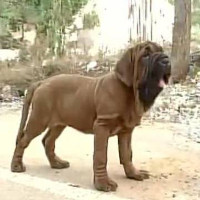
| This breed should not be confused with the Japanese Tosa, even though they are related. Unlike its Japanese cousin, the Mee-Kyun Dosa is not a fighter at all and is bred mainly as a pet and local show dog. There is also the Too-Kyun Dosa fighting variety, which is considered by some to be nothing more than a Korean/Taiwanese variety of the Japanese Tosa breed. The Mee-Kyun Dosa is thought to have been developed in the late 1800s from a variety of imported European and Asian working breeds, but some suspect that it was established as a recognizable type by crossing the Japanese Tosa-Inu with the Neapolitan Mastiff and Dogue de Bordeaux over the past 50 years. However, the breed was originally created from the same stock of dogs as the Japanese Tosa Inu, with a considerable amount of Saint Bernard and English Mastiff blood added in the second half of the 20th century. Regardless of its true ancestry, the Dosa's current "Beauty" has been established through generations of inbreeding and selection based on appearance, coat color and temperament. Despite its frightening and intimidating appearance, the Korean Dosa Mastiff is in fact a very gentle and calm breed of dog. A dignified, noble and affectionate dog, the Korean Dosa Mastiff forms a strong bond with its master and family and enjoys being a huge "lap dog". The dog is very affectionate, gentle and kind with children, gets on well with other dogs and pets in the family, but reserved with strangers. His tendency to lean on his favorite people makes him unsuitable for unsupervised young children, as he may inadvertently step on or knock them over due to his enormous size. This is a rather indolent dog that will fit into apartment life due to its low activity levels. This dog is rarely seen galloping. Instead, walking and trotting are the dog's most common gaits. This huge dog is a natural deterrent to intruders with his fearsome appearance, but to his family, he's a true gentle giant who will love everyone with his cool, calm temperament. Cherry eye is common in the breed, and should be removed, not glued on. Good nutrition is essential for this large, fast-growing breed. It is prone to weathering and should therefore be fed 2 to 3 small meals a day. It can also suffer from hip dysplasia and genetic eye diseases such as Entropia. The short, smooth coat needs little grooming, and once a week brushing keeps the coat clean. Skin folds should be cleaned regularly. Bathing once a month should be enough to keep this dog clean. Puppies develop at a rapid pace, but until their bone structure is fully developed, they should not be subjected to strenuous exercise. This lazy dog should be taken for daily walks. Small children should be supervised when the dog interacts with them because of its enormous size and tendency to "lean lovingly" on them. This is an intelligent dog that is very obedient. He is wary of strangers but does not usually bark. This rather lazy dog cannot demand exercise, but the owner should take him for daily walks. He has moderate energy levels and daily walking will be sufficient to satisfy his exercise needs. The Korean Dosa Mastiff can be a great walking companion. The Korean Dosa Mastiff's coat is short, silky and glossy. Colors include chocolate, mahogany and red. A white patch on the chest is permitted. This tall, massive dog stands between 56 and 76 centimeters and weighs between 66 and 84 kilos. It has a typical mastiff appearance, with a large head and strongly wrinkled body. The wide, square-shaped muzzle leads to a broad, black nose. The wide ears are soft to the touch and hang close to the head. The eyes are medium-sized, set wide apart and dark in color. The body is rectangular. |



 English (United Kingdom)

Comments