 |
Brabantse Bullenbijter |
|
He is not recognized by the F.C.I. |
Origin |
Germany | |
Translation |
Francis Vandersteen | |
This breed is also known as |
Brabanter
|
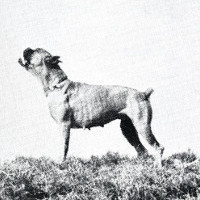
| The Bullenbeisser, Bärenbeisser and Brabanter of Central Europe could be found in the area that now covers Belgium, Holland, Germany and Poland. How these dogs arrived in Central Europe, and for how long, is unknown, but it is most likely that these old Central European Molossers are a mixture of several ancestors, and from different periods in history. Celtic and Cimbrian dogs, guard dogs brought by attacking or passing armies, dogs brought to this land by human migration (bandits, hunters, vandals, etc.), dogs acquired through trade, etc. We shouldn't count on the primary versions of these breeds being uniform in type, since the new arrival of dogs would be used in multiplication, and they had any desired trait. Slowly these dogs obtained a multiplication of type and specific traits, and became combined in the Dutch Mastiff, the Bullenbeisser, the Bärenbeisser, the Brabantse Bullenbitjer or Brabanter Bullenbeisser and the Danziger Bullenbeisser, even if it's not always so clear to trace the lineage, particularly between the small Bärenbeisser and the large Bullenbeisser. For the best descriptions and illustrations of these dogs, we need to move closer to modern times, and stop at the end of the 16th, beginning of the 17th century. John E. L. Riedinger (1698-1767) of Augsburg, Germany, was well known for his portraits of the German Hound, and is the most reliable source of Bullen/Bärenbeisser illustrations from this period in history. Riedinger also gave written references to these dogs, when he wrote : "The main part of most German hunting packs of the olden days consisted of rough-coated dogs with bushy tails and wolf heads called 'Rüden'. They were supplied to the courts in incredible numbers by the peasants and suffered great losses on every hunt, so no special measures were taken to multiply them. The Doggen and Bullenbeisser, however, instinctively knew how to approach the hunting game from behind and hold it in such a way as to be protected from serious damage, which gave the hunters to achieve the kill, so that they were more valuable to the hunt and were consequently highly esteemed and carefully multiplied". From this description we also learn that these dogs were employed for the great hunting game, and we can assume from Riedinger's words that these dogs were "highly esteemed and carefully multiplied", this kept the dogs more or less pure, otherwise they would surely lose their desired and esteemed traits as hunting dogs. We take a leap into history, to read just what Wagner wrote about these dogs in 1950 : "By comparing Spanish and French authors of the 12th to 14th centuries with authentic English and German sources, we find that the so-called title "Dogge" was used as collectivism for all that was strongly built, short-haired hunting dogs with large heads, powerful muzzles developed into a triangle, drooping upper lip, strong body and strong teeth and that the Doggen forms of all European countries from the Middle Ages until today are limited to three types that have in the course of time developed into national breeds" These are : 1. the heavy Bullenbeisser. 2. the large hunting dog created by crossing the Bullenbeisser with the old Wolfhound or Deerhound type. 3. the small Bullenbeisser, which represents a smaller form of the heavy Bullenbeisser through natural selection. The dogs got their name Bullenbeisser (Bull biter) in the same way as the English Bulldogge got its name; through work the dogs were employed on it. Bärenbeisser (Bear biter) are described as almost the same dog, slightly larger than the Bullenbeisser. They were used in hunting and fighting the Bären (brown bear). These two breeds were probably Bullen and Bärenbeisser, differing only in size. Brabanter got its name from the province of Brabant in Belgium and was a smaller Bullenbeisser. An early German author of the 18th century wrote that a different kind of Bullenbeisser, of medium size, was established in the province of Brabant. He tells us that these dogs were bear hunters and baiters, made good guard dogs, with short noses, black muzzles, protruding lower jaws and were striped black and yellow in color. It's believed that the breed didn't exist until the English Bulldog came to Germany and the white gene was introduced to the Bullenbeisser. The Danziger Bullenbeisser got its name from the town of Danzig (now Gdansk) in Poland, which earlier belonged to Germany. These Danziger Bullenbeissers have been described as large, much larger than the Brabanter, and we can assume that the Danziger was more or less the same dog as the Bärenbeisser. The Dutch Mastiff was mentioned by Mr. B. Wynn in his book in 1886 : "There is a breed indigenous, or at least behind great antiquity in Holland and Germany, called the Dutch Mastiff, and is closely allied to the British variety, being of a fierce nature, and presenting the truncated and short muzzle. This breed, which is apparently the true descendant of the war dogs of Gaul, has been much crossed, says a well-known author, with the larger Mastiff. In the chronicles of the knight St. John of Jerusalem, there is mention of a Mastiff called Dreadnaught, who saved his master from the coils of a snake by his courage and agility. The dog is said to have been lowered from the cross mentioned above. However, the Dutch Mastiff can still occasionally be encountered in Holland" Around 1875, Mr. Theo Basset encountered one of these Dutch Mastiffs in Hamburg. He described the dog as being 71 centimeters long, 30 high and weighing 81.5 kg. He drew a rough sketch of this dog, proving that it was long, low, a massive animal, with big bones, but short limbs, coat and hindquarters. All of these were developed from the same ancestors and although some were maintained because of their pure specific abilities, we should count that some cross-breeding was done, and from Wynn's description we learn that the Dutch Mastiff was crossed with the British Mastiff. Today, it is generally accepted that the small Bullenbeisser crossed in the province of Brabant, as well as the British Bulldogge, are the ancestors of the modern boxer. The large Bullenbeisser is thought to be one of the ancestors of the Great Dane. Others, however, believe that the Great Dane is a result of crossing English Mastiffs with Greyhounds. The truth is probably that both versions are accurate. We know for a fact that English Mastiffs and Mastiff crosses were imported to Central Europe. In Britain they crossed the Mastiff with the Greyhound, and probably the Irish Greyhound (Irish Wolfhound), to make faster, more agile hunting dogs. These dogs never became popular in Britain, but once transported to Germany, they soon found many admirers. These dogs, described in early German literature as the "Englische Dogge", together with the great Bullenbeisser, or Bärenbeisser if you prefer, were for the most part probably both involved in the breed base of the dog that was later to be known as the "Deutsche Dogge" (Great Dane). The Bullenbeisser was also brought to South Africa by Boer and German settlers, and can therefore be found in the breed base of the Boerboel and Rhodesian Ridgeback. Today, the Bullenbeisser, or its subtypes, can no longer be found. It is believed to have disappeared at the end of the 18th century, when the Boxer gained popularity in Germany. The Boxer, so to speak, took over the role of the Bullenbeisser and Bullenbeisser, in pedigree and also favored the current breed when dog fighting was banned and the great game had disappeared from the forests, thus achieving its extinction. There are rumors, however, that the Brabanter still lives on, but is only used as a companion dog. |



 English (United Kingdom)

Comments