
 |
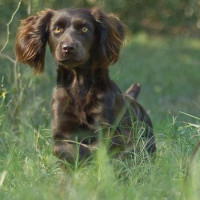
Boykin Spaniel |
|
He is not recognized by the F.C.I. |
Origin |
U.S.A. | |
Translation |
Francis Vandersteen | |
This breed is also known as |
Little Brown Dog |
Usage |
| The Boykin Spaniel is above all an active hunting dog. Structure and solidity are of great importance. |
Brief historical summary |
| The Boykin Spaniel was developed in South Carolina, USA, as a medium-sized sporting dog with a docked tail. The breed is built to cover all types of terrain conditions with agility and reasonable speed. Size and weight were essential to the breed's development, as these hunting companions had to be lighter and smaller than their larger sporting dog cousins to fit in the boats of the portable section of the period. As a result, the Boykin Spaniel came to be known as "the little brown dog that doesn't rock the boat". Being a hunting dog, it needs to be displayed in hard, muscular working condition. His coat should not be too excessive to hinder his active spaniel work, but it should be thick enough to protect him from harsh weather. |
Behaviour / temperament |
| The Boykin Spaniel is friendly, a willing worker, intelligent and easy to train. Boykin Spaniel thrive on human companionship and get on well with other dogs and children. They show great ardor and energy for hunting, but remain controllable in the field. |
Head |
||
Cranial region |
||
Head |
The head should be proportionate to the size of the dog. The expression is alert, impatient, confident, attractive and intelligent. | |
Skull |
The skull is fairly broad, flat on top and slightly rounded on the sides and back. The occiput bone is discreet. | |
Stop |
The stop is moderate. Seen from the side, the nasal bone and the top of the skull form two parallel lines. | |
Facial region |
||
Nose |
The nose should be fully pigmented, dark liver-colored, with well opened nostrils. | |
Muzzle |
The muzzle is approximately the same length as the skull and about half as wide as the skull. The distance between the tip of the nose and the occiput is about the same length as the occiput at the base of the neck. The nasal bone is straight, with no downward inclination or fragmentation. | |
Lips |
The lips are close-fitting and clean, with no excess skin or flecks. | |
Jaws and teeth |
Scissor bite preferred, level dentition acceptable. Excessive or insufficient dentition is a major fault. Broken teeth should not be considered against the dog. | |
Eyes |
Eyes range from yellow to amber to various shades of brown, set wide apart, medium size and almond or oval in shape, confident. Protruding or swollen eyes are a major fault. | |
Ears |
The ears are pendulous and set slightly above or even with the eye line, the defined ear is higher when alert. The ear leather is thin and when pulled forward should almost reach the tip of the nose. The ears hang close to the cheeks and are flat. | |
Neck |
| The neck is moderately long, muscular, slightly arched at the crest and blends gradually into the sloping shoulders, never concave or ewe-necked. |
Body |
||
Body |
The body is solidly built but not too compact and never square. | |
Topline |
The topline is straight, strong and essentially level, and must remain solid and level in movement. | |
Loin |
The loins are short, strong with a slight tuck-up. | |
Croup |
The croup slopes slightly to the tail, and the tail follows the natural line of the croup. | |
Chest |
The chest is well developed but not cannulated, extending to the elbows and not so broad or narrow as to interfere with movement. | |
Tail |
| The tail is set at a length of 7.5 to 12.5 centimeters at maturity. Carried horizontally or slightly raised, it displays a lively, cheerful characteristic in action, especially when the dog is hunting. |
Limbs |
Forequarters |
||
Shoulders |
The Boykin Spaniel's shoulders are sloping, clean and muscular. | |
Upper arm |
Arms are of medium length, straight and well boned, but not too short so as not to interfere with work on heavy terrain and appear clumsy. | |
Pastern |
The metacarpals are strong with no pronounced weakness. | |
Forefeet |
Round, compact, well arched, medium-sized feet with thick pads. Dewclaws should be removed. Toes tightly grouped, webbed and well padded. | |
Hindquarters |
||
Generality |
The hind legs are muscular and, above all, in balance with the front legs. | |
Upper thigh |
Boykin Spaniels have well developed hips and thighs, with angulation of the hindquarters showing strength and dynamism. | |
Metatarsus |
Relatively short, strong and parallel metatarsals seen from the rear. | |
Hock |
Well bent hocks. | |
Hind feet |
See front feet. | |
Gait and movement |
| Movement is effortless with good reach of the shoulders, well relaxed at an angle that allows a long stride in balance with the hind quarters for strong driving power without wasted movement. Seen from the rear, the hocks should pass well under the body after on a line with the forelegs neither too wide nor too close together. As speed increases, it's natural for the legs to fall to a median line. Seen from the side, it should present a good, long forward stride without lateral curling. When walking, the tail is carried at or above the back. |
Coat |
||
Hair |
The coat can vary from flat to slightly wavy to curly, with medium length. The Boykin Spaniel is typically a single-coat breed, but may have an undercoat. Boykin Spaniels are considered easy-care dogs that can easily go from the field to the ring. The ears, chest, legs and belly are fitted with light bangs or feathers. The coat can be trimmed, but never shaved, for a well-groomed appearance and to enhance the dog's natural lines. It is legitimate to trim the head, throat, ears, tail and feet to give an elegant, functional but natural appearance. Honor scars are acceptable. | |
Colour |
The color of the Boykin Spaniel is a solid liver color, a dark reddish brown that includes various shades of chocolate brown, from light to very dark. A small amount of white on the chest is permitted, and no other white markings. Sun-bleaching is acceptable. | |
Size and weight |
||
Height at withers |
Boykin Spaniels are solidly built, with moderate bones and smooth, firm muscles. The ideal height measured from the ground to the highest point of the shoulder blades for dogs is between 39 and 46 centimeters at the withers, for bitches is 35.5 to 42 centimeters at the withers. Any deviation of more than 2.5 centimeters above or below the ideal height constitutes a major fault. Minimum height ranges do not apply to dogs or bitches under 12 months of age. The proportion is slightly longer than tall, never square. However, the exact proportion is not as important as long as the dog is well-balanced and healthy, capable of performing the function intended by the breed. |
|
Faults |
| • Any departure from the foregoing points should be considered a fault and the seriousness with which the fault should be regarded should be in exact proportion to its degree and its effect upon the health and welfare of the dog and its ability to perform its traditional work. • Faults listed should be in degree of seriousness. |
NB : |
| • Any dog clearly showing physical or behavioural abnormalities shall be disqualified. • The above mentioned faults when occurring to a highly marked degree or frequently are disqualifying. • Male animals should have two apparently normal testicles fully descended into the scrotum. • Only functionally and clinically healthy dogs, with breed typical conformation should be used for breeding. |



 English (United Kingdom)

Comments