 |
Bonsai Bulldogge |
|
He is not recognized by the F.C.I. |
Origin |
U.S.A. | |
Translation |
Francis Vandersteen |
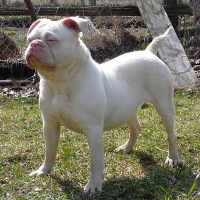
| The Bonsai Bulldogge was created by Laura Kelsch of Hammerhead & Tie Lang Tou Kennels to appease people who want to be able to keep a small dog, without lacking looks or personality. The Bonsai Bulldogge's head is broad and square, moderately recessed between the eyes (medial groove). The circumference of the head should be equal to or greater than the dog's height at the shoulder. A narrow head or one that seems too small for the body is a fault. Pink ears well set on the sides of the head are preferable. Button ears are acceptable, as long as they're small, not "hound dog". Tulip ears are also acceptable, but not preferred. Pricked ears on top of the head or cropped ears are considered a fault. Eyes are set wide apart and of medium size. Any color is acceptable. Deformed or buggy eyes are a serious fault. Pigment around the eyes is preferred. Crossed eyes or eyes that are not symmetrical in shape are disqualifying faults. The nose is broad and black; the tip of the nose should be slightly higher than the root of the muzzle. The muzzle is broad, deep and short, with slight to moderate wrinkles. The teeth on the lower jaw turn noticeably. Lower canines should not protrude. Muzzle too long (over 2 inches), a scissor bite, bite itself or bitten jaws are disqualifying faults. The muzzle should be no shorter than 1 inch. The neck is of medium length and very muscular, flowing into the shoulders and should not be fixed to the dog, so it appears to stop at the shoulders. The ribs should be well sprung (rounded) and the chest broad and deep. Chest depth should reach at least to the elbows. A hollow or narrow chest (side slabs) should be considered a serious fault. Males should appear square and balanced. Females should appear similar in body length. A short to medium-length back with a gentle downward slope from the shoulders to the croup is preferable. A flat back is acceptable as long as the tail does not protrude directly from the upper back. Shoulders should be well relaxed with significant angulation to allow good movement. Straight shoulders are a fault. The forelegs should be straight and wide apart, not bowing or turning. There should be significant bone substance. Elbows should be relatively close to the body. Lack of bone and substance is highly undesirable. Loose elbows or "fiddle-fronts" are a disqualifying fault. East / West" legs are a serious fault. The hind legs must present a significant curvature of the choke to allow good movement. They should be well muscled. Straight or "hind" legs are a serious fault. Cow hocks are a disqualifying fault. Feet should be round, tight in front and back, and pasterns should be strong. Weak pasterns and/or splayed feet are disqualifying faults. Any color is acceptable without preference for one over the other. The coat is short. A wavy or long coat is a disqualifying fault. There should be no sign of feathering on the legs or neck; this is also a disqualifying fault. The tail can be screwed short, a docked tail is most common, but a pump handle tail that naturally reaches the hock is desirable. The pump handle tail should be carried low and not over the back of the dog. The Bonsai Bulldogge should have the tenacity of the bulldog and is generally unaware of its small size when interacting with other dogs. It is just as loyal and courageous as the larger version, but physically takes up less space, making it very suitable for the apartment. With a very stable temperament and unfailing loyalty, this breed makes an excellent watchdog. It's great with children, cats and other pets when properly socialized. The Bonsai Bulldogge has a jovial personality and is much warmer than other breeds of its size, making it an ideal family pet. Make sure you are your dog's firm, confident, responsible pack-mate providing rules for the dog to follow, and placing limits on what the dog can and can't do with proper human dog communication. Daily walks are also essential to keeping a dog happy and stable. Being a smaller dog, the Bonsai Bull is suited to life in the city or country. Its small size makes it an ideal companion for well exercised people. A good brisk walk or a quick romp in the park will keep these guys in shape. With such a short coat, grooming needs are minimal. An occasional bath, brushing and wrinkle cleaning are all that's needed to maintain a healthy appearance. Bonsai Bulldogs are strong dogs with short, straight legs. They enjoy energetic play and will maintain better health if trained regularly. This breed should be taken on daily walks. They also like to let off steam in the park. The short coat offers little protection from the elements, making it unsuitable for outdoor life. When you go out in sub-freezing temperatures, Bonsai will need a coat for longer outings. To maintain the health and appearance of your Bonsai Bulldogge, it's best to have it on a homemade, natural, human-grade pet food diet. Height at withers 30 cm and under for a weight of less than 11 kg. |



 English (United Kingdom)

Comments