 |
Pastor Garafiano |
|
He is not recognized by the F.C.I. |
Origin |
Canary Islands, Spain | |
Translation |
Francis Vandersteen | |
This breed is also known as |
Garafiano Shepherd Dog
|
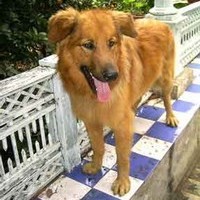
| The Pastor Garafiano is a breed of dog native to La Palma, Canary Islands. The name comes from the north of the island, specifically from the municipality of Garafía, for being the place where the breed was most common, although there are specimens all over the island. The breed was officially recognized by Spain's Royal Canine Society in 2003. These docile, protective dogs are not known for their aggression. Since its origins, it has been associated with grazing, an activity for which it shows particular aptitudes, although it has become very important as a companion animal. For a time, the breed was on the verge of extinction due to interbreeding with other breeds. Successive crossbreeding, especially from the 1960s onwards with other breeds of sheepdog, demonstrated the need to work for their recovery and selection from the few pure specimens of the breed kept by the island's shepherds. To prevent this disappearance, the Working Group for the Recovery of the Garafiano Sheepdog was created, which would become the Spanish Garafiano Sheepdog Association. The association's objectives include development, censuses, the creation of breeding nuclei, participation in dog shows and fairs, etc. The breed has been featured in the samples of native breeds celebrated in the Canary Islands, as well as in international shows held in Santa Cruz de Tenerife and Las Palmas de Gran Canaria. The Ethnology Department of the Veterinary Faculty of the University of Las Palmas de Gran Canaria has carried out several studies on the breed, which were presented at the Native Breeds Symposium held in Cordoba in March 1992. The breed's future looks promising, given the growing interest in these animals, not only by shepherds but also by people looking for an animal companion. This differentiated canine population originated in the Garafía region on the island of La Palma, where it was used by shepherds to herd goats. For this reason, the animal thrives in steep, rocky areas. It has very homogeneous characteristics, as only functional selection has been carried out. Its main suitability is for grazing goats and sheep on steep terrain, due to the geographical characteristics of La Palma. Its origins date back to pre-Hispanic times, although crossbreeding with other breeds after the conquest contributed to the development of the Garafiano shepherd. Similar lupoid, medium to moderately longilineo proportions, well balanced, medium to large size. Croup slightly higher than that of the transverse collar rather short and weak compared to the head of the body. They usually weigh between 28 and 35 kg for males and between 24 and 30 kg for females. The height at the withers of males is between 57 and 64 cm, while that of older females is between 55 and 62 cm. These figures have now changed, and the normal height is 60 to 70 cm for males and 55 to 65 cm for females. The head is conical, small in relation to the body, the forehead slightly convex, highlighting ears with an advanced spread. They may also appear pricked, then there is a tendency to keep them folded at a stimulus, showing their inner side. The nose is always black. The almond-shaped brown eyes are oblique. The lips are short and collected. The bite is pincer-like. The stop is soft and very pronounced. The legs are strong, well positioned and well proportioned. Sometimes they have spurs, which are generally double and some implanted. The coat is fawn or alobada. Puppies are born brown, changing color as they mature, in some cases appearing white hairs or patches on chest, toes or tip of tail, but generally disappearing as they grow. Hair is abundant and of varying length. Sometimes it's soft, while in other cases it's rough. Usually accumulates at the base of the ear, neck, skirts, tail and leg edges. The tail is usually densely populated with hair like a saber being slightly curved, but never on the back. The Garafian Shepherd's character is docile and friendly. When meeting strangers, he displays a typical attitude: barking, folding his ears, wagging his tail and turning his head to show the corner of his mouth-shaped smile. He is calm and peaceful in appearance, but becomes active while engaged in physical activity. |



 English (United Kingdom)

Comments