 |
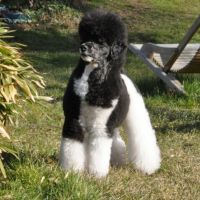
Particolored curly-haired dog |
|
He is not recognized by the F.C.I. |
Origin |
France | |
Translation |
Francis Vandersteen | |
Group |
Group 9 Companion and Toy dogs | |
Section |
Section 2 Poodle | |
Working |
Without working trial |
Usage |
| Companion dog. |
Brief historical summary |
| This dog was created from the poodle. For the record, the Poodle standard has always specified that the breed is unicolored. Breeders therefore produced particolored dogs from poodles and other breeds. These subjects, whose appearance was quite similar to that of the Poodle, could under no circumstances be entered in a stud book under the name Poodle, as parti-colored subjects were disqualified from the breed. Selection was therefore maintained to fix these new colors. The type is medioline like that of the Poodle. However, the heads are slightly less chiseled than those of the Poodle. |
General appearance |
| Medioligne type, with characteristic curly or corded particolored coat. Intelligent, constantly alert, active, harmoniously built, giving an impression of elegance and pride. |
Important proportions |
| The length of the muzzle is about 9/10 that of the skull. The length of the body (scapulo ischiale) is slightly greater than the height at the withers. The height from the withers to the ground is approximately equal to the height from the top of the croup to the ground. The height of the elbow to the ground is 5/9 of the height at the withers. |
Behaviour / temperament |
| Loyal, learnable and trainable, making it a particularly pleasant companion dog. |
Head |
||
Cranial region |
||
Head |
Distinguished, straight, proportionate to the body. The head should be fairly chiseled and expressive, without heaviness but also without excessive finesse. | |
Skull |
Less than half the length of the head. Viewed from above, the skull appears oval and slightly convex in profile. The axes of the skull and muzzle are slightly divergent. Moderately prominent superciliary arches, covered with long hair. The frontal furrow is wide between the eyes, tapering towards the occiput, which is very pronounced. (In dwarfs and Toy dogs, it may be slightly less pronounced). |
|
Stop |
Not very pronounced, but should never be erased. | |
Facial region |
||
Nose |
Developed, with vertical profile line; nostrils open. Well pigmented nose. | |
Muzzle |
Straight upper profile, about 9/10 as long as the skull. The branches of the lower jaw are almost parallel. The muzzle is solid. The lower profile of the muzzle is given by the jaw and not by the edge of the upper lip. | |
Lips |
Moderately developed, rather dry, of medium thickness, the upper lip resting on the lower, without drooping. Lips should be well pigmented. The corners of the mouth should not be pronounced. | |
Jaws and teeth |
Full scissor bite. Strong teeth. | |
Cheeks |
Not prominent, modelled on the bones. Suborbital regions chiseled and sparsely filled. Zygomatic arches only slightly protruding. | |
Eyes |
Fiery, set at stop height and slightly oblique. Almond-shaped. Black or dark brown. Well-pigmented eyelid margins. | |
Ears |
Fairly long, drooping along the cheeks, set on the extension of a line starting from the top of the nose and passing under the outer corner of the eye; flat, widening after setting and rounded at the tip, they are covered with very long, wavy hair. The skin of the auricle, when carried forward, reaches the corners of the mouth, ideally exceeding it. | |
Neck |
| Solid, slightly arched after the nape of the neck, of medium length, well proportioned. Head proud, carried high. Neck without dewlap, oval in cross-section. Its length is slightly less than that of the head. |
Body |
||
Body |
Well proportioned. Length of body slightly greater than height at withers. | |
Topline |
Harmonious and well sustained. Height from withers to ground approximately equal to height from top of croup to ground. | |
Withers |
Moderately developed. | |
Back |
Short. | |
Loin |
Firm and muscular. | |
Croup |
Rounded, but not drooping. The tip of the sternum should be slightly protruding and fairly high. | |
Chest |
Level with the elbow; the width is equal to 2/3 of the height. Chest oval in cross-section, broad at the back. | |
Underline and belly |
Remounted without being lifted. | |
Tail |
| Set fairly high, level with the loins (ideal carriage at 9.10 o'clock in relation to the topline). |
Limbs |
Forequarters |
||
Generality |
Perfectly straight and parallel, well muscled with good bone. The height from the elbow to the ground is slightly more than half the height at the withers. | |
Shoulders |
Oblique, muscular. The shoulder blade forms an angle of about 110° with the humerus. | |
Upper arm |
The length of the humerus corresponds to that of the shoulder blade. | |
Carpal |
In the anterior line of the forearm. | |
Pastern |
Solid and almost straight when viewed from the side. | |
Forefeet |
Rather small, firm, short oval. Toes well arched and tight. Pads are hard and thick. Dark nails. | |
Hindquarters |
||
Generality |
Hindquarters parallel, seen from behind; muscles developed and very apparent. The coxofemoral, femorotibial and tibiotarsal angles should be prominent. | |
Upper thigh |
Well muscled and robust. | |
Metatarsus |
Fairly short and vertical. | |
Hock |
Quite bent. | |
Hind feet |
See forelegs. | |
Gait and movement |
| Hopping, light gait. |
Skin |
| Supple, without laxity, pigmented. |
Coat |
||
Hair |
- Curly-haired dog: abundant hair of fine, woolly texture, well curled, elastic and resistant to hand pressure. It must be thick, well furnished, of uniform length, forming even curls. - Corded: Abundant, fine-textured, woolly, tightly woven, forming well-characterized cords. They must be at least 20 cm long. It must be possible to appreciate the texture of the coat, which means that the dog must not be completely shaved. For shows, the dog may be presented either with a natural coat, or groomed like a Poodle, in which case only the clippings specified in the appendix to the Poodle standard will be accepted. |
|
Colour |
Particolored subjects - Black and white. - Black and tan: tan markings are well defined and of a clear fawn color. - Tricolor: Black, white and tan. - Brown and white. - Brown and tan: the tan markings are well-defined and of a deep tan color. - Blue and white. - Fawn and white. - Brindle. |
|
Size and weight |
||
Height at withers |
In all cases, sexual dimorphism must be visible. - Large: Over 45 cm and up to 60 cm with a tolerance of 2 cm more. - Medium: Over 35 cm and up to 45 cm. - Dwarfs: Over 28 cm and up to 35 cm. - Toys: Over 24 cm (tolerance minus 1 cm) and up to 28 cm (ideal: 25 cm). All signs of "dwarfism" are excluded; only the occipital crest may be slightly less pronounced. |
|
Faults |
| • Any departure from the foregoing points should be considered a fault and the seriousness with which the fault should be regarded should be in exact proportion to its degree and its effect upon the health and welfare of the dog and its ability to perform its traditional work. • Faults listed should be in degree of seriousness. |
Serious faults |
Particular points in the type Eyes too large and round, or set in sockets, insufficiently dark. Ears too short (do not reach corner of mouth). Snipey or pointed muzzle. Busted muzzle. Back arched or swaybacked. Tail set too low. Swallowed croup. Rear angulations too straight or hyper angulation. Long, flowing gait. Eyes too large and round, or set in sockets, insufficiently dark. Ears too short (do not reach corner of mouth). Snipey or pointed muzzle. Busted muzzle. Back arched or swaybacked. Tail set too low. Swallowed croup. Rear angulations too straight or hyper angulation. Long, flowing gait.Coat Sparse, soft or hard coat. Undecided colors. Poorly distributed tan markings in black/fire and brown/fire. Partially depigmented nose.Anomalies Lack of 2 PM2.For subjects with one of these serious faults, no Excellent rating. |
Disqualifying faults |
| Character Aggressive or timid dog. General type Lack of type, especially in head. Over 62 cm for large dogs and under 23 cm for toys.Particular points in the type Lop-sided or brachyury. Dewclaws or traces of dewclaws on hindquarters. Any subject showing signs of "dwarfism": globular skull, absence of occipital crest, very pronounced stop, prominent eye, muzzle too short and wetted. Median furrow practically non-existent. Very light bone structure in toys. Whip carried completely curled.Coat Non-particolored coat. Nose totally depigmented. Coat colors not included in the standard.Anomalies Overshot or undershot mouth. Any problem with the implantation of teeth that could cause injury to the dog (example: poorly implanted canine touching the palate).Teeth Missing incisor, canine or carnassial tooth. Or missing a PM3 or PM4. Or missing 3 or more PM (except PM1). |
Important |
| A show judging of this breed is in no way a grooming competition judging. Excessive grooming should not be encouraged. In accordance with current FCI show regulations, the use of products that can modify the texture of the coat is strictly forbidden for all types of grooming. |
NB : |
| • Any dog clearly showing physical or behavioural abnormalities shall be disqualified. • The above mentioned faults when occurring to a highly marked degree or frequently are disqualifying. • Male animals should have two apparently normal testicles fully descended into the scrotum. • Only functionally and clinically healthy dogs, with breed typical conformation should be used for breeding. |



 English (United Kingdom)

Comments