
 |
Cane da Pastore Calabrese |
|
He is not recognized by the F.C.I. |
Origin |
Sila, Calabria, Italy | |
Translation |
Francis Vandersteen |
Usage |
| Shepherd dogs used to protect flocks and property. |
Brief historical summary |
| The breed's origins are undoubtedly ancient, and according to some experts, it comes from the dogs imported by Greek settlers when they moved to the region. It has been described in numerous newspapers and stories over the past two centuries. This dog was mainly used to keep wolves away from grazing flocks of sheep and goats, but as the wolf no longer lives in these Italian regions, these ancient dogs have a weight in their function and therefore their local popularity, and are in fact rapidly becoming extinct. In 1972, the "race" made its debut, out of competition, at the Cosenza show, with 7 rather homogeneous specimens competing against each other. |
General appearance |
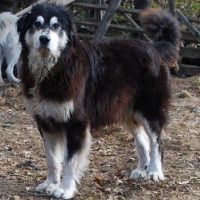
| The Sila Shepherd Dog, alias Pastore Calabrese or Silano, resembles a harmoniously built mesomorph, tall, vigorous, strong-boned but never heavy, with well-developed musculature. Equipped with great agility. The trunk fits into the rectangle, but should never give the impression of being stocky or low on the limbs. Sexual dimorphism is very evident. The coat, rich in undercoat, long and thick in winter, is semi-vitreous and smooth, accentuating the dog's vigor. |
Behaviour / temperament |
| The Sila Shepherd Dog has always played the role of guardian and leader in the management of the herds that populate the Sila and part of the Calabrian territory. Fearless and incorruptible, they carry out their work with the utmost seriousness and dedication, never leaving the unguarded herd with which they spend their entire lives. He is extremely hardy, as he is used to living in extreme conditions, food shortages and climatic adversities, the environment in which he has worked for centuries. It has a vigilant, cautious expression. Equipped with an excellent memory. He distrusts strangers, which makes it difficult for him to get close, but in the presence of the shepherd/owner, equipped with great poise, he familiarizes with great ease. If he grows up in close contact with man, he shows great docility, vivacity and attachment to those who have taken care of him. Loving with children, more spirited and impetuous with adults. He has a great capacity for learning. Likes to be stroked. His psychic abilities suggest that this dog's usefulness is not only limited to guarding, his sensitivity and gentleness make him suitable not only as a companion dog but also for use as a therapy dog. Thanks to its athletic ability and easy training, it is also suitable for sporting activities and social use. The Sila Shepherd Dog can be considered a multi-faceted dog, capable of being employed in a variety of activities. |
Head |
||
Cranial region |
||
Head |
Mesocephalic type, large and massive, powerful but not heavy. Viewed from the side, it is shaped like a truncated cone. | |
Skull |
The skull is almost as long as it is wide. The lateral and front profiles are slightly convex. The axes of the facial skull are parallel. | |
Stop |
Moderate, not too pronounced, soft. | |
Facial region |
||
Nose |
Large and black, with open nostrils. | |
Muzzle |
Broad and deep at the root, the tip of the nose becomes slightly thin. | |
Lips |
The upper lips just cover the teeth of the jaw. The lip margins are always pigmented black. | |
Jaws and teeth |
Healthy, strong and well developed. | |
Cheeks |
Broad and robust. | |
Eyes |
Semi-lateral position, with eye bulb neither protruding nor sunken. Not too large for the size of the skull. Almond-shaped. The eyelids are well adhered and well pigmented with black. Iris color varies from ochre to dark brown. Lively, alert and cheerful expression. | |
Ears |
Set well above the zygomatic arch, close to the cheek, triangular in shape with a slightly rounded tip. Not too large in relation to the dog's head. The roll is pendulous and mobile. | |
Neck |
| Medium length, strong and muscular, thick and free from dewlap. Always covered with abundant hair, especially in adult males. The hair around the neck is much thicker and longer in adult males, almost forming a mane, very useful for defense. |
Body |
||
Topline |
The topline is straight from the withers to the croup. | |
Withers |
Moderately high on the hind line. The distance between the ends of the shoulder blade is fairly wide. | |
Back |
Straight in profile. | |
Loin |
The loins are well blended with the rear line. Strong and muscular. | |
Croup |
Broad, solid and muscular, with a straight profile. | |
Chest |
Deep to the elbows, relatively broad, in harmony with its mesomorphic constitution. | |
Ribs |
Long, sloping ribs, with large intercostal spaces, indicate great lung capacity and therefore resistance. | |
Side |
Strong and robust. Slightly longer than the height at the withers. | |
Underline and belly |
The ventral sternal profile shows a long sternal region that develops into a semicircle with a very wide string, which rises gently towards the abdomen. | |
Tail |
| Its attachment is situated below, beyond the dog's hock in the normal position, bent at rest, carried above the rear line in excitement, with the tip fairly curved, but never curled over itself. Well furnished with thick hair without feathering. |
Limbs |
| Limb development is in good proportion to somatic development, and the individual regions related to these limbs are also among them. | ||
Forequarters |
||
Generality |
Strong, muscular bone structure. Correct apiomb both forwards and laterally. Forelegs and profile must always be correct. | |
Shoulders |
The shoulder is long, sloping, with strong muscles and free in movement. | |
Upper arm |
The upper two-thirds of the upper arm are well fused to the trunk, with strong muscles. | |
Elbows |
Adherent to the side, covered with soft, relaxed skin. They should be in a plane parallel to the median plane of the body. The point of the elbow is located on the perpendicular descending from the caudal angle of the scapula. | |
Forearm |
Follows a straight vertical line, with a solid bone. | |
Carpal |
Located on the vertical line of the forearm. Strong, dry, smooth and thick, with a prominent pisiform bone. | |
Pastern |
Very dry, with minimal subcutaneous cellular tissue. Viewed from the side, it appears slightly extended. | |
Forefeet |
Large, round in shape. Toes tightly closed together, covered with short, thick hair. Nails are pigmented black. | |
Hindquarters |
||
Generality |
The development of the hind limbs is well proportioned to the body, and the various regions associated with the limbs are also well proportioned. | |
Upper thigh |
Long, broad, covered with prominent muscles, with a slightly convex rear margin. Slightly oblique from top to bottom and back to front. | |
Lower thigh |
Strong bone structure and lean musculature, with marked leg groove. | |
Stifle |
Perfectly aligned with the limb, not deviated inwards or outwards. | |
Metatarsus |
Strong, dry. With spurs, often double, but also without. | |
Hock |
Very broad sides. Good thickness. | |
Hind feet |
Like forefeet, but more oval. | |
Gait and movement |
| Long wheelbase, extended trot. |
Skin |
| Well adapted to the body and to each region. Rather thick. Pigment on mucous membranes and sclera is black, as are the soles of digital and orthopedic pads. |
Coat |
||
Hair |
Very abundant, long, rather rough to the touch, adheres well to the body, tolerates slight waviness. It forms a rich collar around the neck and limited feathering on the rear margins of the legs. It is rather short on the muzzle, skull, ears and front edge of all limbs. Hair weave is semi-vitreous. Hair length on the trunk reaches 8 cm. The undercoat is abundant only in winter. | |
Colour |
Permitted colors are those that resemble the colors of native Calabrian goats, bred on the Sila plateau for centuries. | |
Size and weight |
||
Height at withers |
Males 65 to 73 cm at withers, females 60 to 68 cm at withers. | |
Weight |
Males 35-45 kg. Females 30 to 40 kg. | |
Faults |
| • Any departure from the foregoing points should be considered a fault and the seriousness with which the fault should be regarded should be in exact proportion to its degree and its effect upon the health and welfare of the dog and its ability to perform its traditional work. • Faults listed should be in degree of seriousness. |
Disqualifying faults |
 Converging cranial-facial axes. Accentuated, deforming prognathism. Tail rolled over back. Stature above or below indicated limits. Continuous amble gait. Converging cranial-facial axes. Accentuated, deforming prognathism. Tail rolled over back. Stature above or below indicated limits. Continuous amble gait. |
Faults of non-confirmation |
| Totally depigmented nose. Entirely convex or concave muzzle. Moderate or bilateral depigmentation of eyelids. Bilateral squint. Prognatism. Monorchidism, cryptorchidism, obvious deficiency in the development of one or both testicles. Tail : anourism, brachyourism, congenital and artificial. Curly hair. Mottled coat. |
NB : |
| • Any dog clearly showing physical or behavioural abnormalities shall be disqualified. • The above mentioned faults when occurring to a highly marked degree or frequently are disqualifying. • Male animals should have two apparently normal testicles fully descended into the scrotum. • Only functionally and clinically healthy dogs, with breed typical conformation should be used for breeding. |



 English (United Kingdom)

Comments