 |
Cane da Pastore Apuano |
|
He is not recognized by the F.C.I. |
Origin |
Italy | |
Translation |
Francis Vandersteen |
Usage |
| Sheepdog used to protect flocks and property. |
Brief historical summary |
| The Apuano sheepdog originated in the Apuan Alps, and has always been used to herd sheep with a dual attitude, as both an intermediary and a guardian. Bred exclusively by shepherds, it is currently threatened with extinction due to the reduction in pastoralism and hybridization in recent years. |
General appearance |
| The Apuano Sheepdog is a medium-sized dog that expresses strength, endurance and agility through hard work and selection. |
Behaviour / temperament |
| Today's Apuano dogs retain the attitude of working with livestock; their aptitude for learning enables them to achieve outstanding results in cino-sport disciplines such as agility, disc dog, utility and defense, rally-obedience and trekking. Many subjects are suitable for pet therapy and pet advice. Depending on their upbringing and the environment in which they live, they can be little or highly socialized. They are extraordinary pets and family dogs, companions for life and adventure. Selection has considerably harmonized aesthetic characteristics while maintaining efficiency in the ability to learn and function in parallel. |
Head |
||
Cranial region |
||
Head |
The head is dolichocephalic with a fairly obvious stop. | |
Skull |
Longitudinal craniofacial axes diverge slightly from each other. | |
Facial region |
||
Nose |
Nose always on the same line as the nasal reed, voluminous with wide-open nostrils, black or with partial depigmentation in spotted individuals. | |
Muzzle |
The muzzle should be broad and fairly strong, measuring about 40% of the total length of the head. | |
Jaws and teeth |
Teeth well developed and complete in number, pincer bite with contact between upper and lower incisors. | |
Eyes |
Almond-shaped, light brown iris, sometimes blue or gazzuoli one or both, especially in ashen subjects. | |
Ears |
Small, carried erect, ending slightly outwards (in puppies, erection occurs at the end of the second month). | |
Neck |
| Muscular, but dry and not heavy, with close-fitting skin along the length of the head. |
Body |
||
Body |
Elongated trunk typical of a trotter, yet always about 10% longer than the height at the withers. Powerful, long, well developed muscles throughout. | |
Topline |
Straight topline with slight lumbar convexity. | |
Back |
Well loaded, lively back. | |
Tail |
| Tail with low, thick insertion at the root. Carried high in a scimitar when the dog is moving and at the pump handle when the dog is stationary. |
Limbs |
| Strong, vigorous, well boned forequarters and hindquarters. | ||
Forequarters |
||
Shoulders |
Powerful shoulders. | |
Hindquarters |
||
Hock |
Often with a single or double spur on the hock (the double spur is very popular). | |
Skin |
| Thick, adherent skin on all parts of the body. |
Coat |
||
Hair |
Short or medium-length, close, possibly glossy and shiny. | |
Colour |
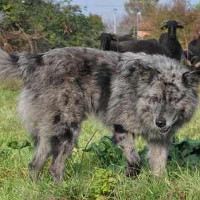
Typical colors : The basic colors are black, black on a wolf background. In the merle gene manifestation, there are even gray or gray-black patches of all gradations, even on a "wolf" background. In all versions, they can have white patches starting from the feet and chest, without exceeding 20% of the total body surface. | |
Size and weight |
||
Height at withers |
Males from 53 cm to 63 cm, females from 51 cm to 61 cm. | |
Weight |
Males from 20 kg to 35 kg, females from 17 kg to 28 kg. | |
Faults |
| • Any departure from the foregoing points should be considered a fault and the seriousness with which the fault should be regarded should be in exact proportion to its degree and its effect upon the health and welfare of the dog and its ability to perform its traditional work. • Faults listed should be in degree of seriousness. |
Shortcomings |
 Teeth tending to shear. Over-extended white coats. Teeth tending to shear. Over-extended white coats. |
General faults |
| Enognatism. Craniofacial axis divergence. Nasal reed or montusa. Cryptorchidism, monorchidism. |
NB : |
| • Any dog clearly showing physical or behavioural abnormalities shall be disqualified. • The above mentioned faults when occurring to a highly marked degree or frequently are disqualifying. • Male animals should have two apparently normal testicles fully descended into the scrotum. • Only functionally and clinically healthy dogs, with breed typical conformation should be used for breeding. |



 English (United Kingdom)

Comments