Appearance of the Australian Bandog
|
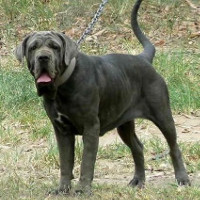
| The Australian Bandog has a short, hard coat and a long, tapering tail. Color-wise, its coat is usually brindle or black, but has also been found in tan, fawn, red, white and cow-colored patches. The Australian Bandog's coat should be short, fine and medium, in a variety of colors such as brindle, black, tan, fawn, red and can be accented with white and colored cow patches. However, all-white or predominantly white dogs are not considered desirable. The Australian Bandog's coat is easy to care for, and can be brushed occasionally with a rubber brush to remove dead hairs. |
Temperament of the Australian Bandog
|
The Australian Bandog is described as having an American canine temperament. This means it has a high stimulation threshold and a pack mentality, with no desire to assert its rank. When properly bred, this temperament makes them trustworthy around children, making this dog a self-proclaimed babysitter. Full of the spirit to play and work, the Australian Bandog is calm, composed and easy to get along with in its downtime. He won't fear or worry when meeting other people or other dogs, is very tolerant and recovers quickly from stress. Good-tempered and extremely social, the Australian Bandog is devoted to its owner and eager to work. If you raise him as a puppy, he'll get on well with other pets. As long as you treat the Australian Bandog with respect, it will become a protective, caring and loving member of your family.
The Australian Bandog will switch from its calm state when a bad situation arises. This makes him an exceptional guard dog and an intruder's worst nightmare. He doesn't bark before attacking, which gives him the element of surprise. This breed has an uncanny ability to discern between general human activity and suspicious or aggressive behavior. It has a good balance between motivation and self-confidence, making it a very predictable and stable dog. The Australian Bandog can move from one suppleness to another with little prompting. So it takes an experienced handler to discern the change before it happens. But don't be put off, this breed's impulses don't favor external aggression, but it's important to be wary of this dog's abilities when threatened. As a puppy, the Australian Bandog can be agitated, which may be related to the maturation rate of larger breeds, as well as to its environment and upbringing. This dog is recommended for those who have experience with the breed, so that it can be shaped and nurtured according to its individual traits and behaviors. |
Needs and activities of the Australian Bandog
|
The Australian Bandog requires moderate exercise, but if you don't provide enough physical and mental exercise, your dog will be upset if left alone, difficult to control and destructive. What's more, if the Australian Bandog doesn't get enough exercise, he can be quite lazy. This breed generally needs around 45 minutes of exercise every day to stay healthy and happy. Even though it's a larger dog, the Australian Bandog can do well in an apartment if properly exercised. The ideal situation for this breed is a house with a large fenced-in yard. What's more, even though this dog loves his daily walk outdoors, you shouldn't let him live outside; he needs to stay with his owner indoors.
Although the Australian Bandog is an extremely intelligent dog and trains easily, it needs an experienced owner. When you start training your Australian Bandog, make sure you become the pack leader. If you don't take control of this breed of dog, expect considerable damage to your home and garden. As he likes to be active, you'll need to provide an opportunity for exercise during the day. When training the Australian Bandog, being firm and consistent is the best way to ensure that this breed becomes obedient. The Australian Bandog is an attentive breed and will respond to your every request. Once you've defined your role as pack master, you'll find it much easier to train this breed. |
Maintenance of the Australian Bandog
|
Grooming an Australian Bandog is fairly easy, as this is a short-haired breed. It's a good idea to train your puppy to stand still for brushing and grooming. Not only is this a great way to bond, but it will be easier for you once your dog weighs over 45 kilos. At first, your puppy may not like to be groomed. Be patient, and with a little kindness, your dog will soon love the practice, as long as you're calm and consistent. Start by brushing your puppy for a few minutes a day for a week or two, then gradually increase the grooming time. Be sure to brush your Australian Bandog regularly to rid it of dandruff, dead hair and dust. And when you brush your dog regularly, it reduces shedding, prevents skin infections and improves that annoying doggy smell.
When brushing, use a stiff bristle brush, a rubber brush or a dog glove. If you don't have a brush handy, use your hand. Simply wet your hand and run it along your Australian Bandog. After a good brushing, you can rub your dog's coat with a cloth to give it a shine. And grooming doesn't just mean brushing teeth, it also includes the occasional bath, eye and ear cleaning and nail trimming. While you don't have to do these things every day, you should always check your Australian Bandog's eyes and ears regularly. Another tip to help reduce shedding and doggy odor, you should bathe your Australian Bandog occasionally. Make sure you don't do this too often, as it can harm their skin. You'll find that once a month is usually fine, unless your dog really starts to smell. |




 English (United Kingdom)

Comments