 |
Australian Bulldog |
|
He is not recognized by the F.C.I. |
Origin |
Australia | |
Translation |
Francis Vandersteen | |
This breed is also known as |
Aussie Bulldog |
A brief presentation of the Australian Bulldog |
| The Australian Bulldog is a proud dog with an easy-going nature that loves spending time with its family. They love to play and are kind and gentle with children. Intelligent and loyal, Australian Bulldogs respond well to training and are easy to teach. Although they make an alert and active watchdog, they are not a defense dog. They are not aggressive towards other people or animals, and have a stable, gentle temperament. If you work at home, the Australian Bulldog will be your constant companion, seeking affection and comfort from their owners. The Australian Bulldog resembles a Bulldog, but has been influenced by cross-breeding with other breeds such as the Bullmastiff and Boxer. They were created specifically for the unique Australian climate and terrain. Friendly, sociable and reliable, the Australian Bulldog is a true companion and friend. |
History of the Australian Bulldog |
| The Australian Bulldog is a recent breed developed with the aim of several breeders to create an Australian Bulldog that could excel in Australian terrain and climate. Early development began with the work of Pip Nobes of the Nobes, and Noel and Tina Green of Jag, both of whom had extensive experience in this field. Many breeders were involved in the process of creating this new version of the Bulldog. They wanted a dog that could take on many roles, such as being a guard dog, a family companion and one that could excel in agility and obedience. This requirement was met thanks to the new Australian Bulldog's enduring structure, size and alertness, and the slightly longer muzzle that meant the dog had no respiratory problems and was more resistant to the extremes of heat and cold that exist in Australia. The breeds used to create this new breed included the English Staffordshire Bull Terrier, Bullmastiff, British Bulldog and Boxer. Each breed had something special to offer the new breed and, together, these traits were molded into the Australian Bulldog. Traits such as affection and beauty came from the British Bulldog, while the Boxer and Mastiff offered vigilance and a reliable watchdog. The Staffordshire Bull Terrier offered the required body structure with muscle tone and, again, alertness. It takes time to develop a new breed and make modifications where necessary. Cooperation between breeders was vital throughout the development. Fortunately, the breeders all made health a priority and didn't sacrifice it for appearance. In return for their efforts, they have produced a dog that is an incredible companion. |
Appearance of the Australian Bulldog |
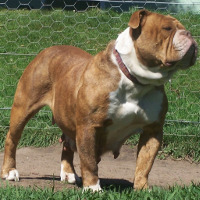
| A distinct Bulldog type, the Australian Bulldog stands out from similar breeds by being free from anatomical exaggeration. On the front, the muzzle is not as squashed as other breeds, allowing the dog to breathe freely. The Australian Bulldog has a more natural freedom of movement and great ease of motion. The head is broad but streamlined in appearance, with a broad nose that is not too wrinkled. The eyes are round and dark, with an alert, friendly expression. The Australian Bulldog's ears are medium-sized and fold back. The underside of the jaw is level, with ruffles hanging over the lower jaw at the sides. The teeth are covered and not obviously protruding. The body is solid, with a thick neck and deep chest. Legs are solid and strong, never bandaged or curved. With round, compact paws, a thick tail, often straight but sometimes a loose curl, and a smooth, sleek coat, this dog is both robust and attractive. |
Temperament of the Australian Bulldog |
| A solidly built medium-sized dog, the Australian Bulldog may seem fierce and imposing, but they are truly loving and affectionate animals. They are blessed with a healthy temperament and make ideal family companions. Australian Bulldogs love children and will take it upon themselves to watch what they do. This won't keep the kids out of trouble as the Australian Bulldog will probably associate with what they're doing too, but at least they're over there if help was needed. Their appearance may deter strangers from coming into the yard, but appearances are deceiving, as this dog will let you know, although they don't have the aggression to do more than bark and posture. The Australian Bulldog is intelligent and loyal, responds well to fair and positive training methods and has a personality you'll fall in love with. They may not have the best face in the world, but they have a heart of gold. This determined dog needs a firm but calm leader, compatible with training and commands. |
Needs and activities of the Australian Bulldog |
| The Australian Bulldog has moderate needs in terms of physical activity, requiring only a daily walk or perhaps a few family games. They also enjoy wading in water or chasing the hose. Extreme temperatures can affect them, but in a temperate climate, they're right at home. They are relatively easy to train, as they are willing to listen to instructions and please their master. Although this dog may seem formidable, he loves his family and the time he spends with them is what he wants most. Daily physical and mental exercises to challenge the dog will prevent any behavioral problems. They love garden yards and are not suited to apartment living. However, they are adaptable as long as they're with their family, and will happily settle down anywhere, as long as they can always snuggle up to you. |
Maintenance of the Australian Bulldog |
| The Australian Bulldog is a low-maintenance dog, with a short, clean coat that only needs brushing once a week. This dog always looks dapper, with a close-fitting coat and an elegant yet robust shape. They rarely need a bath unless they've rolled in something stinky. All they need is a wipe down with a soft, damp cloth. Grooming is a great opportunity to enjoy quality time that your Australian Bulldog will appreciate. Train him when he's young to let you brush his teeth and trim his nails, an action that will pay off later when they're more mature and weigh over 70 kilos. Don't forget to check inside the ear to make sure there's no inflammation or dirt. |



 English (United Kingdom)

Comments