
 |
Bankhar |
|
He is not recognized by the F.C.I. |
Origin |
Mongolia | |
Translation |
Francis Vandersteen |
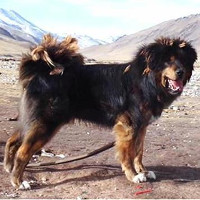
| Historically, the Bankhar was an inseparable part of the nomadic herder's life. The traditional greeting when approaching a Mongolian ger is to say "Hold your dog!". In Mongolia, Bankhar dogs are believed to be "of the same spirit" as humans, and dogs are the only animals to have been given a name. When a Bankhar dies, its remains are usually placed on top of a mountain, so it's closer to the gods and the spirit world, and so people don't walk on its bones. It is believed that humans can be reincarnated as dogs and dogs as humans. At death, a dog's tail is cut off so that if its spirit is reborn human, the human has no embarrassing tail. Dogs were and are an enormous source of pride for nomadic families. Unfortunately, over the last 80 years, modern breeds have been introduced to Mongolia. Bankhars, historically the only dogs in Mongolia, are now very rare. Bankhar dogs are an ancient breed, not a breed but a type of dog formed by thousands of years of co-evolution with humans, driven by the need for an efficient guardian of livestock on the Mongolian steppe. Bankhars are big, athletic, protective and need relatively little food for their size. They are perfectly adapted to Mongolia's intense ecosystems. The Bankhar may also be the ancestor of all cattle guard dogs. Recent studies indicate the origin of the domestic dog in Central Asia around 15,000 years ago. Our DNA samples were used to support this hypothesis and in the paper (in press) on this study, Doug Lally was co-author, among others, with Professor Adam Boyko PHD of Cornel University. During Mongolia's communist era, which lasted from the 1920s to the 1990s, during which Mongolia was a satellite state of the Soviet Union, Bankhar dogs were released or exterminated when nomads were forcibly relocated to socialist colonies. In addition, Bankhar dogs were targeted because of the misconception that dogs transmit disease to people and livestock. Bankhar skins became fashionable for elegant Russian coats, and the larger dogs were killed to feed the growing dog coat industry. In general, the communist education system based in the Soviet Union led to a loss of knowledge about how to breed, train and employ livestock protection dogs. A current danger to the Bankhar population is cross-breeding with the fashionable Tibetan Mastiff. Mastiffs are genetically distinct from Bankhar and are not working dogs. The mixed Mastiff genes in the Bankhar gene pool have degraded the quality of the Bankhar working dog genes. A few pockets of true Bankhar dogs remain. The Mongolian Bankhar Dog project has identified these dogs using DNA testing and isolated them to breed the next generation of working Bankhar guard dogs. Livestock Protection Dogs (LPDs) have been used by humans for millennia to protect herds of cattle and domestic goats from predators. The effectiveness of LPDs in reducing livestock predation is well documented on every continent. Currently, over 50% of sheep farmers in the western USA use livestock protection dogs as part of their management programs. The Bankhar, like many other livestock guarding dogs across Asia and Europe, is not a breed, but a "Landrace". A landrace is a domesticated animal species that has developed over time by adapting to its natural and cultural environment of agriculture and pastoralism. This is an essential distinction of the word breed. Bankhar dogs have evolved and co-evolved with humans to adapt to a very particular niche. The reason a Bankhar dog looks and behaves the way it does is to maximize its efficiency and effectiveness as a working livestock protection animal. This means that Bankhar near Kazakhstan will have more influences from dogs in Kazakhstan (these are just the natural regional variations of the Central Asian Ovcharka, not to be confused with the modern show breed of the same name). The same applies to Tibetan guardian dogs. It is this continuum of traits and a continuous gene flow that keeps genetic diversity high. High genetic diversity ensures that dogs are able to adapt to changes or roles effectively, while helping to avoid deleterious recessive genes being expressed in the population or in an individual. It is our policy to avoid referring to the Bankhar as a breed and not to distinguish it substantially from other forms of the great land breed of dogs, from Spain to Mongolia. We feel it is important that our dogs represent the naturally developed variations of the Bankhar found in Mongolia. We use DNA analysis to ensure that our dogs have no modern dog breed genes. However, we do not distinguish genes from "neighboring" natural dog types, as these genes have always moved in and out of the Bankhar's genetic make-up. Females measure 66 to 74 centimetres at the withers, and males 71 to 84 centimetres at the withers. Females weigh from 36 to 41 kilos, and males from 38 to 57 kilos. All colors are visible, but white is rare. The most common is black and mahogany, with mahogany "eye patches" over the eyes and a white patch on the chest. The Mongolian dog is said to have four eyes, but tannin, brown and black and white are also common. Mongolians traditionally like darker "four-eyed" dogs, as it helps them distinguish their dogs from wolves. The "extra" eyes are also thought to see into the spirit world. The Bankhar's coat tends to be very full and long (3-4 inches, or about 9 centimeters) in winter with a very heavy undercoat. However, due to Mongolia's vastness and climate variation, the Bankhar seems to have a plastic reaction to climatic conditions and does not thrive in warmer regions. This is of course relative, as Mongolia is one of the coldest places in the world, with temperatures ranging from 43° C to -48° C (110° F to -55° F), with an annual average of 31° F (-1° C). These dogs are built lighter and more athletic than their close relatives the Tibetan Mastiff or Central Asian Ovcharka. DNA analysis by Cornell University shows that the Bankhar has a very high genetic diversity (linked to the primitiveness and high gene flow between regional "breeds" of a Landrace versus the reduced genetic diversity of breed development). Bankhars are relatively long-lived. Examples of 15-18 year old dogs working with nomads in the field are not uncommon, this is of interest as most Bankhar never receive veterinary care and eat only boiled cattle entrails, rice or noodles and bones. Bone diseases such as hip dysplasia appear to be very rare. This could be an artifact of survival, i.e. if a dog had problems it wouldn't do so in Mongolia, however nomads have never seen any problems that could be explained as a bone disorder. Our experience and data show that the Bankhar breeds once a year in Mongolia (one of the coldest countries in the world). However, we do not assume that they breed more than once a year in a less hostile climate. Bankhars, like most livestock guard dogs, have an independent character and tend to think for themselves. They are very loyal to their charges and protect them with their lives. They don't tend to be dogs that chase predators over long distances, but will attack predators without hesitation if the predator doesn't back off or leave the area immediately. Bankhars are not very aggressive towards people unless bred to be so. Once introduced, a functioning Bankhar will typically ignore a human and return to its protective work. The Bankhar will not let people near their charges unless accompanied by a human the dog trusts. Well-bred and socialized with people, Bankhar is like any other pet dog, trustworthy and part of the community. |



 English (United Kingdom)

Comments