Perdiguero Navarro

He is not recognized by the F.C.I.

Origin
Spain
Translation
Francis Vandersteen
This breed is also known as
Pachon Navarro

A brief presentation of the Perdiguero Navarro

Calm, intelligent, strong and loyal, the Pachon Navarro is a friendly dog born to hunt with its master. They are hard-working dogs with floppy ears and mouths that give them a solemn appearance that is dissipated by their warm brown eyes. The breed was developed in Spain and is easy to recognize thanks to its unique double nose. The nostrils are separated by a strip of skin and have a deep slit that divides the nose. It's like looking at the business end of a double-barreled shotgun. As well as hunting or partying in the countryside, this dog is an ideal family dog. They are affectionate and fun-loving, have good relationships with other dogs and are gentle and kind with children. Nothing escapes their keen eyes and they'll warn you of strangers, but in general, the Pachon is a calm dog. Other smaller animals or birds don't fare as well, as Pachons are bred to hunt and flush them out. Although they can get along well with cats and other small animals if bred with them, they should not be trusted, as their chase instinct can intervene at any time. This dog is best suited to places where they have a large yard, the farm being the ideal place, especially if the owner likes to hunt. The Pachon Navarro loves to be with its people and will pout if left alone outside. They're part of your pack and want to be included, pampered and loved.

History of the Perdiguero Navarro

The Pachon Navarro first appeared in history in 12th century Spain, at a time when it was fashionable to develop various varieties of hunting dogs in Europe. Every breeder and club had its favorites, and many new breeds were quickly developed. The Pachon was no different, with the exception of their unique double nose, often referred to as the business end of a double-barreled shotgun. We can only guess how this nose arrived, as documentation of the breeding line is lost in time. In the 19th century, it was decided to divide the different breeds into groups, with a dedicated group of breeders lining up around the group that interested them. Then, in 1922, the Pachon Navarro was officially recognized as the breed standard. Unfortunately, disaster struck in the 1950s when a virus called myxomatosis almost wiped out the Pachon. This, combined with earlier losses in the Spanish Civil War, decimated the number of dogs. In fact, many people thought the breed had been wiped out, but in 1970, a handful of dogs were found in remote villages. Pressure on Madrid's Central Canine Society led to the launch of a survey of Spanish breeds, with the aim of finding and saving the various breeds on the brink of extinction. Today, the Pachon Navarro is still in recovery mode, fighting to secure its place among today's many breeds. The aim is to promote the dog's growth without altering the breed, a noble and virtuous objective.

Appearance of the Perdiguero Navarro

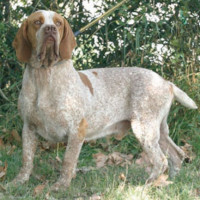
The Pachon Navarro is a large breed of dog with great strength and stamina. The Pachon can weigh over 60 kilos and was developed to meet the need for an agile hunting companion. They have a rectangular body shape, a thick, muscular neck and short but sturdy legs. Most of this breed are short-haired, although some rare dogs have long silky hair. The skin can be quite loose around the neck, often resulting in a double chin. The Pachon Navarro has a solid boxy skull, broad forehead and expressive eyebrows. A long muzzle and hanging mouth give them a serious, almost somber air, but their soft, warm brown eyes immediately dispel this impression. Long, floppy ears sit low on their heads, but it's their noses that set them apart. Most Pachons have a double nose. This nose appears to be a normal nose, but has two large, distinct nostrils separated by a strip of skin that divides the nose. It is claimed that this nose made them superior hunting dogs, but this remains to be proven. They come in various colors ranging from black and white, brown and white, dark brown (liver) and white, and rich orange and white. They may also have freckles on their coats. Noble and serious dogs, they are devoted and loyal companions and excellent hunting dogs.

Temperament of the Perdiguero Navarro

The Pachon Navarro is a gentle, gentle dog, devoted to its family and master. They like to be active, and large, open spaces suit this dog, giving it plenty of room to explore. Apartment living is not for them, as there's not enough room for this big, active dog. The Pachon is well suited to their purpose as a hunting dog. They have the determination and patience needed to hunt game and birds, but are obedient and loyal to their master. Daily exercise is important for this dog. They need to get out and do something, not just laze around on a terrace, although they will let themselves go if the opportunity arises. Although they have a somber appearance, Pachons are happy, playful dogs. They'll take part in family games and enjoy fetching and playing rope or other games. Don't lose your muscles, this dog is a good player for you in a game that requires strength. The Pachon Navarro is a devoted pet and will sulk if left outside. They want to be inside with you and the family because that's where they believe they belong, part of your pack. Adorable as puppies, they grow into beautiful, mature dogs with great natures and loving personalities.

Needs and activities of the Perdiguero Navarro

These unique Spanish dogs are renowned for their ability to hunt small game and birds. They love open spaces and do best in a home with plenty of room to move around. Apartments can't provide this space and, although the Pachon Navarro is adaptable, it's not fair to confine them so much. They like to be busy and need plenty of daily exercise to stay healthy. They are closely bonded to their family and are affectionate and playful at home. Games where they have to follow and find an object would be perfect for this dog, as would long walks along the beach or country road. Although they're a big, sturdy dog, they're kind and gentle with children and protect them although they're not aggressive. Keep them on a leash when out and about, as a newly scented trail could lead them astray. Pachon Navarro respond well to training, as they are both intelligent and eager to please. They mix well with other people and dogs, and are hard workers who will serve their owners well.

Maintenance of the Perdiguero Navarro

Pachons Navarro are considered low-maintenance, requiring only a weekly brushing and perhaps a wipe with a damp cloth to give them a dapper appearance. Brushing will remove hair and dirt, or help during those moments when they lose their coat. If you bathe your Pachon Navarro, a mild dog shampoo will be gentler on the skin than a human product. With long, floppy ears, you'll need to check the inside frequently and gently wipe the inner ear to avoid inflammation from dirt and debris. Also, when brushing, don't forget to check for fleas, to which this dog is highly exposed. Staying on top of this will prevent health problems. Finally, check his eyes to make sure they don't hurt, brush his teeth 2-3 times a week, trim his nails and your Pachon Navarro is ready for action.

Comments

Latest page updates

  • Telomian

    Telomian He is not recognized by the F.C.I. Origin Malaysia Translation Francis Vandersteen A brief presentation of the Telomian The Telomian is a very rare breed of dog, and the only one native to Malaysia to have been bred outside the country. They were originally bred by the indigenous people of Malaysia to combat parasites such as snakes, rats,...
  • King Wheaten -- Cavalier King Charles Spaniel X Irish Soft Coated Wheaten Terrier

    King Wheaten He is not recognized by the F.C.I. Origin Great Britain <> Ireland -> U.S.A. Translation Francis Vandersteen A brief presentation of the King Wheaten The King Wheaten is a small dog with a heart this big and a playful disposition. Borrowing the energy and soft-coated waves of the Irish Soft Coated Wheaten Terrier and the size and...
  • Spanierd -- English Springer Spaniel X German Shepherd

    Spanierd He is not recognized by the F.C.I. Origin Great Britain <> Germany -> U.S.A. Translation Francis Vandersteen A brief presentation of the Spanierd The Spanierd is a hybrid dog. Its parent breeds are the English Springer Spaniel and the German Shepherd. They have an affable personality. He's known for entertaining family and friends with his...
  • Alaskan Goldenmute -- Alaskan Malamute X Golden Retriever

    Alaskan Goldenmute He is not recognized by the F.C.I. Origin U.S.A. <> Great Britain -> U.S.A. Translation Francis Vandersteen This breed is also known as Alaskan GoldenGoldenmuteAlaskan Gold Retriever     A brief presentation of the Alaskan Goldenmute The Alaskan Goldenmute is a descendant of two great dog breeds: the Alaskan Malamute and the Golden...
  • French pointing dog Pyrenean type

    French pointing dog Pyrenean type FCI standard Nº 134 Origin France Translation Mrs. Peggy Davis Group Group 7 Pointing Dogs Section Section 1.1 Continental Pointing Dogs « Braque » Type Working With working trial Acceptance on a definitive basis by the FCI Tuesday 18 January 1955 Publication of the official valid standard Tuesday 01 August 2023 Last...
  • French pointing dog Gascogne type

    French pointing dog Gascogne type FCI standard Nº 133 Origin France Translation Mrs. Peggy Davis Group Group 7 Pointing Dogs Section Section 1.1 Continental Pointing Dogs « Braque » Type Working With working trial Acceptance on a definitive basis by the FCI Monday 17 January 1955 Publication of the official valid standard Tuesday 01 August 2023 Last...
  • Vucciriscu

    Vucciriscu He is not recognized by the F.C.I. Origin Sicily Translation Francis Vandersteen En français, cette race se dit Vucciriscu Diese Norm ist in deutscher Sprache sichtbar Vucciriscu En español, esta raza se dice Vucciriscu In het Nederlands, wordt dit ras gezegd Vucciriscu This breed is also known as Sicilian Vucciriscu Sicilian Butcher...

© 2026 Groupe Milouchouchou ASBL. Tous droits réservés. En savoir plus

Protected by Copyright01
We use cookies

We use cookies on our website. Some of them are essential for the operation of the site, while others help us to improve this site and the user experience (tracking cookies). You can decide for yourself whether you want to allow cookies or not. Please note that if you reject them, you may not be able to use all the functionalities of the site.

Ok