
 |
Penn-Marydel Hound |
|
He is not recognized by the F.C.I. |
Origin |
U.S.A. | |
Translation |
Francis Vandersteen |
A brief presentation of the Penn-Marydel Hound |
| The Penn-Marydel Hound is a variety of American Foxhound developed in the states of Pennsylvania, Maryland and Deleware, from which its name is derived. This breed or strain of dog is a motivated and hardy hunter when chasing a fox or coyote with a deep bay that can be heard for miles, but they are generally playful and friendly at home. This particular variety of American Foxhound has been classified as a separate breed by the Masters of Foxhounds Association since 2008, but is still listed as a lineage of American Foxhounds with all the major kennel clubs. |
History of the Penn-Marydel Hound |
| The Penn-Marydel Hound is one of many varieties of the American Foxhound that were developed in the 19th and 20th centuries to hunt red fox and coyote more effectively. There were many different breeders in the eastern and southern states breeding American Foxhounds at this time, including the Running Walker strain and the Trigg strain from Kentucky, and the July Hound, developed in Georgia from a puppy bred and born in Maryland. Meanwhile, an American Foxhound strain from the Pennsylvania, Maryland and Delaware region began to emerge as notable hunters, and from 1934 onwards, the Penn-Marydel Association was formed to preserve the line. The original pedigree book for these dogs dates back to 1933, and for a dog to be considered a registered Penn-Marydel Hound, they must be able to trace at least five generations of breeding in this pedigree book. In the early 2000s, breeders began working with the Masters of Foxhounds Association, which holds the herd books for hunting dogs across the USA, to determine what rules were necessary for the Penn-Marydel to be listed as a purebred dog rather than a specific strain of American Foxhound. Although the Penn-Marydel is not listed as a distinct breed by any of the major kennel clubs and is considered a specific strain within American Foxhounds, the Masters of Foxhounds Association began registering them as a distinct breed in 2008. |
Appearance of the Penn-Marydel Hound |
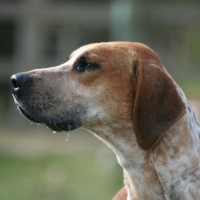
| The Penn-Marydel Hound is generally slightly longer than it is tall, with strong, straight legs and a well-muscled hindquarters. They are generally athletic and agile in order to track their prey, usually red foxes and coyotes, with a long tail that tapers towards the tip and can be held straight or have a slight curve or saber shape. They tend to have broad, slightly domed skulls with broad, square muzzles that are about the same length as the skull and taper slightly towards the end. A generally kind but alert expression can be seen in their eyes, which can be any color and can be almond, oval or even diamond-shaped, and their semi-long ears are set low and hang close to the head. Although many colors are possible, the most common colors for Penn-Marydel Hounds are white with large black and brown patches, often with ticking in the white areas of the coat. |
Temperament of the Penn-Marydel Hound |
| These dogs are hard-hitting, determined animals that are well suited to hunting red or gray foxes. They tend to be affectionate, playful and eager to please their families, but can be a little wary of strangers. They are also generally playful with children, and can prove too noisy for younger ones, so interactions need to be closely supervised. The Penn-Marydel is generally easier to work with in training than most Foxhounds as they have been bred for their submissive nature, however, like most American Foxhounds, the Penn-Marydel strain can be quite difficult to train. They get on quite well with other dogs as well as most animals they are bred with or socialized to, but they are bred with a strong desire to chase other animals, especially running ones, which can sometimes include cats and other pets. |
Needs and activities of the Penn-Marydel Hound |
| The Penn-Marydel Hound is an extremely active animal that needs plenty of exercise, at least an hour to an hour and a half a day of vigorous physical activity every day, in order to stay in top shape, both physically and mentally. If these dogs aren't offered enough activity throughout the day, they can be prone to problematic barking, separation anxiety and even destructive chewing. Because of their noisy bay and energetic nature, these dogs generally don't do well in small houses and apartments, generally preferring the space offered by larger homes with yards. |
Maintenance of the Penn-Marydel Hound |
| These dogs have a short, easy-care coat that is naturally somewhat weather-resistant. They should be bathed only when necessary, as too frequent bathing can lead to the removal of the coat's naturally protective oils, reducing its effectiveness. They shed moderately all year round, but a good brushing with a smooth brush or grooming glove once or twice a week will keep the coat shiny and supple. It's important to check these dogs' ears regularly for moisture, dirt and debris, as their hanging ears can make them more susceptible to ear infections than other dogs. |



 English (United Kingdom)

Comments