
 |
Arlequin Pinscher |
|
He is not recognized by the F.C.I. |
Origin |
Germany | |
Translation |
Francis Vandersteen | |
This breed is also known as |
Harlequin Pinscher
|
A brief presentation of the Arlequin Pinscher |
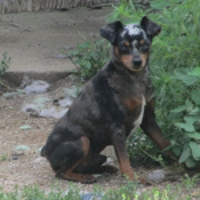
| The Harlequin Pinscher is a newly-developed breed that attempts to recreate a variety of dwarf Pinschers from the 1800s that sported coats with unusual patterns such as brindle, merle and piebald. Due to the serious and often fatal genetic defects that occur in offspring when two dogs carrying the merle gene are bred together, the first Harlequin Pinschers eventually became extinct. The ancestry of the original Harlequin Pinscher was lost when the breed was lost, but at the turn of the century, breeders began a painstaking development program using contributions from Rat Terriers to re-establish the breed. |
History of the Arlequin Pinscher |
| The Harlequin Pinscher, essentially a dwarf Pinscher that has been developed with a patterned coat, can be merle, brindle, piebald or any combination of these. The first attempts to create the Harlequin Pinscher took place in Germany at some point in the late 18th century, and some believe that the coloring was obtained by crossing with Dachshund dogs, although there's no way of knowing for sure as this original strain is no longer in existence. Breeding merle-colored animals must be done with extreme care, as breeding two dogs with merle genetics can result in serious, sometimes fatal, birth defects. Unfortunately, genetic defects began to appear in many patterned-coated dogs such as the Harlequin variety of the Miniature Pinscher, causing them to fall out of favor and fade away. Although these patterns were initially accepted in the breed standard, in 1958 the breed standard was updated with the inclusion that the basic colors black, red and brown would be the only colors accepted, and specifying that any white marking greater than one and a half centimeters in any direction. is a disqualifying marking. In the first part of this century, some breeders began the laborious process of bringing back the Harlequin Pinscher, but without the health problems. A plan was agreed in 2007 in which a merle-patterned Rat Terrier would bring merle genetics into the line, the offspring being bred to purebred Dwarf Pinschers. The seventh generation after the Rat Terrier's contribution is considered by the Harlequin Pinscher Society to be a pure-bred Harlequin Pinscher. Although the breed has not been recognized by any of the major kennel clubs, Harlequin Pinschers can be registered as such with the American Canine Association or the Dog Registry of America, Inc. |
Appearance of the Arlequin Pinscher |
| The Harlequin Pinscher is a small dog, the largest measuring just over 30.5 centimeters in height and looking rather like a deer. Most have a square profile, the back being about as long as the dog is tall, although some Harlequins can be a little long in the leg. They have elongated heads that are broad and flat towards the ears, tapering forward towards the muzzle, which is also somewhat tapered. The eyes of this breed can be blue, brown or green and even bi-colored on occasion, and their triangular ears that stand upright tend to be a little large in relation to their heads. While their hind legs are angulated, the front legs must be completely straight, and the Harlequin Pinscher's feet are compact with slightly arched toes. The main physical difference between the Harlequin Pinscher and the more traditional Miniature Pinscher is coloring, as all brindle, merle and piebald markings are intentionally derived from the Miniature Pinscher breed. |
Temperament of the Arlequin Pinscher |
| These dogs are generally very curious and lively, with a strong sense of loyalty to their chosen human. Although their playful, alert nature makes them excellent companions for older children, interactions with toddlers and young children must be closely supervised to ensure that the dog is treated gently. They are naturally wary of strangers and other dogs, but this trait can usually be mitigated somewhat by appropriate socialization. Harlequin Pinschers are also quite intelligent and thrive on a regular training regime, but when not given proper training and boundaries, they can succumb to small dog syndrome and become vocal, demanding and stubborn. Although they respond well to most facets of training, they are notoriously difficult to train. Beware, this small dog will chew small objects and may choke on them. |
Needs and activities of the Arlequin Pinscher |
| Although the Harlequin Pinscher is very lively and does its best with frequent activities and interactions throughout the day, it doesn't need these activities to take up a lot of time as long as they are mentally stimulating and can often be handled indoors, as these small dogs don't need much space. They also make decent apartment dwellers, provided they're not left to their own devices too often, as they can become quite noisy if they develop separation anxiety. However, it's important not to overfeed these little dogs, as an excess of calories in their diet can easily lead to obesity. |
Maintenance of the Arlequin Pinscher |
| The Harlequin Pinscher's coat is generally very easy to care for. The short, coarse fur tends to wick away dirt and dust, and these dogs have very little doggy odor, so bathing is only really necessary if they get into something, and can often be replaced by a simple rub down with a warm, damp washcloth. Brushing your dog with a smooth brush or grooming glove once every week or two is usually enough to help control shedding and keep the coat healthy and shiny. Small dogs and toys such as Harlequins and Miniature Pinschers are sometimes more prone to dental problems than larger dogs, and dental hygiene should be started early and maintained throughout their lives. |



 English (United Kingdom)

Comments