 |
Hairless Khala |
|
He is not recognized by the F.C.I. |
Origin |
Bolivia | |
Translation |
Francis Vandersteen |
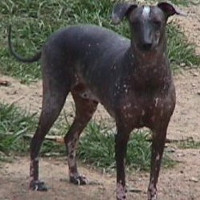
| From the American Khala Association's breed standard, the hairless dog is native to Mexico in Central and Latin America, and almost all Latin countries have a variety, either medium-sized or the rather heavy "pottery" type. The difference between the two is more substance than height, both types can and do appear in the same litter and no attempt has yet been made to breed selectively for one type or the other. The dogs are known by different names, even within the same country. Only recently have we classified them under the name Khala, which is the Bolivian Quechua Indian word meaning "without clothes". The Peruvian Quechua word for the breed is "caa allepo", meaning "without clothes". In other countries, Indian names translate the same way, which would indicate a difference of dialect rather than breed: the Khala is a naturally healthy, warm-hearted animal that survives without being pampered from high in the Andes with the people, and shares their meager existence with affection and a willingness to do what is common to most unrefined dogs. Like their man's family tree, Khala pedigrees are rarely written down and are more common knowledge and talk by villages, to know the names, and much more, of parents, grandparents, etc., of several generations. An effort is being made in several countries, notably Argentina, Bolivia and Peru, to track and record the pedigree and exchange of breeding stock between geographical locations. Export to the USA and Europe is limited but not impossible. There are two types of hairless Khalas: the hairless Khala Medio (short-legged, also known as the pottery type) and the hairless Khala Grande (long-legged or sighthound). The Medio is a medium-sized dog, powerful yet graceful. The Grande gives the impression of a greyhound, well coordinated and able to move with ease and agility. Color is immaterial, but most Khalas are dark gray when mature. Loving and docile with family and friends, the hairless Khala can be aloof, even hostile with strangers, so it needs to be socialized well. They are tolerant and happy with pets. Owners need to show gentle but firm authority over the dog. With the right leadership, they will accept other dogs. They tend to walk (or run away) from serious confrontation, which is good because they have no hair and adult teeth are generally rare. When frightened, they freeze... which is great for piling into the ring. A primitive breed, they need very little care, but require an owner with doggy experience to understand them. Generally speaking, due to the loss of protection provided by the hair and good dentition, escape is preferable to fight. The Khala tends to identify very closely with others of its kind (most hairless dogs) and is happiest when there are at least two in a house. Don't let this dog develop small dog syndrome, human-induced behaviors where the dog believes he is pack leader to humans. This can cause varying degrees of behavioral problems. Of necessity, Khalas are a naturally healthy breed. In their countries of origin, veterinary care is rarely available or affordable to the Indian peasants with whom the dogs live. As with most hairless dogs, adult dentition is very poor. The root system is shallow and even puppy teeth are primitive. Coats and sun protection may be necessary, depending on the weather, although little is provided in their native country, where they live from the top of the mountains to the edge of the sea. One Khala owner/breeder says: "When the temperature is too extreme for them, whether hot or cold, they let you know (each of us has a full wardrobe of sweaters and sweatshirts with a different color for each dog, I take a sweater in the dog's color. If I don't go for the dog clothes, one ... or all ... I'll get myself a sweater and they bring their own, they're strange ... and I'll never believe again that dogs can't see colors. A fenced yard is suggested as, being a hunting dog, the Khala tends to hunt without thinking. This breed needs to be taken daily. When walking, make sure the dog's heels are beside or behind the person holding the leash, never in front, as instinct tells a dog that the leader leads the way, and that leader must be the human. An occasional bath. Khala's nails are described as "heavy claws a little longer than most breeds" and the dogs are very sensitive and resistant to their size. Height at withers : for the medium, 36 to 41 cm; for the large, 43 to 51 cm. Weight : medium from 6.8 to 13.9 kg, large from 8 to 13.5 kg. |



 English (United Kingdom)

Comments