Lakota Mastino

He is not recognized by the F.C.I.

Origin
U.S.A.
Translation
Francis Vandersteen
This breed is also known as
Supernatural Bandogge
Light Mediterranean Mastiff
Shiloka's Bandogge

A brief presentation of the Lakota Mastino

The Lakota Mastino is a type of Bandogge. The concept and use of the Bandogge predates most of today's "established breeds". Breeders did their best for thousands of years to produce functional working dogs that farmers and their families could rely on. The old Bandog breed was a beautiful, powerful, athletic and very capable working dog that was revered and respected by families the world over. The Bandogge is not a new breed and has been produced for thousands of years. Originally a cross-breed (most breeds are originally a cross-breed), the concept of the Bandogge, which is the crossing of two superior breeds with a specific purpose and function in mind, is as old as canine history. Ever since man first emerged from the caves to hunt wild beasts for food, we've been harnessing the abilities of domestic dogs to help us survive. The Mighty Lakota Mastino was (re)created in the early 1990s by Jonothan Shiloka, top breeders, judges and shaman. Shiloka used only Colby & Carver "Bulldog", a working strain of Mastiff and Neapolitan Bandogges. The aim was to use only the best lines of working dogs, successfully establishing a line that possessed superb drive, stable temperament, good health and remarkable agility and trainability.

History of the Lakota Mastino

The roots of the Lakota Mastino Bandogge go back more than 400 years, to the period of Spanish exploration of the New World, in particular the Gulf Coast and the southern parts of the East Coast of the United States. During these expeditions, the Spaniards were accompanied by "war dogs", believed to be Mastiffs and Bulldogs. These dogs helped with hunting, guarding camps and fighting. Hernando DeSoto had traveled from Florida to Louisiana, bringing with him the "war dogs" that had made the journey to the New World. The breeds that came to be known as "war dogs" were Bandogges. After suffering defeat in battle, DeSoto abandoned his war dogs, who were allowed to roam free. Some of these dogs were wounded or abandoned and were captured by Native American warriors. They bred "Wolf Killers" and were crossed and the offspring of the different breeds were used by different Indian tribes to protect their chief, hunt wild game, protect horses and the tribe from boar attacks, crossing the bush and hot. The natives around Florida and much later, the Lakota tribe bred these dogs, adopting them in all aspects of their daily activities. These Bandogges became known as "Lakota Mastino", and were the companions and protectors of Native American warriors and the personal companions of chiefs. They were used to locate and catch wild game, in the same way that hunters use their dogs to catch wild boar today. Although Bandog breeders today disagree on which breeds went into the original Bandogge breeding program, the general compromise is that it was 50% working Bulldog, and 50% very large, molosser type. Through selective breeding for type and ability, relentless breeding, best for best for at least 6 generations, for a homogeneous type to start breeding true and producing greatness.

Appearance of the Lakota Mastino

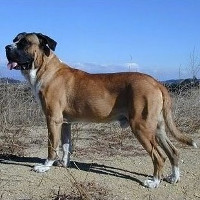
The Lakota Mastino is a large dog, with a very muscular, yet agile body built for working dog sports. The skull is broad, strong and muscular, with extra skin. The stop is rather abrupt. The nose is broad and black, red or any color. The muzzle is moderately long, with a straight nasal bridge. Jaws are powerful, with upper and lower jaw strength. Teeth are super-strong with a scissor bite. The eyes are intense when alert, of any color, with a dignified expression. Ears are naturally small, rather thin, set high on the skull or with a working dog crop. The neck is thick and muscular, with a dewlap. The body is muscular, long and low for long-distance running. The withers are high. The back is level and straight. The tail is high, thick at the root, reaching to the hocks, tapering at the end. May or may not be docked, depending on the breeder. Shoulders are moderately sloping. Forearms are large, moderately long and strong. The hindquarters are powerful and capable. The Lakota Mastino has a short, dense coat, permitted in all colors, but preferred in shades of black, blue and brindle, with or without small white markings. Double tracking, powerful, capable of cadence for long distances.

Temperament of the Lakota Mastino

The Lakota Mastino is a big, strong dog, lighter and more agile than the modern neo, and more powerful than most bouleDogues. The most important characteristic of the Lakota Mastino is its stable temperament. Driven, energetic and highly intelligent, this courageous breed is highly trainable and excels in sports such as personal protection, pull-weight, Mondio Ring and similar activities. The Lakota Mastino shows strong prey and defense attacks, and has a temperament perfect for working dog training tasks and is highly intelligent. Its temperament is marked by patience, composure, boldness and courage. He is energetic and willing to be active. Careful, he's on the lookout and attentive to his environment. A Lakota Mastino should be aware of what's going on around him. It may be the glance or a quick glance, but few things go unnoticed. When working, he is determined and resolute in a decision and maintain an intense and constant focus on the task at hand. This breed is fearless and will face the unknown with a confident, steady attitude. Alert and aware of the environment and ready to respond. Loyal, with loyalty to its master; it has the desire to give 100% without question and remains firm in defending and supporting its master's needs. In the ring, obedience is a positive attitude towards the handler and a desire to please. Stability, confidence, courage, neatness, toughness, sociability and sensitivity are characteristics for which the Lakota Mastino is renowned.

Needs and activities of the Lakota Mastino

When training for protection, a dog should be brought along slowly to build confidence and understanding. A dog should not be hurt or frightened in order to elicit aggression. If neither prey nor defensive postures elicit a response, the dog either doesn't have the right reflexes or isn't mature enough to handle the job. Some owners inappropriately encourage aggression in their dogs outside of protection training. They don't. They sometimes fail to keep control of the dog, often delighting in their dog's macho behavior. Working dog training will not change the dog's basic temperament. It will give you a good insight into the total temperament of the stressed dog. An angry dog will always be angry. A Lakota Mastino will always be stable and should demonstrate a high level of performance, ability and courage. As a property guardian, the Lakota Mastino is a calm, calculated and intuitive watchdog, but when it feels threatened and must protect its territory and the master's family from an intruder, the Lakota Mastino becomes an intimidating and convincing watchdog. safeguard its threats with quick and precise actions. The Lakota Mastino can be aggressive and on guard when needed, and the Lakota Mastino is a very stable and noble breed, making a wonderful family companion, gentle with children and totally devoted to its master and family. The perfect balance. He's an intelligent, calm dog, choosing his battles carefully and reacting only when necessary. Early socialization and proper training are very important, as is responsible handling, as the Lakota Mastino can sometimes be confronted with strange dogs without him. Fairly playful and loving of its human family, the Lakota Mastino requires a lot of exercise and leadership. Bred with other pedigree dogs and small animals, this beautiful breed accepts them as part of its pack. This breed is not for the passive owner who has no intention of working the dog. It needs a strong leader who understands the dog's behavior.

Maintenance of the Lakota Mastino

These giant short-haired dogs are easy to groom. Remove loose, dead hair with a rubber brush. This breed is a medium excretor.

Comments

Latest page updates

  • Telomian

    Telomian He is not recognized by the F.C.I. Origin Malaysia Translation Francis Vandersteen A brief presentation of the Telomian The Telomian is a very rare breed of dog, and the only one native to Malaysia to have been bred outside the country. They were originally bred by the indigenous people of Malaysia to combat parasites such as snakes, rats,...
  • King Wheaten -- Cavalier King Charles Spaniel X Irish Soft Coated Wheaten Terrier

    King Wheaten He is not recognized by the F.C.I. Origin Great Britain <> Ireland -> U.S.A. Translation Francis Vandersteen A brief presentation of the King Wheaten The King Wheaten is a small dog with a heart this big and a playful disposition. Borrowing the energy and soft-coated waves of the Irish Soft Coated Wheaten Terrier and the size and...
  • Spanierd -- English Springer Spaniel X German Shepherd

    Spanierd He is not recognized by the F.C.I. Origin Great Britain <> Germany -> U.S.A. Translation Francis Vandersteen A brief presentation of the Spanierd The Spanierd is a hybrid dog. Its parent breeds are the English Springer Spaniel and the German Shepherd. They have an affable personality. He's known for entertaining family and friends with his...
  • Alaskan Goldenmute -- Alaskan Malamute X Golden Retriever

    Alaskan Goldenmute He is not recognized by the F.C.I. Origin U.S.A. <> Great Britain -> U.S.A. Translation Francis Vandersteen This breed is also known as Alaskan GoldenGoldenmuteAlaskan Gold Retriever     A brief presentation of the Alaskan Goldenmute The Alaskan Goldenmute is a descendant of two great dog breeds: the Alaskan Malamute and the Golden...
  • French pointing dog Pyrenean type

    French pointing dog Pyrenean type FCI standard Nº 134 Origin France Translation Mrs. Peggy Davis Group Group 7 Pointing Dogs Section Section 1.1 Continental Pointing Dogs « Braque » Type Working With working trial Acceptance on a definitive basis by the FCI Tuesday 18 January 1955 Publication of the official valid standard Tuesday 01 August 2023 Last...
  • French pointing dog Gascogne type

    French pointing dog Gascogne type FCI standard Nº 133 Origin France Translation Mrs. Peggy Davis Group Group 7 Pointing Dogs Section Section 1.1 Continental Pointing Dogs « Braque » Type Working With working trial Acceptance on a definitive basis by the FCI Monday 17 January 1955 Publication of the official valid standard Tuesday 01 August 2023 Last...
  • Vucciriscu

    Vucciriscu He is not recognized by the F.C.I. Origin Sicily Translation Francis Vandersteen En français, cette race se dit Vucciriscu Diese Norm ist in deutscher Sprache sichtbar Vucciriscu En español, esta raza se dice Vucciriscu In het Nederlands, wordt dit ras gezegd Vucciriscu This breed is also known as Sicilian Vucciriscu Sicilian Butcher...

© 2026 Groupe Milouchouchou ASBL. Tous droits réservés. En savoir plus

Protected by Copyright01
We use cookies

We use cookies on our website. Some of them are essential for the operation of the site, while others help us to improve this site and the user experience (tracking cookies). You can decide for yourself whether you want to allow cookies or not. Please note that if you reject them, you may not be able to use all the functionalities of the site.

Ok