 |
Nenets Herding Laika |
|
He is not recognized by the F.C.I. |
Origin |
Russia | |
Translation |
Francis Vandersteen | |
Working |
Without work test |
Usage |
| Traditional reindeer herding in native habitats, search and rescue service, companion dog. |
Preambule |
| Approved by the Standards Committee of the Russian Kennel Federation on December 23, 1999. The latest version of the standard for Nenets Herding Laika was approved by the RKF Scientific Committee on March 13, 2016. |
Brief historical summary |
| The Nenets Herding Laika is an aboriginal breed developed centuries ago for reindeer breeding by the Nenets of northern Europe and the Yamal Peninsula. Today, the breed is widely used in the traditional reindeer breeding areas of northern and northeastern Russia. The breed's functional conformation, compact size, high adaptability and well-developed sensory organs enable it to be used for purposes other than its traditional reindeer breeding function, notably for search and rescue and customs services. |
General appearance |
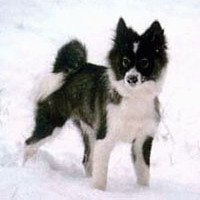
| Medium-sized, agile, durable and energetic. Like other spitz-type dogs, it has a wedge-shaped head, erect ears, thick coat and tail carried over the back. Strong build and substance. Well-developed muscles. Clearly pronounced sexual dimorphism. |
Important proportions |
| - In dogs, the length of the back is approximately the same as the height at the withers. Bitches may have longer backs. - The length of the muzzle is equal to or slightly shorter than the length of the cranial section. - Chest depth is about half the height at the withers. - Forearm length is equal to or slightly greater than half the height at the withers. |
Behaviour / temperament |
| The dog has a lively, agile temperament, is easily trainable, can be trained in various skills. Can be wary of strangers. |
Head |
||
Cranial region |
||
Head |
Medium-sized, proportionate to the body, wedge-shaped, moderately pointed. The upper line of the skull runs parallel to the muzzle. | |
Skull |
Moderately broad, almost flat between the ears. The length of the cranial region is equal to or slightly greater than its width. Slightly protruding forehead. Pronounced occiput. | |
Stop |
The transitions from forehead and cheeks to muzzle are well pronounced and enhanced by a gentle change in hair length. | |
Facial region |
||
Nose |
Medium colors, preferably black, but gray or light brown are acceptable. Brown coats have an attractive nose color. | |
Muzzle |
Muzzle tapers gently to the nose. Length of muzzle equal to or slightly shorter than length of cranial region. Bridge of nose straight. | |
Lips |
Dry, close-fitting, preferably fully pigmented. | |
Jaws and teeth |
Strong jaws. Sufficiently large white teeth. Front teeth evenly positioned. Scissor bite, direct bite acceptable. Missing premolars due to injury is not a reason for a lower score, a missing molar is acceptable but not desirable. A missing M3 is acceptable. | |
Cheeks |
Well pronounced, but not prominent. | |
Eyes |
Medium-sized, oval, slightly oblique, neither deep-set nor bulging, dark brown to hazel. A lighter coat can be matched by eye color of the same tone, although brown is preferable. Brown coats should be matched by brown eyes. Intense, lively expression. | |
Ears |
Erect, mobile, relatively small, shaped like an isosceles triangle. High and set wide apart, with slightly rounded tips pointing upwards and slightly forward, with well-developed protective hairs on the inside. | |
Neck |
| Moderately long, set at about 50° to the horizon, dry, muscular, oval in cross-section. |
Body |
||
Withers |
Well pronounced, especially in dogs, moderately long. | |
Back |
Strong, straight, broad, muscular. | |
Loin |
Short, slightly protruding, broad, muscular. | |
Croup |
Long, broad, slightly sloping, muscular. | |
Chest |
Sufficiently deep, oval in cross-section. The depth of the chest is about half the height at the withers. | |
Underline and belly |
Belly moderately tucked up. | |
Tail |
| Set sufficiently high, reaching the hock joint or shorter, carried over the back in a circle or semicircle when the dog is agitated, log-shaped or sickle-shaped and dropped behind the back when the dog is at rest. |
Limbs |
Forequarters |
||
Generality |
Muscular, straight, parallel when viewed from the front. | |
Shoulders |
Medium-sized, oblique, muscular. | |
Upper arm |
Oblique, with shoulder joint angle 90-100°. | |
Elbows |
Points parallel to the axis of the body. | |
Forearm |
Straight and parallel, oval bones in cross-section. | |
Pastern |
Slightly oblique. | |
Hindquarters |
||
Generality |
Straight and parallel when viewed from the rear, wider than the forelegs, with sufficiently pronounced angulation. | |
Upper thigh |
Muscular, moderately long. | |
Lower thigh |
Muscular, moderately long. | |
Metatarsus |
Moderately long, straight, presence of dewclaws (polydactilism) does not influence score. | |
Feet |
| Oval, strong, tightly knit, with thick, hard pads and short, hard claws. Thick hair growth between toes. |
Gait and movement |
| Free, easy, agile, coordinated. Characteristic gaits are gallop and moderate trot. |
Coat |
||
Hair |
Double coat, smooth, coarse, well-developed outer coat, thick, water-resistant undercoat. The hair on the body is at least 8-10 cm long. The decorative hairs are well developed, forming stigmas on the cheekbones, a collar on the neck and shoulders, feathers on the back of the forearms and pants on the back of the thighs, the length of the pants reaching 15-20 cm. The longest hairs measure up to 25 cm and grow on the rump. The hair on the back of the pasterns is also long and thick. There is a protective growth of brush-like hair between the toes that increases the surface area of the pad and makes it easier for the dog to move over the snow crust. The muzzle, forehead and front of the limbs are covered with shorter, denser hair. |
|
Colour |
Gray areas, red areas; red may vary in intensity up to light fawn; white, black, black and tan, brown, piebald, patched. Small spots are acceptable but not desirable. | |
Size and weight |
||
Height at withers |
For dogs, height at withers should be 40 to 52 cm, preferably 46 cm. For bitches, height at withers should be 39 - 47 cm, preferably 42 cm. Height differences of more than +/- 2 cm considerably reduce the animal's genetic value. |
|
Faults |
| • Any departure from the foregoing points should be considered a fault and the seriousness with which the fault should be regarded should be in exact proportion to its degree and its effect upon the health and welfare of the dog and its ability to perform its traditional work. • Faults listed should be in degree of seriousness. |
General faults |
 Teeth not worn in an age-appropriate manner; yellow, small, sparse teeth; congenital absence of one or two first premolars; absence of a molar. Muzzle wide, too narrow, too long. Ears too large, too far apart, slightly floppy. Eyes a little large, too small, slightly rounded, directly fixed. Tail set low or too high. Deviation in height less than +/- 2 cm. Slightly wavy coat. Teeth not worn in an age-appropriate manner; yellow, small, sparse teeth; congenital absence of one or two first premolars; absence of a molar. Muzzle wide, too narrow, too long. Ears too large, too far apart, slightly floppy. Eyes a little large, too small, slightly rounded, directly fixed. Tail set low or too high. Deviation in height less than +/- 2 cm. Slightly wavy coat. |
Serious faults |
| Coarse or dry conformation. Coarse or light head not in proportion to type of conformation. Cheeks too prominent. Whistling, blunt, snub nose, hawk nose. Stop abrupt or too regular. Overdeveloped supraorbital ridge. Eyes too large, round, bulging, different colors, drooping eyelids. Eyelids not pigmented. Missing anterior teeth, incisors or premolars, including PM1 and PM2, not caused by injury. Butterfly nose. Neck too short, too long, low, flabby. Soft or arched back. Stiff croup. Tail not carried over back in alert condition or carried over croup. Curved forearms, elbows turned in or out, feet oriented east-west; crow's feet, soft pasterns, over-angulated pasterns. Hindquarters straight, hindquarters narrow, hocks crooked, hocks too close together or turning. No feathers in male animals. Any abnormality in the body or limbs preventing the dog from moving normally. Large, thick, soft ears; not enough hair inside ears. Too anxious. Too shy. Wavy coat, short coat, soft outer layer, underdeveloped undercoat. Height deviation of more than +/- 2 cm. |
Disqualifying faults |
| Aggressiveness, cowardice. Brindle, speckled patterns. Curly coat, no undercoat. Blue eyes. Drop ears; semi-drop ears. Nose not pigmented. Tail carried as a tight double circle, bobtail. Overshot or undershot mouth, misaligned jaws. |
NB : |
| • Any dog clearly showing physical or behavioural abnormalities shall be disqualified. • The above mentioned faults when occurring to a highly marked degree or frequently are disqualifying. • Male animals should have two apparently normal testicles fully descended into the scrotum. • Only functionally and clinically healthy dogs, with breed typical conformation should be used for breeding. |



 English (United Kingdom)

Comments