 |
Miniature Australian Shepherd |
|
He is not recognized by the F.C.I. |
Origin |
U.S.A. | |
Translation |
Francis Vandersteen |
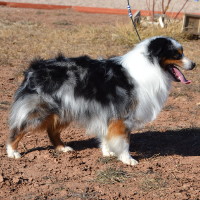
| A breeding program to develop the Miniature Australian Shepherd (North American Miniature Australian Shepherd) began in 1968 using small Australian Shepherds. Breeders reduced them in size to produce a smaller dog and continue today to strive to produce a mirror image of the Australian Shepherd in a size that fits well with today's lifestyle, without sacrificing instinct, ability or character. The leading club in the USA is the Miniature Australian Club of the United States of America. MASCUSA, as the parent club, has applied to the American Kennel Club for inclusion in AKC. The process of acceptance into AKC begins with registration with the AKC Foundation Stock Service. The Australian Shepherd Club of America has accepted the Miniature Australian Shepherd ONLY if the Miniature changes its name and has no reference to the Australian Shepherd or its history. Many Australian Miniature Shepherd owners register with AKC FSS. The official name of the AKC is Miniature American Shepherd. The Miniature Australian Shepherd (North American Australian Shepherd) has a medium-length coat. It comes in blue or red merle, red or black tricolor, all with white markings and/or tan. The hair around the ears and eyes should not be white. The coat can be straight or slightly wavy, and should have feathering on the back of the legs, and a mane and ruff around the neck. The hair on the head, in front of the forelegs and outside the ears is shorter than the rest of the coat. The hindquarters are the same length as the forequarters. The top of the skull is fairly flat and clean. The feet are oval and compact. The lips do not hang over the lower jaw. Miniature Australian Shepherds are perpetual, easy-going puppies that love to play. Courageous, loyal and affectionate, they make excellent children's companions who are great with active kids. A devoted friend and guardian. Very lively, agile and attentive, they are eager to please with a sixth sense about what the owner wants. Miniature Australian Shepherds are highly intelligent and easy to train. They can become nervous and destructive if left too alone without sufficient mental and physical exercise. They need a job to do, as the breed is highly intelligent, active and therefore easily bored. Socialize your dog well when it's a puppy to avoid becoming suspicious of strangers. Some like to nip at people's heels in an attempt to keep them. They need to be taught, as human breeding is not acceptable. A good companion, they also like to work small jobs. They are quiet workers. This breed is generally not aggressive. Make sure you are this dog's firm, confident and consistent pack leader to avoid small dog syndrome, human-induced behavior problems. Always remember, dogs are dogs, not humans. Make sure you meet their natural instincts as animals. The gene for beautiful robin coloration also carries a blind/deaf factor. This can only be expressed in merle / merle crosses. The vast majority of North American Miniature Australian Shepherds are heterozygous merles (one parent is merle, the other is solid) and these merles are not prone to any particular health problems due to their coloration. Be sure to check the hearing on merle puppies. Hip and eye problems can occur. Make sure that the sire and dam of the puppies have been tested and certified before buying a puppy. Some pedigree dogs carry an MDR1 gene that makes them sensitive to certain drugs, which can otherwise give them another dog, but if they test positive for this gene, it can kill them. Miniature Australian Shepherds will do well in an apartment if sufficiently exercised. They are moderately active indoors and do well with a small yard. This breed will do well in cold climates. The Mini Aussie should be taken for long walks on a daily basis. This energetic little dog needs plenty of vigorous exercise to stay in shape, or better still, a real job to do. The Miniature Australian Shepherd's coat is easy to groom and requires little attention. Brush occasionally with a firm bristle brush and bathe only when necessary. This breed is a medium excretor. Toy height from 26 to 36 cm. Toy weight from 3 to 9 kg. Miniature height from 33 to 46 cm. Weight of miniature from 6 to 16 kg. There is some overlap in weight, as a stocky toy could weigh more than a tiny miniature. |



 English (United Kingdom)

Comments