 |
Indian Pariah dog |
|
He is not recognized by the F.C.I. |
Origin |
India | |
Translation |
Francis Vandersteen |
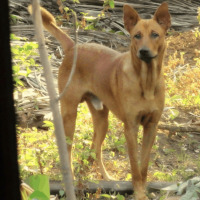
| The Indian pye-dog, also known as the Desi dog, is an ancient indigenous breed found throughout India, Pakistan, Bangladesh, Afghanistan and even beyond South Asia. Archaeological evidence shows Indian pye-dogs dating back to around 15,000 BC, the breed having been developed by natural selection rather than any other type of selection. An Indian pye-dog skull has been discovered at the ancient Indian site of Mohenjo-daro, and prehistoric cave paintings depicting the breed have been found in the rock shelters of Bhimbetka. It was featured on the National Geographic Channel film Search for the First Dog along with other related ancient types, such as the Canaan Dog of Israel and the Australian dingo. The Indian pye-dog was introduced to the Andaman Islands with the establishment of a penal colony, dogs having previously been unknown to the Andamanese. Although the Indian pariah dog is highly intelligent and easy to train, the breed was intentionally downplayed during the British Raj by merchants wishing to sell their foreign breeds in the country. Their popularity in the West in recent years, however, has led to hundreds of dogs being exported from the Indian subcontinent. In 2015, a breed standard was published in the Indian Kennel Gazette, a publication of the Kennel Club of India, and the dog was recognized by the Primitive and Aboriginal Dog Society (PADS), an international group of enthusiasts based in the U.S.A. Some in society consider these dogs a risk, citing their growing population in India in recent years. They see these dogs as a threat and a nuisance because of the constant barking and biting. Nevertheless, most of these attacks are due to human provocation, such as hitting them with sticks or throwing stones at them. The number of dog bites and deaths due to dog attacks increases every year. As these dogs are generally unvaccinated, they are frequently carriers of rabies. Outcast dogs are highly alert and social. They are used as guard and police dogs, being highly territorial and defensive. They need to be well socialized as puppies, and do well with families and children if given the opportunity. They are highly intelligent and easy to train, to which end veterinarian Premlata Choudhary has stated that "desi dogs are much more intelligent and robust than most of the controlled breed dogs that people spend so much money on." Health Being a naturally evolved breed, they have very few health problems and thrive with minimal "maintenance" in appropriate climates. The skin requires very little grooming and the dogs themselves are relatively clean. They have little body odor. Genetic conditions such as hip dysplasia are extremely rare, as there is no inbreeding and the dominant genes that favor their survival are naturally selected over time. Most of their deaths are due to accidents on roads and railroads, lack of food or polluted water, tumors in the body or blows from humans. Indian pariah dogs are an example of pariah-type dogs, an ancient group of dogs that evolved through natural selection. They have erect ears, a wedge-shaped head and a curved tail. Although most street dogs in the Indian subcontinent are in fact Indian dogs, the names of this breed are often mistakenly used to refer to all urban stray dogs in South Asia, even though some free-roaming dogs in the Indian subcontinent do not fit the "pariah type" and may not be pure native dogs, but mixed breeds, particularly around places where European settlers historically settled in India, due to their mixing with European dog breeds. These are medium-sized, square to slightly rectangular, short-haired dogs. The dog has a double coat, with a coarse top layer and a soft undercoat. The most commonly observed colors are browns, ranging from dark brown to reddish brown, with or without white markings. Solid blacks are rare, but some dogs are. Shaded coats, brindle, solid white and Dalmatian-type markings are never seen in pure populations. These may be a sign of mixing with modern breeds, as they are only seen in dogs in cities and other sites where non-native dogs have been introduced. The head is medium-sized and wedge-shaped. The muzzle is pointed and equal or slightly longer than the head. The neck is noble and the forelegs erect. The hind legs are slightly sloping. The trot is short. The eyes are almond-shaped and dark brown. The ears are held erect and pointed at the tips, with a broad base, set low on the head, and the tail is curled and held high when excited. |



 English (United Kingdom)

Comments