
 |
Indian Alangu Mastiff |
|
He is not recognized by the F.C.I. |
Origin |
India | |
Translation |
Francis Vandersteen | |
This breed is also known as |
Alangu Mastiff
|
A brief presentation of the Indian Alangu Mastiff |
| The Alangu Mastiff is an ancient breed that would have been widely used by the Persian army to guard enemy soldiers' camps and prisoners of war during their campaigns in ancient times. In modern times, the name Alangu Mastiff (as this breed is known in India) has become synonymous with the Bully Kutta, a large Mastiff breed found mainly in Pakistan. The Alangu Mastiff is also known as the Sindh Mastiff and is one of three mastiff-type breeds, along with the Alaunt Mastif and the Assyrian Mastiff, found in the regions surrounding Persia and India. Today, this breed is generally owned by wealthy farmers for protection or dog fighting in the heavily rural areas of the Indian subcontinent. |
History of the Indian Alangu Mastiff |
| The origins of the Alangu Mastiff can be traced back to parts of Rajasthan, the Bhawalpur region of Punjab, and the desert area of Kutch. Although this breed is rare, it is most often found in the Thanjavur and Trichy districts of southern India. Prior to Pakistan's independence from British colonial rule in 1947, the Kutch region of Rajasthan, in present-day Pakistan, was under Sindh rule. Thus, in Pakistan, locals refer to the breed as the Sindhi Mastiff, while in the rest of the world it is known as the Pakistani Mastiff or Bully Kutta and in India, the breeds agree on the country of origin known as the Alangu Mastiff. The Alangu Mastiff is considered an ancient breed and like many ancient dog breeds, the process of determining its exact origin is hampered by a lack of accurate documentation. This has led to the creation of numerous theories, and much of what is put forward in modern times is simply speculation and conjecture. Among the many theories put forward to explain the development of this remarkable breed, the Alangu Mastiff was probably developed by the intentional crossing of pointers with English Mastiffs and several other British hunting dog breeds while India was under British colonial rule. This theory is widely refuted by many historians who claim that the Alangu Mastiff is of much older origin, asserting that the breed likely predates the birth of Christ. These historians base their ancient Alangu Mastiff theory on evidence that Mastiff-type breeds were documented in India and Pakistan centuries before the British legion arrived and conquered the region. Another, and probably more likely, theory is that the birth of the breed is linked to the Persian army, which used Mastiff-type breeds to protect camps of soldiers and enemy prisoners of war in their campaigns during antiquity. The crux of this theory revolves around Xerxes I of Persia, who is said to have introduced the breed's antecedents to the Indian continent between 486-465 BC. That these early types accompanied him when he marched into Greece to punish the Athenians, Naxians and Eretrians for their interference in the Ionian revolt and their victory over the Persians at Marathon. Shortly after conquering the region, Xerxes was forced to send the majority of his forces home to prevent a revolt due to civil unrest in Babylon. He would do so, however, leaving behind a contingent force in Greece under the command of Mardonius, who would be defeated the following year by the Greeks. The Greeks would attack and burn the entire Persian fleet anchored at Mycale. With their navy in ruins and unable to resupply their army, the Persian forces were forced to withdraw, probably leaving some of these Mastiff-type breeds behind. These early Mastiffs would then remain in the Indo-Pakistan subcontinent and become known as Indian Mastiffs, where they would be used for hunting, guarding and other purposes. Historians also point to the writings of Alexander the Great and his childhood tutor, Aristotle, which describe not only his campaigns, but also the dogs brought with his armies. These early descriptions of similar large Mastiff-type dogs are used to support the fact that the Alangu Mastiff is an ancient breed probably descended from the Persian White Alaunt, the ancient Persian Hyrcania dog and the Assyrian Molosser. In 326 B.C., Alexander the Great invaded India, fought and eventually defeated the Hindu king Porus at the Battle of the Hydaspes River on the banks of the Hydaspes River (Jhelum) in the Punjab near Bhera in what is now Pakistan. However, when his exhausted army learned of his plans to push on and cross the Hyphasis (Beas River), they mutinied and refused to go further into India. Alexander then waged short but victorious campaigns against the Indian clans resident in the region, to ensure his reign, and found cities to serve as outposts and trading centers before returning to Babylon. It is known that he brought dogs very similar to the Alangu Mastiff back to Babylon with him on his return. So it's likely that Alexander the Great, through his military campaigns, was responsible for the breed through his introduction of the Assyrian Mastiff from Iraq to India, where they were bred with the Alaunt and Indian Mastiff to create the Alangu Mastiff. Due to the constant interaction between Persia and the Assyrian Empire, it's quite possible that Indian and Persian Mastiff dogs influenced each other. The fierce nature of the Mastiff Alangu led to their adoption and use by the Indian royal family for the sport of big game hunting. The Alangu Mastiff was later demoted to serve as a simple guard dog when its role as a sporting hunting dog came to an end when the royal family began using cheetahs for this purpose. The breed's inherently aggressive nature led locals to develop it further, for use as a fighting dog. Although these tournaments are technically illegal, many dog-fighting tournaments take place in Pakistan and Afghanistan every year due to the rural nature of the country and poor law enforcement. In modern times, the Alangu Mastiff is mainly used as a guard dog for the home, and as a fighting dog for these illegal tournaments. Although the Mastiff Alangu is considered one of the most dangerous fighting dogs and superior to the true Bully Kuta, in Pakistan, all fighting dogs including the Mastiff Alangu and the true Bully Kuta are known by the same name of Bully Kuta. |
Appearance of the Indian Alangu Mastiff |
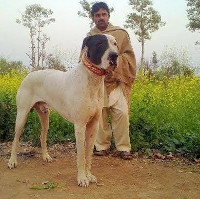
| The Alangu Mastiff as with most other mastiff breeds is massive in size and like most fighting dogs was bred for performance rather than a unified appearance. At the time of its use as a hunter, the Mastiff was larger than the current representation of the breed. Those interested in improving their agility and fighting ability reduced the breed's size from over 86 centimeters at the withers to around 75 centimeters with an average weight of around 68 kilos. A giant, muscular breed, the Alangu Mastiff is slightly longer than it is tall. The head is large but well proportioned to the rest of the dog's body, with a broad, thick skull and a muzzle that is about half the total length of the skull. The short, erect ears are set wide apart and high on the skull, giving the dog's head a rather square appearance. Their eyes are set wide apart and deep in the skull, giving the dog an alert appearance. The initial appearance of the Alangu Mastiff is that it is a dog of extreme power. The medium-length neck is muscular and powerful, often with muscular striation clearly evident. The front quarters are squarely built, with powerful shoulders set wide apart on the chest. The chest is deep and solidly built, extending close to the elbows. The ribs are well sprung from the spine. The back is straight, long and extends solidly from the withers to the well-developed, muscular loins and hindquarters. The thighs are muscular and powerful in appearance. The legs are well boned and lead to extremities like large bear paws. Cheeks are generally large and pendulous, and dewlap may or may not be present under the jaws. Overall, the skin is rather loose, a probable adaptation to combat lesson injuries during these contests. The tail is thick and tapers gradually to a point. The Alangu Mastiff's coat is short and double. The short outer coat is thick, coarse and straight, flat with the body. The undercoat is also short, dense and close to the body. Coloration varies within this breed, as it does with many fighting dog breeds that have been bred for performance, not appearance. The coat may be brown, fawn, brindle or most often white, but other colors are not unusual. Members of this breed may also have a black mask as part of their overall coloring. |
Temperament of the Indian Alangu Mastiff |
| The Alangu Mastiff owes its dominant, aggressive personality to its long history of use as a war and fighting dog. A fairly intelligent and highly territorial dog, they have strong natural guarding instincts and would be difficult to train. This is a breed that is highly unsuitable for first-time dog owners or individuals unable to assert themselves as the dominant figure in a dog's life. As such, it is recommended only for experienced handlers and individuals with strong Alpha personality traits. This breed has acquired a reputation for being fierce and bloodthirsty. It is also a naturally territorial and aggressive breed. The Alangu Mastiff will not coexist with other dogs and may well kill them, establishing itself and its territory as Alpha. This breed also poses a threat to other animals and livestock. The breed's aggressive nature makes it totally unsuitable for homes with children. This is not a breed that likes to be teased, and unsupervised children who take it upon themselves to tease the dog may well be risking their lives. |
Needs and activities of the Indian Alangu Mastiff |
| With good early socialization and appropriate training, the Alangu Mastiff can make an accommodating companion for strong, responsible and knowledgeable owners. Overall, this breed is very loyal to its master and will aggressively defend its master, property and home from strangers. Owners of this breed require secure fences that can be locked not only to guard the dog, but also to ensure that no one can enter its territory when the owner is not present, as the dog will act aggressively towards strangers. Because of its size and relatively high energy level, it is not suited to apartment living and requires plenty of space and exercise to stay healthy and happy. |
Maintenance of the Indian Alangu Mastiff |
| One of the few advantages of owning an Alangu Mastiff is that it's a low-maintenance breed. As a short-haired breed, the Alangu Mastiff is a moderate shedder, requiring only occasional brushing with a smooth brush to keep the coat in good condition. Bathing would be a tip in the yard affair and even below that, a damp towel can be used to remove dirt and bring out the coat's luster. The Alangu Mastiff is considered a very healthy breed of dog, with a low propensity for congenital health problems. The only known problems associated with this breed are the tendency to develop arthritis and blindness later in life, which is not uncommon for most dog breeds. Because of its size, bloat may also be a concern, or other illnesses generally associated with large dog breeds. |



 English (United Kingdom)

Comments