
 |
Bulgarian Dog |
|
He is not recognized by the F.C.I. |
Origin |
Bulgaria | |
Translation |
Francis Vandersteen |
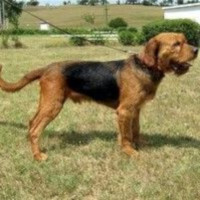
| The Bulgarian Dog, also known as the Bulgarian Barak, is an ancient breed of dog. The word "Barak" comes from an old Turkish word meaning "shaggy", which describes the coat of these scent-trained working dogs. As the name suggests, these dogs use their noses to track small mammals. But more than that, they are capable of hunting and killing some of the most fearsome types of animals, such as wild boar, which once lived in the Balkan region. Baraks are active dogs that like to think for themselves, are not good at taking direction and can be hard to control. Although they are good-natured, their natural straggling means they are not suitable as first dogs, and generally do best with an experienced handler. The Bulgarian dog has a long and mysterious history. It is thought that their history of origin goes back over a thousand years, to a time when no records were kept. There are two dominant theories about the creation of the Barak. The first concerns dogs bred by the ancient Thracians, while the second theory concerns the invasion of the Turks. Whatever the truth, it is undisputed that the Balkan region was an important crossroads where different peoples met or passed through. It's entirely reasonable that the dogs that accompanied the travelers of ancient times would then have bred with dogs native to the region. The result of this cross-breeding, so long ago, became what we now consider two distinct lines of hunting dogs considered indigenous to the region. One breed is wire-haired and known as the Bulgarian Hound (or Bulgarian Barak), while the other is smooth and covered in a distinct black and beige color, known as the Bulgarian Scenthound (or Gonche). The Barak's success is due to its unrivalled tracking skills and steely character, which give them the courage to take on terrible boars. The Bulgarian Hound is a medium to large dog with a silhouette similar to that of the Beagle. They are solidly built, but lean, with well-proportioned legs and a sensible proportion to head and muzzle. The characteristic that most distinguishes the Bulgarian Hound from other similar dogs is its coat. Its hairy nature lends itself well to the nickname Barak's Hound (meaning "hairy"). However, this is not a long, curly coat that hangs in braids, but thicker, slightly wavy hair that grows about 6-7 cm long. The Bulgarian Hound is available in a range of colors, including: black, white, brown, gray, red and rust; and is more often bicolor or tricolor, with a darker-colored saddle region. Understanding the Barak's character means understanding the work for which they were bred. This involved following a scent and following it over rough terrain. This explains their obsession with scents, from which it can be difficult to distract them. Another characteristic of their character is that the dog frequently runs in front of its owner, then barks to signal its position. This has enabled their owners to locate and catch them. In practical terms, this makes Baraks immensely independent and free-thinking, not to mention noisy. While a good trait in a hunting dog, it can make for a frustratingly disobedient animal. Like many hunting dogs, the Bulgarian Hound tends to form a strong bond with its master. Once they've learned to ask their owner for advice, they've become devoted pets, provided the owner meets their needs for mental stimulation and exercise. Another factor to consider is that strong hunting instinct. A Barak can't tell the difference between a wild rabbit and a beloved pet rabbit. To the dog, they're both prey, and things aren't going to end well. The result is that Baraks make uncomfortable household companions with other pets, and this is a scenario to be avoided. The Barak is an intelligent dog but can have trouble concentrating on instruction. This is because they are easily distracted by their noses and prone to using their own initiative rather than following instructions. However, with an experienced handler, they can achieve great things, especially when using reward-based training methods. The wise handler uses the dog's sense of smell to stimulate his mind by having him follow an olfactory trail. Training sessions should be fun and involve movement to get the best out of your dog. Consider training outdoors and have the dog fetch him, rather than in a school room where he has to sit still. Remember, this is a dog that likes to be on the move, not sitting learning. |



 English (United Kingdom)

Comments