King Vladislav's Dog

He is not recognized by the F.C.I.

Origin
Serbia
Translation
Francis Vandersteen
This breed is also known as
Pas Kralja Vladislava
Mileševac
Milesheva Watchdog
Vladislav's Moloss
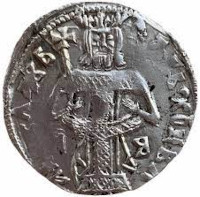
Believed to be extinct, the Milesheva Moloss was a breed supposedly developed by King Vladislav of Eastern Serbia in the 1230s, inspired by the great Greek royal dogs like the Skilos tou Pyrrou and the Skilos tou Alexandrou, King Vladislav ordered to create an established breed in his name, after supposedly receiving a vision from God. Initially using only the Sarplaninac, Sumadinac and Naissus, he also introduced some Greek Sheepdogs and Central Asian Sheepdogs to create a dog with the coloration of the one in his vision. The result was a colossal breed with docked tail and cropped ears, bearing resemblance to some Central Asian Shepherd Dog types found today. Said to be "as big as a donkey, as mean as a wolf, as smart as a man and as fair as an angel", the Milesevac was a dog that inspired awe wherever it was seen. The king gave many dogs to other kingdoms, but he saved the best specimens for the priests of the Milesheva monastery. There the dogs were used as cart pullers and guards, but soon they became a nuisance for inexperienced monks to care for, due in part to the breed's aggressive nature, such as its size and power. When King Vladislav died, the dogs were given to the new King Urosh, who showed very little interest in them and subsequently gave them away to villagers to use as they saw fit.

Popular for its working skills, the breed survived among peasants until the Otoman invasion, when a large number of dogs were destroyed by the Turks for being too aggressive. While many believe that King Vladislav's Molossus never survived the centuries under Turkish rule, some are convinced that the breed was saved by the western Serbs and that the Dinara Sheepdog is its direct descendant. Regardless of the difference in size and coat type, there are some striking similarities. The great Milesheva Moloss was always richly double-fleeced and bicolored, preferably wolf-gray with large white patches. It is said that the average representative of this breed was never less than 96.5 centimetres.

Comments

Latest page updates

  • Telomian

    Telomian He is not recognized by the F.C.I. Origin Malaysia Translation Francis Vandersteen A brief presentation of the Telomian The Telomian is a very rare breed of dog, and the only one native to Malaysia to have been bred outside the country. They were originally bred by the indigenous people of Malaysia to combat parasites such as snakes, rats,...
  • King Wheaten -- Cavalier King Charles Spaniel X Irish Soft Coated Wheaten Terrier

    King Wheaten He is not recognized by the F.C.I. Origin Great Britain <> Ireland -> U.S.A. Translation Francis Vandersteen A brief presentation of the King Wheaten The King Wheaten is a small dog with a heart this big and a playful disposition. Borrowing the energy and soft-coated waves of the Irish Soft Coated Wheaten Terrier and the size and...
  • Spanierd -- English Springer Spaniel X German Shepherd

    Spanierd He is not recognized by the F.C.I. Origin Great Britain <> Germany -> U.S.A. Translation Francis Vandersteen A brief presentation of the Spanierd The Spanierd is a hybrid dog. Its parent breeds are the English Springer Spaniel and the German Shepherd. They have an affable personality. He's known for entertaining family and friends with his...
  • Alaskan Goldenmute -- Alaskan Malamute X Golden Retriever

    Alaskan Goldenmute He is not recognized by the F.C.I. Origin U.S.A. <> Great Britain -> U.S.A. Translation Francis Vandersteen This breed is also known as Alaskan GoldenGoldenmuteAlaskan Gold Retriever     A brief presentation of the Alaskan Goldenmute The Alaskan Goldenmute is a descendant of two great dog breeds: the Alaskan Malamute and the Golden...
  • French pointing dog Pyrenean type

    French pointing dog Pyrenean type FCI standard Nº 134 Origin France Translation Mrs. Peggy Davis Group Group 7 Pointing Dogs Section Section 1.1 Continental Pointing Dogs « Braque » Type Working With working trial Acceptance on a definitive basis by the FCI Tuesday 18 January 1955 Publication of the official valid standard Tuesday 01 August 2023 Last...
  • French pointing dog Gascogne type

    French pointing dog Gascogne type FCI standard Nº 133 Origin France Translation Mrs. Peggy Davis Group Group 7 Pointing Dogs Section Section 1.1 Continental Pointing Dogs « Braque » Type Working With working trial Acceptance on a definitive basis by the FCI Monday 17 January 1955 Publication of the official valid standard Tuesday 01 August 2023 Last...
  • Vucciriscu

    Vucciriscu He is not recognized by the F.C.I. Origin Sicily Translation Francis Vandersteen En français, cette race se dit Vucciriscu Diese Norm ist in deutscher Sprache sichtbar Vucciriscu En español, esta raza se dice Vucciriscu In het Nederlands, wordt dit ras gezegd Vucciriscu This breed is also known as Sicilian Vucciriscu Sicilian Butcher...

© 2026 Groupe Milouchouchou ASBL. Tous droits réservés. En savoir plus

Protected by Copyright01
We use cookies

We use cookies on our website. Some of them are essential for the operation of the site, while others help us to improve this site and the user experience (tracking cookies). You can decide for yourself whether you want to allow cookies or not. Please note that if you reject them, you may not be able to use all the functionalities of the site.

Ok

