
 |
Bat-eared Fox |
|
He is a wild animal |
Origin |
Southern Africa | |
Translation |
Francis Vandersteen |
| The possession of this animal is not authorized |
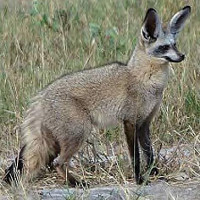
| The Bat-eared Fox (Otocyon megalotis) is a carnivorous mammal of the Canidae family, colonizing southern Africa. Populations have been observed from Ethiopia and southern Sudan to Tanzania, as well as from southern Angola and Zimbabwe to South Africa. The otocyon lives in savannahs and rather arid grasslands. The otocyon is about 60 cm long, excluding the tail. Its height at the withers reaches 30 cm. Its coat is light fawn, with black patches on the ears, muzzle, limbs (relatively short) and tip of the tail. The throat and underside of the body are lighter. It has the same facial mask as the raccoon. Apart from its long ears (114 to 135 mm), the otocyon has a unique feature: it has more teeth than any other heterodont placental mammal. It has between 46 and 50 teeth, i.e. at least three more upper molars and four lower molars. Its powerful digastric muscle enables it to chew insects quickly. It belongs to the Otocyon genus (of which it is the only representative) and not to the Vulpes genus like most of the species grouped under the name fox. Otocyon is apparently not commercially exploited. In Botswana, however, it is hunted for its fur. The otocyon occupies burrows that it digs itself or that have been abandoned by other animals, such as the aardvark. These burrows are several meters long, with numerous entrances and chambers. A family may occupy several burrows. In the Serengeti, the otocyon is a nocturnal animal (85%). In contrast, South African populations are diurnal in winter and nocturnal in summer. Otocyon live in families comprising an adult couple and their young, or more rarely one male and two females. They mark their territory with urine. Couples are very close-knit, sleeping in the same burrow and hunting together. Social contacts within the family are very important. All members support and protect each other. In South Africa, family habitat zones overlap considerably. Territorial marking is virtually non-existent. Burrows are sometimes grouped together, and population density can reach ten individuals per km². Communal living offers certain advantages: termite hunting is more fruitful, and predators are better and faster spotted. As for the offspring, they learn to feed themselves more quickly. The playful behavior of the young is already showing similarities with the flight behavior generally adopted by adults who avoid confrontation. To escape predators, the otocyon relies primarily on its speed and incredible dodging ability. It can completely reverse its direction of escape belly-down, without losing speed. Predators include jackals and eagles. Daytime birds of prey are a major threat to the young. Mating season lasts from September to November, with a gestation period of 60-70 days. Number of young: 2 to 6. The otocyon raises one litter a year. Newborns open their eyes at 9 days. They emerge from the burrow at 17 days. At birth, they have a sparse gray undercoat, which gradually disappears. By 4-5 weeks of age, their coats have already taken on the color of adult coats. They nurse for 15 weeks. The young then start hunting with their parents. They reach adult size at 5-6 months. Once mature, most young disperse. Some young females remain within the natal group. Males are just as, if not more, involved than mothers in raising their young (guarding, caring, playing). The otocyon's diet consists mainly of insects and other arthropods, but occasionally small rodents, lizards, bird eggs and chicks, as well as plant matter. Harvesting termites (Hodotermes) and dung beetles (Scarabidae) can make up over 80% of its diet. The otocyon absorbs much of the water it needs from the body fluids of these insects. It often ingests termites while they are eating grass. Dung beetles feed on the feces of ungulates, on which they also lay their eggs. The otocyon therefore also maintains a commensal relationship with large herbivores such as wildebeest, zebra and buffalo. It uses its long ears to detect dung beetle larvae gnawing on their fecal pellets. Otocyon hunt alone or in groups when insects are abundant. Communal hunting is more fruitful. |



 English (United Kingdom)

Comments