
 |
Swift Fox |
|
He is a wild animal |
Origin |
U.S.A. and Canada | |
Translation |
Francis Vandersteen |
| The possession of this animal is not authorized |
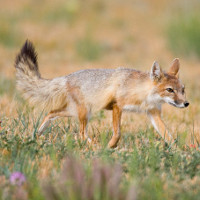
| The Swift Fox (Vulpes velox) is a species of fox found in North America. Weighing no more than three kilograms, it is the smallest fox in North America. Inhabiting the prairies of the Great Plains, the swift fox is highly dependent on its burrow, which it uses to hide from predators such as the coyote (Canis latrans). It is a predator of small mammals, and its diet consists mainly of lagomorphs. They live in pairs and raise a litter of three to six fox cubs every year. Unlike many canids, the territory is maintained by the female. It is closely related to the Polar Fox (Vulpes lagopus) and the Dwarf Fox (V. macrotis), and the latter is sometimes considered a subspecies, as hybrids of the two species occur naturally where their ranges overlap. The Swift Fox can be found at many American archaeological sites, and is of great cultural importance to the Plains Indians. With its size close to that of the domestic cat (Felis silvestris catus), the Swift Fox is the smallest species of fox in North America. Body length varies from 37.5 to 52.5 cm, and tail length from 22.5 to 35 cm. This fox weighs from 1.8 to 3 kg. On average, males are slightly larger than females. The winter coat is long and dense, dark buff-gray on the upper parts of the body and bronze-red on the flanks, legs and ventral part of the tail. In summer, the coat is shorter, harder and tends towards reddish. The throat, chest, inside ears and inner parts of the body are creamy white. The tip of the tail is black. The Swift Fox resembles the Dwarf Fox (Vulpes macrotis). However, it has smaller ears, a broader muzzle and a shorter tail. It can be distinguished from all other canids in its range by the black spots on its muzzle, the tip of its black tail and its small size. The Swift Fox is a meadow-dweller. It is particularly fond of short- to medium-grass meadows on gently undulating terrain. It also thrives on fallow land, as confirmed by observations in Kansas. The Swift Fox is extremely dependent on burrows, which it uses all year round, in particular to avoid predation by Coyotes (Canis latrans) and interspecific competition from Red Foxes (Vulpes vulpes), but also to raise young and protect itself from the extreme climatic conditions of its range. It digs its own burrow or uses the burrow of another animal. Swift Fox burrows are generally located high up in well-drained ground. Tunnels, with one to seven entrances, can be up to 3.50 m long and lead to a chamber buried to a depth of 1.50 m. The Swift Fox is fast, as its name suggests. Its top speed is around 50-60 km/h, enabling it to flee from predators and capture its prey. The Swift Fox lives in pairs, accompanied by its young. Occasional sightings of a male living with two females have been reported. Females only come into heat once a year, and the breeding season differs according to latitude, running from December to January in Oklahoma, January to February in Colorado, February to early March in Nebraska and March in Canada. The female gives birth to three to six cubs after an average gestation period of 51 days. The cubs' eyes open between ten and fifteen days. The young remain confined to the burrow until about a month old, and are weaned at six to seven weeks. The Swift Fox can occupy up to thirteen burrows in a year. The pair moves the young when prey becomes scarce or when parasites become too numerous in the burrow. Both parents are responsible for raising the young. Fox cubs leave the family unit at four to six months of age, in August and September in Oklahoma, between September and October in Colorado and Kansas, and in August in Canada. The Swift Fox is a nocturnal predator, traveling around 13 km every night, according to a study in Nebraska. During the day, the Swift Fox may sunbathe in front of a burrow entrance, but usually remains hidden in its burrow. Its main prey are small mammals, but its diet also includes insects, birds, eggs, carcasses and plants such as prickly pear, wild plum and sunflower seeds. Leporidae (hares and rabbits) are usually the Swift Fox's main prey. In South Dakota, small mammals account for 49% of the diet, and the main prey is the Black-tailed Prairie Dog (Cynomys ludovicianus). In Kansas and Nebraska, the Swift Fox feeds mainly on murid rodents. In summer, the proportion of insects in the diet increases sharply. |



 English (United Kingdom)

Comments