
 |
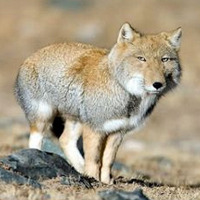
Tibetan fox |
|
He is a wild animal |
Origin |
Tibet | |
Translation |
Francis Vandersteen |
| The possession of this animal is not authorized |
| The Tibetan fox (Vulpes ferrilata) is a species of fox that lives mainly in Tibet. It could live 8 to 10 years in ideal conditions, but rarely lives more than 5 years in the wild. This species particularly inhabits the steppes and semi-deserts of the Tibetan plateau. Its distribution covers India (Ladakh and Sikkim), China (Xinjiang, Gansu, Qinghai, Sichuan and Yunnan provinces) and Nepal (Mustang region north of the Himalayas). It is also probably present in the Chinese province of Bhutan. According to 1989 estimates, the Tibetan plateau is home to some 37,000 Tibetan foxes, with a density of two to four individuals per km2. In the north of its geographic range, the Tibetan fox rubs shoulders with its congeners, the steppe fox (Vulpes corsac). The Tibetan fox is known to inhabit plains and mountainous regions. Semi-arid to arid grasslands, where it can find black-lipped pikas, are its typical habitat. It spends much of its time during the day in a burrow or hollow in the landscape. It is found between 2,500 and 5,300 m, but generally lives at altitudes above 3,500 m2. The Tibetan fox is 57.5 to 70 cm long, with a tail of 40 to 47.5 cm. It is wider than the steppe fox (Vulpes corsac). Adults weigh between 3 and 6 kg. Compared with other foxes, it has a fairly long muzzle and very large canine teeth. It also has the best hearing of all foxes. Its thick, soft fur is made up of a dense undercoat that enables it to withstand temperatures as low as -40°C. It is generally gray, but can also be black, brown or rusty, even yellowish on the neck and back. It also has a tan stripe on its back and a white stripe on its tail, legs, muzzle and belly. It feeds mainly on black-lipped pikas (Ochotona curzoniae), a small lagomorph mammal, and rodents of the Alticola, Cricetulus and Pitymys genera. It supplements its diet with insects, carrion and a few plants. Rarely, it attacks Tibetan antelopes (Pantholops hodgsonii). A Tibetan fox has been observed following a brown bear (Ursus Arctos) to catch the black-lipped pikas that escaped when the bear dug to reach them in their burrow. Being a faithful species, Tibetan foxes hunt in pairs, sharing all the food they catch. Tibetan foxes live in pairs for the rest of their lives, and are monogamous. Mating usually takes place in late February or early March. After a gestation period of 50 to 60 days, the female gives birth to a litter of 2 to 5 cubs in late April or early May. These newborns, weighing 60 g to 120 g, stay with their parents for 5 months before emancipating. They obviously reproduce annually. The Tibetan fox is not endangered according to the IUCN, and is therefore classified as a species of minor concern. The main threat to this species is humans, who hunt it and destroy its habitat. Local communities hunt it for its fur, often to make hats. Another is the decline in pika populations, its main source of food. The problem is that the governments of the Tibetan plateau are implementing a program to poison pikas, a species that is harmful to humans in this region. A drop in pika populations could have a significant impact on fox populations in Tibet. In China's Sichuan province, habitat destruction is also a threat to the species. Nevertheless, the species is protected in several large parks in the People's Republic of China, mainly five parks covering a total area of 616,000 km2. However, there are as yet no reports of breeding success in captivity. According to IUCN data, around 40% of the Tibetan fox's range is protected land. |



 English (United Kingdom)

Comments