
 |
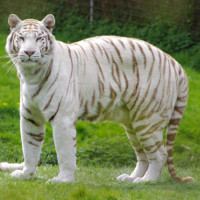
White tiger |
|
He is a wild animal |
Origin |
India | |
Translation |
Francis Vandersteen |
| The possession of this animal is not authorized |
| The white tiger, sometimes also called the royal white tiger, is a carnivorous mammal of the felidae family, with a genetic mutation that gives it a white coat with black stripes. It is not a species or subspecies in its own right and is therefore not threatened with extinction as such, although the tiger species is classified as "endangered" by the International Union for Conservation of Nature. This genetic anomaly is known as leucistism or leucism. White tigers are therefore not albino specimens, which have no stripes and rather light eyes, an appearance due in this case to another genetic mutation, albinism. White tigers began to make news towards the end of the 19th century, with a few wild specimens reported. White tigers with black stripes were reported in the wild in India during the Mughal Empire (1556-1605). A 1590 painting of Akbar the Great hunting near Gwalior shows four tigers, two of them white. Seventeen cases of white tigers were recorded in India between 1907 and 1933 in the districts of Orissa, Bilaspur, Sohagpur and Rewa. On January 22, 1939, the Nepalese Prime Minister shot a white tiger at the Barda camp in Terai, Nepal. The last white tiger was killed in 1958, and the mutation is considered extinct in the wild. Numerous rumors of wild white tigers have scoured India since then, but none have been considered credible. In his film Man-Eaters of Kumaon, famous hunter Jim Corbett filmed a white tigress and her two ginger cubs; this video, the only one showing a white tiger in the wild, was used by National Geographic in a film about Jim Corbett. In 1965, Marjorie Merriweather Post's "Indian Collection" in Washington included a chair upholstered in white tiger skin. A color photograph of this object appeared in the November 5, 1965 issue of Life magazine. The October 1975 issue of National Geographic shows a photograph of the UAE Defense Minister with a stuffed white tiger in his office. S.H. Prater writes in The book of Indian Animals (1948) that "white or partially white tigers are not uncommon in some of the open rainforests of central India." It is a myth that white tigers are unable to thrive in the wild, and India had planned a reintroduction of captive white tigers to a reserve near Rewa. In the wild, white tigers have been breeding for generations and A.A. Dunbar Brander in Wild animals in central India (1923) adds that "White tigers meet occasionally. There are regular cross-breedings of these animals in the vicinity of Amarkantak, at the junction between the state of Rewa and the districts of Mandla and Bilaspur. The last time I was in Mandla in 1919, a white tigress and her white cubs lived there. In 1915, a male was captured by the state of Rewa and imprisoned. An excellent description of this animal by Mr. Scott of the Indian police was published in volume XXVII, number 47 of the journal of the Bombay Natural History Society. This article mentioned by A. A. Dunbar Brander described : "The captive white tiger of Rewa was captured in December 1915 in the jungles of the state, near Sohagpur. He must have been two years old at the time. There were two other white tigers south of Rewa linked to this one, but this animal's mother was not considered to be white. A white tiger was killed by a Sardar in Sohargpur Tahasil ten to twelve years ago. Two other tigers were reported near Shahdol and Annuppur, but His Majesty's orders were not to kill them. The one in Annuppuer was said to be the brother of the one that had been captured. These white tigers roamed in the vicinity of the British districts of the central provinces and seemed to live in the Maikal Mountains." Victor H. Cahalane reported white tigers in northern China in 1943 : "North China has produced many albinos, with the inevitable brown stripes obliterated. Very rare melanistic (black) tigers are known." |



 English (United Kingdom)

Comments