Caspian Tiger

He is a wild animal

Origin
Southwest Asia
Translation
Francis Vandersteen
The possession of this animal is not authorized Royal Decree establishing the list of mammals not kept for production purposes that may be kept (M.B. 24.08.2009)
The Caspian Tiger was the westernmost tiger subspecies. It was found in Armenia, Azerbaijan, Georgia, southern Russia, Kazakhstan, Iran, Iraq, Afghanistan, Turkey, Mongolia, Tajikistan, Turkmenistan and Uzbekistan until its extinction in 1972.

Recent genetic research has shown that the Caspian tiger actually belongs to the same subspecies as the Siberian tiger, which is morphologically very close and still exists, opening up the possibility of reintroducing Siberian tigers into Central Asia.

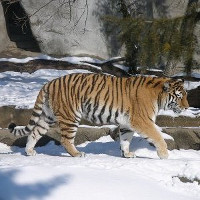
The Caspian Tiger was the third largest of all known tigers. The animal's body was quite massive and elongated, with strong limbs, large, wide paws and unusually large claws. The ears were small and short, and seemed to be devoid of hair at the tips. The male measured 270 to 290 cm, and the female 240 to 260 cm. Weights ranged from 180 to 220 kg for the male, and 85 to 135 kg for the female.

The animal had long, thick fur, abundant around the cheeks. Its color resembled that of the Bengal tiger. The skin of one specimen, preserved in the British Museum, is golden yellow on the back and flanks, with the sides lighter than the back and stripes ranging from light to dark brown. The chest and abdomen are white with yellow stripes, while the face is yellow with brown stripes on the forehead and white spots around the eyes and cheeks. The outer part of the limbs is yellow, while the inner part is white. The tail of this subspecies is yellow, with yellowish-white stripes. In winter, the coat was very long. This tiger had a large ventral mane, as well as a short mane on the nape of the neck.

Caspian tigers spent most of their lives alone. They rarely spawned with other tigers outside the breeding season, usually in winter or spring. The male tiger was larger than the female and lived from ten to fifteen years.

The Caspian tiger was originally widespread in southwest Asia. It came from Mongolia and southern Russia via western China (Xinjiang), the former Soviet republics of Central Asia, the Caucasus, Afghanistan, Persia and Mesopotamia. In the Middle Ages, it may even have reached Ukraine. In modern times, it was found in the southern Caucasus, eastern Turkey, northern Iran and northern Afghanistan.

The intensification of cultivation, leading to the reduction of its natural habitat and the scarcity of its prey, combined with the intensive hunting to which the subspecies fell victim, to cause its gradual disappearance and eventual extinction. The last sighting was in 1972.

Comments

Latest page updates

  • Telomian

    Telomian He is not recognized by the F.C.I. Origin Malaysia Translation Francis Vandersteen A brief presentation of the Telomian The Telomian is a very rare breed of dog, and the only one native to Malaysia to have been bred outside the country. They were originally bred by the indigenous people of Malaysia to combat parasites such as snakes, rats,...
  • King Wheaten -- Cavalier King Charles Spaniel X Irish Soft Coated Wheaten Terrier

    King Wheaten He is not recognized by the F.C.I. Origin Great Britain <> Ireland -> U.S.A. Translation Francis Vandersteen A brief presentation of the King Wheaten The King Wheaten is a small dog with a heart this big and a playful disposition. Borrowing the energy and soft-coated waves of the Irish Soft Coated Wheaten Terrier and the size and...
  • Spanierd -- English Springer Spaniel X German Shepherd

    Spanierd He is not recognized by the F.C.I. Origin Great Britain <> Germany -> U.S.A. Translation Francis Vandersteen A brief presentation of the Spanierd The Spanierd is a hybrid dog. Its parent breeds are the English Springer Spaniel and the German Shepherd. They have an affable personality. He's known for entertaining family and friends with his...
  • Alaskan Goldenmute -- Alaskan Malamute X Golden Retriever

    Alaskan Goldenmute He is not recognized by the F.C.I. Origin U.S.A. <> Great Britain -> U.S.A. Translation Francis Vandersteen This breed is also known as Alaskan GoldenGoldenmuteAlaskan Gold Retriever     A brief presentation of the Alaskan Goldenmute The Alaskan Goldenmute is a descendant of two great dog breeds: the Alaskan Malamute and the Golden...
  • French pointing dog Pyrenean type

    French pointing dog Pyrenean type FCI standard Nº 134 Origin France Translation Mrs. Peggy Davis Group Group 7 Pointing Dogs Section Section 1.1 Continental Pointing Dogs « Braque » Type Working With working trial Acceptance on a definitive basis by the FCI Tuesday 18 January 1955 Publication of the official valid standard Tuesday 01 August 2023 Last...
  • French pointing dog Gascogne type

    French pointing dog Gascogne type FCI standard Nº 133 Origin France Translation Mrs. Peggy Davis Group Group 7 Pointing Dogs Section Section 1.1 Continental Pointing Dogs « Braque » Type Working With working trial Acceptance on a definitive basis by the FCI Monday 17 January 1955 Publication of the official valid standard Tuesday 01 August 2023 Last...
  • Vucciriscu

    Vucciriscu He is not recognized by the F.C.I. Origin Sicily Translation Francis Vandersteen En français, cette race se dit Vucciriscu Diese Norm ist in deutscher Sprache sichtbar Vucciriscu En español, esta raza se dice Vucciriscu In het Nederlands, wordt dit ras gezegd Vucciriscu This breed is also known as Sicilian Vucciriscu Sicilian Butcher...

© 2026 Groupe Milouchouchou ASBL. Tous droits réservés. En savoir plus

Protected by Copyright01
We use cookies

We use cookies on our website. Some of them are essential for the operation of the site, while others help us to improve this site and the user experience (tracking cookies). You can decide for yourself whether you want to allow cookies or not. Please note that if you reject them, you may not be able to use all the functionalities of the site.

Ok

