
 |
Marbled Cat |
|
He is a wild animal |
Origin |
Borneo, Sumatra and the Indochinese peninsula | |
Translation |
Francis Vandersteen |
| The possession of this animal is not authorized |
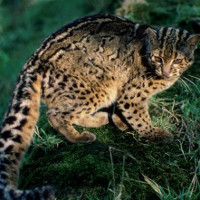
| The Marbled Cat is a species of cat in the Pardofelis genus. Similar in size to the domestic cat, it is characterized by its long tail, which accounts for half its total length. Its mottled coat is reminiscent of marble. With characteristics similar to those of the big cats, its taxonomic position has varied considerably. Inhabiting tropical rainforests, this feline is probably arboreal, solitary and territorial. Its range includes the islands of Borneo and Sumatra, the Indochinese peninsula and extends as far as the Himalayan foothills of Nepal and southern China. Its numbers in the wild are difficult to assess, as the species is discreet and evolves in an environment that is difficult to access. Considered a vulnerable species by the International Union for Conservation of Nature, the main threat to the Marbled Cat is deforestation. Fewer than a dozen specimens are kept in zoos, yet this has enabled us to gather essential data on the species' reproduction and behavior. In the 2000s, several studies carried out on small Asian felines enabled us to increase our knowledge of the Marbled Cat, and in particular to assess the size of its territory. This feline's fur is reddish-brown to yellowish-grey, with large brown spots circled in black, similar to those of the Nebula Panther, although less distinct. The inner thighs, belly and chest are lighter. The fur is soft and thick, very full, especially on the tail. On the legs, tail and head, numerous black patches cover the coat, sometimes joining to form narrow stripes. There are two stripes on the top of the skull, near the ears, and a very long line along the back. The tail is spotted at the base and ringed at the tip, and represents half the total length of the body. The total length of a Marbled Cat is 80 to 115 cm. The height at the withers is 35 to 55 cm. Marbled Cats weigh from 4 to 8 kg. Legs are supple and rather short, with very wide paws. The ears are small and rounded, and the underside is black with a white spot in the middle. The eyes are yellow to golden with slit pupils, like the domestic cat. The Marbled Cat's canine teeth are long in relation to its size, and the upper front premolar is generally absent or vestigial. The skull is round with a low sagittal crest; a bony ring surrounds the eye sockets, which is quite rare in felines. According to Peter Jackson, the Marbled Cat is one of the most difficult felines to identify in the wild. It can be easily confused with the Nebula Panther and the Bornean Nebula Panther due to its morphological similarity (tail-to-body length ratio, coat); these two felines, however, are much larger. The Leopard Cat can also be mistaken for a Marbled Cat, as it is the same size and shares the same habitat, but does not have such a long tail and mottled coat. The Marbled Cat remains poorly understood, and little is known about its behavior and diet: its social structure is probably solitary, like most felines. In captivity, they are considered docile and tame. The Marbled Cat is a particularly skilful arboreal feline, and mainly nocturnal. Its long tail acts as a pendulum, enabling it to suspend itself by its hind legs alone and to climb down trees with its head forward. The way it moves through the trees is reminiscent of primates. In Borneo, it is more likely to be found on the ground. It preys on squirrels, small reptiles, frogs, giant dogfish, rats and birds; its diet is thought to consist mainly of birds and squirrels. In captivity, it refuses carrion. During Lon Grassman's study of a female Marbled Cat, data collected revealed a territory covering around 5.3 km2. The female covered at least 477 meters every day, and seemed most active at night and dusk. |



 English (United Kingdom)

Comments