
 |
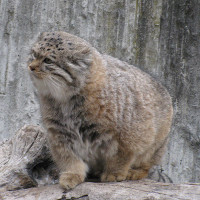
Manul |
|
He is a wild animal |
Origin |
Central Asia | |
Translation |
Francis Vandersteen |
| The possession of this animal is not authorized |
| The Manul or Pallas Cat is a feline of the feline subfamily. It is the only species of the Otocolobus genus. The Manul has a compact, stocky body, with short legs and a short, thick tail. Its very long, thick fur makes it look bigger than it is. The fur on the lower parts (belly, inside legs and tail) is almost twice as long as that on the flanks or back, enabling it to walk belly-down when hunting while protected from winter temperatures. The Manul curls up in its tail to lie down, as this allows it to retain body heat. The coat is gray in the north of its range to tawny to russet in the south. Color can vary seasonally. Some individuals have vertical dark stripes on the flanks. The tips of the hairs are white, giving it a silvery appearance. Chin, chest and belly are white. The legs are marked with indistinct black stripes. The tail is ringed with seven to nine narrow black markings, the tip black. The coat color is an excellent camouflage in its natural environment. The Pallas Cat measures between 50 and 65 cm in length, with a tail of 21 to 31 cm. Height at the withers is 28 to 30 cm. Weight varies from 2.5 to 4.5 kg on average. Males are generally heavier than females. The head is flat and broad. The ears are short, rounded and set low on the head, barely protruding above the fur. The very low profile of the head is well suited to hunting in open environments with little vegetation cover. Small ears prevent excessive heat loss. The forehead is spotted with small black dots. The cheeks are marked with dark and white stripes. The vibrissae are white. The eyes are edged with black and white lines. The Manul also has a third eyelid to protect against cold winds and dust storms. The pupils are round. The jaw is smaller than that of other felines, as it has no upper premolars. This animal is highly territorial, aggressive and solitary. The Manul easily climbs rocks and cliffs. It is not adapted to walking in snow, and moves through valleys when it snows on higher ground. The Manul has the smallest territory of all felines. Its range can be limited to the immediate vicinity of its den (movements between 500 and 1,000 meters), covering an area of one square kilometer. In Russia, the average territory size is estimated at 1.5 km2. Because of its small size, the Pallas cat is prey for many predators (birds of prey, foxes, etc.). This threat forces it to hide regularly and avoid open areas (meadows). Like all felines, the Pallas cat is a carnivore. It feeds on small mammals such as pikas, marmots, ground squirrels, small rodents like voles and birds like partridges and larks. In Nepal, a faecal sample contained 76% pika hair, 18% woolly hare hair, 4% vegetation and various debris. Crepuscular, it spends its days hiding in cavities. It generally comes out at dusk and dawn to hunt; however, when its prey is diurnal, it also comes out during the day, as when hunting the Great Jerboa in Iran. The Manul is a stalking hunter: when it sees prey, it crawls towards it and, when close enough, pounces to deliver the fatal blow. It can also wait at the edge of rodent burrows and unearth them by plunging a paw in. This wild cat is a poorly described and poorly understood species. The number of individuals present in the wild is not defined. The number of individuals in the wild is estimated at 4-6/100km2, or just 15,000 in the whole of Asia. This species has been hunted extensively for its fur, which is used to make hats and coats. At the beginning of the 20th century, Mongolia was selling 50,000 skins a year. Similarly, in China, trappers capture ten thousand Manuls a year. In the 1980s, Manul was harvested less from the wild, and in 1987, 9,000 skins were exported from Mongolia. The Manul is now protected by law in China, Mongolia, India, Iran, Kazakhstan, Kyrgyzstan, Pakistan, Russia and Turkmenistan. |



 English (United Kingdom)

Comments