Forest cat

He is a wild animal

Origin
Europe
Translation
Francis Vandersteen
The possession of this animal is not authorized Royal Decree establishing the list of mammals not kept for production purposes that may be kept (M.B. 24.08.2009)
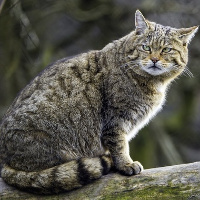
Although they may look like our domesticated companions, forest cats (also known as wildcats) are a species in their own right, living, as their name suggests, in and around forested areas. It consumes small mammals and other prey, which it hunts mainly in open areas near forest edges.

The problem of hybridization with the domestic cat (and in particular with domestic individuals that have returned to the wild, known as "harets" or "strays") poses a significant problem for the conservation of the forest species. A study on the introgression of domestic genes in forest cats is currently underway at the University of Liège.

The forest cat is slightly larger than the domestic cat, measuring between 73 cm and 1 m in length (including tail), with an average weight of around 4 to 5 kg in the male and between 3.5 and 4 kg in the female. However, individual body weights can vary considerably depending on the season.


The forest cat's basic coat color varies from grayish fawn to light fawn. It is generally barred with black stripes, very diffuse on the flanks. These are connected to a fairly clear black dorsal line that starts between the shoulder blades and runs to the tip of the body (but not on the tail).

The tail is cylindrical, with black rings (more pronounced towards the tip) and a thick black terminal tip (about 3.5 to 4 cm wide), unlike the domestic cat, where it is tapered. The forest cat's skull is wider, its hind legs more robust and its fur thicker than the domestic cat's, giving it a stockier appearance.

However, since hybridization between the Forest Cat and the Domestic Cat is well documented, and not necessarily based on visible characteristics, it is impossible to tell the difference between a Forest Cat and a hybridized cat by simple observation.

The forest cat's distribution in Europe is highly fragmented. These nuclei probably reflect the regression of forest massifs, especially during the period 1700-1900. The forest cat occupies the Iberian peninsula, central and eastern Europe, Italy and Sicily (the only Mediterranean island where the species is present). In Scotland, hybridization with the domestic cat seems to have been so strong that it is difficult to find pure-bred sylvan individuals (88% of individuals are said to be hybridized). The Belgian population is part of a nucleus that also includes northeastern France, Luxembourg and southwestern Germany.

Comments

Latest page updates

  • Telomian

    Telomian He is not recognized by the F.C.I. Origin Malaysia Translation Francis Vandersteen A brief presentation of the Telomian The Telomian is a very rare breed of dog, and the only one native to Malaysia to have been bred outside the country. They were originally bred by the indigenous people of Malaysia to combat parasites such as snakes, rats,...
  • King Wheaten -- Cavalier King Charles Spaniel X Irish Soft Coated Wheaten Terrier

    King Wheaten He is not recognized by the F.C.I. Origin Great Britain <> Ireland -> U.S.A. Translation Francis Vandersteen A brief presentation of the King Wheaten The King Wheaten is a small dog with a heart this big and a playful disposition. Borrowing the energy and soft-coated waves of the Irish Soft Coated Wheaten Terrier and the size and...
  • Spanierd -- English Springer Spaniel X German Shepherd

    Spanierd He is not recognized by the F.C.I. Origin Great Britain <> Germany -> U.S.A. Translation Francis Vandersteen A brief presentation of the Spanierd The Spanierd is a hybrid dog. Its parent breeds are the English Springer Spaniel and the German Shepherd. They have an affable personality. He's known for entertaining family and friends with his...
  • Alaskan Goldenmute -- Alaskan Malamute X Golden Retriever

    Alaskan Goldenmute He is not recognized by the F.C.I. Origin U.S.A. <> Great Britain -> U.S.A. Translation Francis Vandersteen This breed is also known as Alaskan GoldenGoldenmuteAlaskan Gold Retriever     A brief presentation of the Alaskan Goldenmute The Alaskan Goldenmute is a descendant of two great dog breeds: the Alaskan Malamute and the Golden...
  • French pointing dog Pyrenean type

    French pointing dog Pyrenean type FCI standard Nº 134 Origin France Translation Mrs. Peggy Davis Group Group 7 Pointing Dogs Section Section 1.1 Continental Pointing Dogs « Braque » Type Working With working trial Acceptance on a definitive basis by the FCI Tuesday 18 January 1955 Publication of the official valid standard Tuesday 01 August 2023 Last...
  • French pointing dog Gascogne type

    French pointing dog Gascogne type FCI standard Nº 133 Origin France Translation Mrs. Peggy Davis Group Group 7 Pointing Dogs Section Section 1.1 Continental Pointing Dogs « Braque » Type Working With working trial Acceptance on a definitive basis by the FCI Monday 17 January 1955 Publication of the official valid standard Tuesday 01 August 2023 Last...
  • Vucciriscu

    Vucciriscu He is not recognized by the F.C.I. Origin Sicily Translation Francis Vandersteen En français, cette race se dit Vucciriscu Diese Norm ist in deutscher Sprache sichtbar Vucciriscu En español, esta raza se dice Vucciriscu In het Nederlands, wordt dit ras gezegd Vucciriscu This breed is also known as Sicilian Vucciriscu Sicilian Butcher...

© 2026 Groupe Milouchouchou ASBL. Tous droits réservés. En savoir plus

Protected by Copyright01
We use cookies

We use cookies on our website. Some of them are essential for the operation of the site, while others help us to improve this site and the user experience (tracking cookies). You can decide for yourself whether you want to allow cookies or not. Please note that if you reject them, you may not be able to use all the functionalities of the site.

Ok

