
 |
Biet cat |
|
He is a wild animal |
Origin |
China | |
Translation |
Francis Vandersteen |
| The possession of this animal is not authorized |
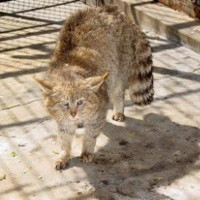
| The Biet cat is a cat species (or subspecies) of the genus Felis. It is sometimes called the Mongolian Cat, Monseigneur Biet's Cat, Gobi Cat or Chinese Desert Cat. This sturdy-looking feline has a thick brown to light gray coat with blurred darker markings. Only the front legs, face and tail are clearly striped. The ears are topped by a brush of dark hair. A solitary, nocturnal feline, it hunts mainly small mammals such as pikas and mole rats, resting in a den during the day. Endemic to China, the Biet's Cat lives on the eastern Tibetan plateau, in grasslands and bushes at altitudes of between 2,500 and 5,000 m, and avoids deserts. This rare feline is legally protected throughout its range. The main threats to the subspecies are pest poisoning campaigns, which reduce the number of its prey, and possibly the fur trade. The International Union for Conservation of Nature (IUCN) classifies it as "vulnerable" (VU). The Biet's Cat has been little studied and is one of the most misunderstood felines on the planet. Larger than a domestic cat, the Chat de Biet averages 115.7 cm in total length, with a head and body length of 70 to 85 cm and a tail length of 29 to 35 cm. The height at the withers is 35 to 45 cm. Males are larger than females5. The average weight is 5.5 kg, the record being held by a male in captivity who weighed 9 kg. The skull of the Chat de Biet can be distinguished from that of other felines by the presence of a mesial ridge on the basisphenoid and presphenoid bones, and by the absence of the metaconid on the lower carnassial m1. The tympanic bullae represent 25% of the total length of the skull, which is quite developed8, and characteristic of other felines living in arid zones, such as the Black-footed Cat or the Sand Cat. The Biet Cat is a strong, well-built feline, with short legs and a thick tail. The soles are covered with black hair. The yellowish-gray ears are pointed, ending in brushes of dark or reddish hair at the tips, measuring around 2 cm. There are two horizontal brown stripes on each cheek, and a blurred ring around the neck. The very thick fur is dark brown in summer and light gray in winter, with indistinct markings, providing excellent camouflage in its natural environment. The dense undercoat is slate-gray close to the skin and brownish at the tip. Brown stripes line the front legs. On other parts of the body, the dark-brown stripes are indistinct and imprecise. The full tail is longer than the foot, ringed with five to six black stripes and black at the tip. The belly, chest and inside of the limbs are cream or light gray. In the wild, the Biet's Cat can be confused with the Ornate Cat, the Manul and the Northern Lynx. Confusion with the domestic cat is also common. However, the Ornate Cat has no ear brushes and its coat is shorter and distinctly marked with spots or stripes, while the Manul is smaller than the Biet Cat, has a gray coat with a shorter tail that has no rings, and its ears have no ear brushes. As for the Lynx boréal, it's a much larger feline than the Chat de Biet, with a shortened tail. A nocturnal hunter, the Biet's Cat is active throughout the night in captivity, and hunts mainly at dawn and dusk in the wild. According to a faecal content analysis, small mammals make up 90% of its diet. The feline's prey includes moles, pika, voles, marmots, hamsters and gerbils, as well as birds such as partridges, pheasants and larks. In Qinghai, mammals hunted include the Kansu Pika, the Black-lipped Pika, the Daourie Pika, the Northern Vole and the Woolly Hare. The usual hunting technique consists of a slow, silent approach followed by a quick leap to grab the prey by the neck and snap its spine. For mole rats living in tunnels, the Biet's Cat scans the location of the underground gallery, listening for the movements of the prey, which it quickly digs up before killing. |



 English (United Kingdom)

Comments