
 |
Bengal Leopard Cat |
|
He is a wild animal |
Origin |
Afghanistan, Bangladesh, Burma, Bhutan, Brunei, Cambodia, China, India, Indonesia, Japan (Tsushima and Iriomote Islands), Laos, Malaysia, Mongolia, Nepal, Pakistan, Philippines, Singapore, North and South Korea, Taiwan, Thailand, Russia (Far East), Vietnam | |
Translation |
Francis Vandersteen |
| The possession of this animal is not authorized |
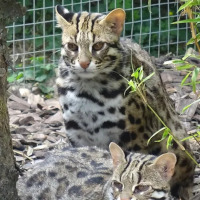
| The Bengal Leopard Cat (Prionailurus bengalensis), Leopard Cat or Chinese Cat, is a species of feline in the genus Prionailurus. The Bengal Leopard Cat is a small feline from Southeast Asia and the Far East. The upper body of this feline is pale yellowish-brown with three rows of short black stripes along the back and a perpendicular black stripe behind each shoulder. This very elegant feline is about the size of a cat. There is little sexual dimorphism, but males can be more massive than females. Its weight varies from 2 to 7 kilos, with a body measuring 46 to 81 centimetres and a tail length of 23 to 36 centimetres. Specimens from Russia are three times heavier than those from the Indonesian rainforests. The head is small with large eyes. The ears are large and rounded. The hind limbs are slightly longer than the front ones. The tail is long, full of hair and fluffy. This feline can be found in many types of habitat, although it prefers wooded areas such as forests and bushes. These habitats range from tropical rainforest to temperate hardwood forest and, marginally, coniferous forest as well as shrub forest and successional grasslands. It prefers riparian zones and can be found in mangroves. It has also adapted to agricultural areas and is present, for example, in oil palm plantations, rubber plantations or sugar cane fields, provided there is a forest within 2 km. It can approach dwellings. It can be observed from sea level up to an altitude of 3500 meters. The Bengal Leopard Cat is mainly nocturnal, with crepuscular activity, but can be seen during the day. It is an excellent swimmer and climber, capable of reaching heights of up to 20 meters. Like most felines, the Bengal Leopard Cat is a solitary animal outside the breeding season. It is rather territorial, although it can also be non-territorial, with a larger territory size for males than females, ranging from 1.5 to 12.4 km². It rests in hollow trees or in holes made under the roots of large trees. Probably to leave little trace of its presence, some of its droppings are made in river water. The Bengal Leopard Cat is a very rare species. The Bengal Leopard Cat is an opportunistic hunter, preying on small prey but content with carrion in times of scarcity, and may attack poultry in villages. Its diet consists mainly of rodents from the muridae family, such as Leopoldamys sabanus or the Maxomys genus, as well as mice, rats and field mice. These rodents may be endemic or exotic. It also consumes rodents from the Cricetidae family, such as Hyperacrius wynnei, from the Sciuridae family, such as Eoglaucomys fimbriatus or Callosciurus notatus, and from the Gliridae family, such as Dryomys nitedula. The Bengal Leopard Cat may consume around 2,000 mice a year. It also hunts small mammals, including lagomorphs such as Pika. It can also catch flying foxes and bats. It can prey on small ungulates such as serow, goral or Tragulus javanicus, and even larger ones like Cervus unicolor. Its diet includes birds, and it can also attack domestic poultry. It captures fish such as Siluriformes, amphibians such as frogs, reptiles and snakes. It also consumes insects such as Acrididae or nymphs or adults of Cicadidae or butterflies of the Tortricidae family. While the Bengal Leopard Cat's diet consists mainly of mammals, also including birds, amphibians, reptiles and invertebrates, the low occurrence of mammals, as on the island of Iriomote for example, can be compensated for by the consumption of a higher proportion of reptiles and amphibians. The proportions of its diet also vary according to the season, and it may, for example, contain more birds during migration and consequently fewer insects. In the south of its range, the hat-leopard has no fixed breeding season, although there is a peak at the end of the year, unlike in the north where births take place in May after a gestation period of 56 to 72 days. A litter consists of one to four cubs, usually two or three of which open their eyes at around ten days. The young can eat solid food from 23 days. The male can sometimes help raise the young. The Bengal Leopard Cat is classified as Least Concern (LC) by the IUCN, as this relatively common feline has a wide range. However, due to deforestation and habitat loss, the Prionailurus bengalensis rabori subspecies is listed as Vulnerable (VU) and the Prionailurus bengalensis iriomotensis subspecies is considered Critically Endangered (CR). In Japan, the population of Prionailurus bengalensis euptilurus on Tsushima Island is considered endangered, as is that of Prionailurus bengalensis iriomotensis on Iriomote Island. |



 English (United Kingdom)

Comments