
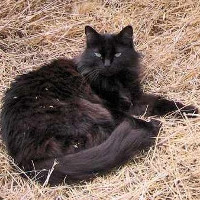
 |
Tiffany |
|
TranslationFrancis Vandersteen |
||
OriginThe Tiffany, Tiffanie or Asian longhair is a breed of cat originating in the United Kingdom and bred from the English Burmese. |
| This medium-sized cat is the semi-long-haired variety of the Asian and English Burmese. |
A brief historical overview |
| Breeding of the breed began by accident in England, in 1981, when, unbeknownst to their mistress Baroness Miranda von Kirchberg, a European Burmese and a Persian Chinchilla had a litter of kittens that looked like Burmeses but were Chinchillas. The beauty of the kittens prompted the Baroness to launch a breeding program for silver Burmeses and create the Burmilla breed. In 1999, this breeding program produced many kittens whose color was not Chinchilla or whose coats were long-haired, giving rise to the Asian and Tiffany breeds respectively. The latter was recognized in 1999 by the Waratah State Cat Alliance as a new breed in New South Wales. Another minor breeding program begins in Victoria and Queensland. Some 50 cats are produced by nine breeders in New South Wales, three in Victoria and two in Queensland. The breed name can be written with a y (Tiffany) at the end, like the famous US jewelry store Tiffany & Co, or with ie (Tiffanie). This is to distinguish it from the American longhaired Burmese also known as "Tiffany". The British Tiffanie corresponds to the LOOF Tiffany, and the Chantilly is not necessarily a Tiffany. |
General appearance |
| The Tiffany should not be confused with the Chantilly-Tiffany. |
Behavior / characteristics |
| Character traits are completely individual and depend above all on the history of each cat. This breed is described as refined, sociable, peaceful, affectionate and easy-going, with a dignified air. The breed's character is considered to be a happy medium between the placidity of the Persian and the energy of Oriental cats, with an intermediate level of activity. The Tiffany is therefore a suitable compromise for people who like the character of the Burmese and the fur of long-haired cats. Breeders of this cat breed describe it as less demanding than the Burmese and calmer than the Siamese. However, the Tiffany is less active than the Burmilla. The Tiffany adapts well to life in an apartment, and enjoys the presence of its master as much as it does solitude. Suitable for families and the elderly. |
Head |
||
Cranial region |
||
Head |
The head is of medium size, but should be fairly high. The top should be rounded; a flat forehead is a fault. From the front, it forms a small triangle, completed by broad cheekbones, compact cheeks, a pronounced stop and a delicate chin without protuberance. | |
Facial region |
||
Nose |
The nose leaks neither forward nor backward. | |
Eyes |
The eyes are large, oblique and set wide apart, not like those of Oriental cats, but well proportioned. Eye color varies from golden to green amber. However, several other colors are valid depending on coat color, except green, which is considered a fault. | |
Ears |
The ears are fine, large and slightly tilted forward, of moderate size. They are set wide apart on the skull, rounding off in profile. A tuft of hair on the tips of the ears is acceptable. | |
Body |
||
Generality |
The Tiffany's body is of medium size and length, with a strong musculature due to its thick fur close to its body and a weight that one would imagine to be less heavy on sight. Females are smaller and more slender than males. | |
Tail |
| The tail is moderately thick at the base, tapering to a rounded tip. When pulled back over the body, it should reach the cat's shoulders. |
Limbs |
| The legs are slender and proportionate to the body, with the hind legs higher than the front legs. | ||
Forequarters |
Hindquarters |
Coat |
||
Coat and texture |
The coat is medium-long or long, depending on the type, with a silky, fine texture as it is made up of little woolly undercoat. It should appear dense and full, softening the cat's silhouette. It lies close to the spine, well glossed. The coat is glossy and smooth, extending over the breeches, ruff, under the belly and on the tail. Phantom tabby markings in non-agouti adults (except for the orange color) are penalizing, except for kittens. The tail is furnished like a feather duster. A ruff is desirable in adults, but preference is given to cats with a ruff and full breeches at shows. The Ttiffany is available in a wide variety of coats; the authorized patterns are identical to those of the Burmese and Asian: self, tabby, silver, ticked, smoke, whether in traditional colors or sepia. For subjects with a traditional coat, all shades of green and yellow are accepted, although gold is preferred if the coat is plain or green in the case of a silver coat. For Tiffany sepia, only shades of yellow are accepted. Uniform color with no white spots. |
|
Size and weight |
||
Height at withers |
Male height at withers: between 21 and 23 cm. Female height at withers: between 21 and 23 cm. |
|
Weight |
Average adult male weight: between 4 and 5 kg. Average adult female weight: between 4 and 5 kg. |
|
Tolerances |
 Phantom tabby markings on kittens and non-agouti young adults. Tabby markings on head, legs and tail in non-agouti orange series cats. Phantom tabby markings on kittens and non-agouti young adults. Tabby markings on head, legs and tail in non-agouti orange series cats. |
Penalties |
| Flat top of skull. Pinch in an adult. Busted nose. Nose running forward. Round or oriental eyes, very small or very close. Protruding eyes or chin. Phantom tabby markings in non-agouti adults (except orange series). |
Refusal of any title |
| Medallion or white spots. Oriental or cobby morphology. Green eyes in English Burmese. Small, puny or thin-boned adult. General faults and defects eliminatory in show. |
Authorized marriages |
| The only authorized matings are those with the English Burmese, the Asian and the breed itself. |



 English (United Kingdom)

Comments