
 |
Tonkinois |
|
TranslationFrancis Vandersteen |
||
OriginThe Tonkinois is a cat breed popular in the USA and Canada, but rare in Europe. |
| The Tonkinois was originally bred from a Siamois and a Burmese. |
A brief historical overview |
| The Tonkinois is a cat that has been around for centuries, born of the marriage of two breeds that were once very close and often intermingled: the Siamois and the Burmese. In its country of origin, Thailand, it has been around for a long time, but without really having a name. It seems that the original cat of today's Burmese and Tonkinois lines was called Wong Mau, that she was a Mink and that she arrived in the United States in 1930. Americans wishing to develop the burmese were then only interested in sepia babies. But what was then known as the “golden Siamese” seemed to have inherited the qualities of its two parent breeds, without having taken on any of their faults: it was therefore of great interest to Canadians, who officially recognized it in 1965 under the name Tonkinois. It was recognized in 1974 by the Canadian Cat Association (CCA), then in 1978 by the CFA. The morphologies of the two original breeds diverged so widely that breeders had great difficulty stabilizing the breed's physique. This is why it was agreed to breed Tonkinois between themselves. However, as the mating of two Mink cats produces colorpoint and sepia babies as well as Mink babies, the standard now also accepts cats with the blue eyes of the Siamois pattern (colorpoint) or the amber eyes of the Burmese pattern (sepia). |
Behavior / characteristics |
| The Tonkinois is a perfect compromise between the Siamois and the Burmese: more active and present than the Burmese, less exclusive and less talkative than the Siamois. Yet it knows how to make its wishes understood and is infinitely tender. Very sociable, he gets on well with other cats, dogs and other animals, and loves to play with children. He's an active cat, very intelligent and cuddly, but with a great need to exercise: he's neither quiet nor shy, and retains the happy demeanor of a kitten for most of his life. Very curious, he loves to mingle, explore, climb, play with everything that moves and actively participates in family life. Often greedy and inveterate spies, they are ingenious and determined to get what they want. He's always alert, always present. He's an extrovert but friendly cat, and his eternal good humor makes him irresistibly endearing. |
Head |
||
Cranial region |
||
Head |
From the front, the head forms a triangle with softened contours. However, it is slightly longer than it is wide. | |
Facial region |
||
Forehead |
In profile, the forehead is slightly rounded and the nose marked by a discreet stop. | |
Eyes |
Walnut-shaped, set at a slight angle. | |
Ears |
Medium-sized, broad at the base, with rounded tips. | |
Body |
||
Generality |
The Tonkinois is a medium-sized, muscular and athletic semi-foreign cat. When carried, its weight can be surprising. | |
Tail |
| The Tonkinois tail is also medium-sized, with a slightly rounded tip. |
Limbs |
| The legs are rather slender but of a length proportionate to the body. | ||
Forequarters |
Hindquarters |
Feet |
| Medium-sized, oval paws. |
Coat |
||
Coat and texture |
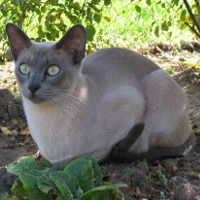
The Tonkinois has a very soft coat. There are short-haired Tonkinois and, in some countries, a semi-long-haired variety, sometimes called “Tibetan”. Tonkinois have a dense, silky coat that lies close to the body, while Tibetans have almost no undercoat and a very fine, silky coat that lies close to the body, sometimes with a ruff. The cross between the colorpoint of the Siamois and the sepia of the Burmese gave rise to the mink coat, a typical Tonkinois pattern. The Tonkinois can thus have three different patterns : - Colorpoint : in this case, the eyes should be between pale blue and purplish blue. - Sepia : in this case, the eyes should be between green and golden. - Mink : in this case, typical of this pattern, the eyes are aquamarine. These patterns are available in all colors, with or without tabby, silver or smoke markings. |
|
Authorized marriages |
 In France, first-generation crossbreeding (Siamois x Burmese) has not been authorized since 2009, and mating with a Siamois or Balinais cat has not been possible since January 1, 2011. Only marriage with another Tonkinois, an English Burmese or an Asian longhair remains authorized. The first French longhaired Tonkinois kittens were born in 2011. In France, first-generation crossbreeding (Siamois x Burmese) has not been authorized since 2009, and mating with a Siamois or Balinais cat has not been possible since January 1, 2011. Only marriage with another Tonkinois, an English Burmese or an Asian longhair remains authorized. The first French longhaired Tonkinois kittens were born in 2011. |



 English (United Kingdom)

Comments