
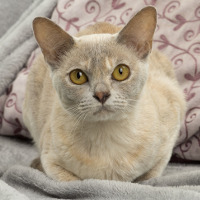
 |
English Burmese |
|
TranslationFrancis Vandersteen |
||
OriginThe English Burmese or European Burmese is a cat breed descended from the American Burmese and developed in the United Kingdom from the 1950s onwards. |
| This medium-sized cat is characterized by its sepia-toned coat. It differs from its American counterpart mainly by its triangular face and less round eyes. |
Standard |
| The Livre officiel des origines félines (LOOF) and the Cat Fanciers' Association (CFA) distinguish between the two types; note that the CFA calls the American Burmese a "Burmese" and the English Burmese a "European Burmese". The Governing Council of the Cat Fancy (GCCF), the Fédération Internationale Féline (FIFé) and the World Cat Federation recognize only the English Burmese, under the name "Burmese". |
A brief historical overview |
| The Tamra Meow or Book of Cat Poems is a richly illustrated Thai collection of verse written between 1350 and 1767, describing seventeen different cats, some lucky and some not. The manuscript lists and poetically describes the breeds of cat in existence at the time, including a description of the Burmese. It is possible that Burmeses competed in England in the 19th century as Siamese. In 1930, an American sailor brought a Burmese cat back to San Francisco: Wong-Mau, whose hazel-colored coat showed slight variations in color intensity, stronger at the extremities (legs, tail, head) but without the spiked pattern. Wong-Mau was purchased by Dr. Joseph Thomson. Another version of the story holds that Joseph Thomson brought Wong-Mau directly from Burma. The doctor made several crosses with cats of Thai origin, notably a sealpoint Siamese, to reproduce Wong-Mau's coat. The Cat Fancier Association (CFA) recognized the breed in 1936. The first Burmeses were imported to the UK in the early 1950s and recognized by the Governing Council of the Cat Fancy (GCCF) in 1952. British breeders continued the Siamese breeding program longer than in America and developed their own Burmese type, more oriental than the American Burmese and accepting a wider range of colors. The blue color was registered within a few years. Red, cream and tortoiseshell, the result of accidental cross-breeding as these colors do not occur naturally in Burmese, were accepted in the 1970s. The differences between the American-type Burmese and the English-type Burmese became too great, and two breeds were now recognized: the English Burmese and the American Burmese. The English Burmese is very popular in the UK, where it is one of the top 10 most popular breeds. |
General appearance |
| The English Burmese is a medium-sized cat with an athletic, harmonious semi-foreign physique. |
Behavior / characteristics |
| Christiane Sacase describes the Burmese as exuberant and athletic, adapting to life in an apartment but preferring to live outdoors, where they are good hunters. He is loyal and affectionate with his master. Its voice is reminiscent of the Siamese. |
Genetics |
| Burmeses carry only the sepia gene. Color appears gradually as the dog grows. |
Head |
||
Cranial region |
||
Head |
The head forms a triangle with high cheekbones and a rounded muzzle, with the ears in line with the triangle. | |
Facial region |
||
Forehead |
The forehead is slightly rounded but not domed. | |
Nose |
Straight nose with pronounced stop. | |
Eyes |
Large, yellow eyes with oblique upper line and rounded lower line. | |
Ears |
Medium-sized, set wide apart on a slightly rounded skull, ideally in line with the triangle formed by the head. Wide at the base, they have rounded tips. Viewed from the side, they point slightly forward. The ears may appear proportionally larger in kittens than in adults, and smaller in males with developed jowls. | |
Neck |
| Medium-sized, well-muscled neck. |
Body |
||
Chest |
Broad chest. | |
Tail |
| Medium length, but longer and finer than the American Burmese. |
Limbs |
| The legs are slender, proportionate to the body. | ||
Forequarters |
Hindquarters |
Feet |
| Oval paws. |
Coat |
||
Coat and texture |
The coat is short, soft and glossy. The pattern is sepia, i.e. solid color with subtle shading on legs, head and tail. Accepted colors are black (seal sepia or sable), blue, chocolate (champagne), lilac (platinum), russet, cream, tortie. | |
Size and weight |
||
Height at withers |
Male height at withers: between 22 and 25 cm. Female height at withers: between 22 and 25 cm. |
|
Weight |
Average adult male weight: between 3.5 and 7 kg. Average adult female weight: between 3.5 and 7 kg. |
|
Tolerances |
 Phantom tabby markings in kittens and non-agouti young adults. Tabby markings on head, legs and tail in non-agouti orange series cats. Phantom tabby markings in kittens and non-agouti young adults. Tabby markings on head, legs and tail in non-agouti orange series cats. |
Penalties |
| Flat top of skull. Pinch in an adult. Busted nose. Nose running forward. Round or oriental eyes, very small or very close. Protruding eyes or chin. Phantom tabby markings in non-agouti adults (except orange series). |
Refusal of any title |
| Medallion or white spots. Oriental or cobby morphology. Green eyes in English Burmese. Small, puny or thin-boned adult. General faults and defects eliminatory in show. |
Authorized marriages |
| Asian x Asian Asian x English Burmese Asian x Burmilla English Burmese x English Burmese English Burmese x Burmilla Burmilla x Burmilla |



 English (United Kingdom)

Comments