
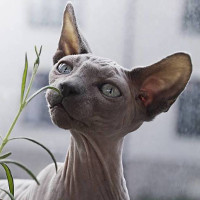
 |
Donskoy |
|
TranslationFrancis Vandersteen |
||
OriginThe Donskoy, also known as Don Sphynx and Sphynx du Don, Don Hairless, originated in Rostov-on-Don, Russia. |
| The Donskoy remains very rare. In France, 57 pedigrees were issued between 2003 and 2014. |
A brief historical overview |
| The discovery of the Donskoy dates back to 1987, when a schoolteacher recovered a kitten in her home town of Rostov-sur-le-Don. As the kitten grew, it lost all its hair, despite attempts by veterinary surgeons to treat it. Elena Kovalena named the kitten Varvana. It was this cat that gave birth to the breed. A few years later, Varvana gave birth to her first litter. There were both hairless and hairy kittens. Those born with fur began to lose it, as had their mothers. The new owners of these kittens thought they were in poor health and didn't want to keep them. One of the kittens was taken in by a breeder who was totally won over and decided to make it a breed. The gene responsible for the absence of hair being dominant, it was not difficult to establish the breed by crossing it with Europeans, Persians or Siberians. The Donskoy was also crossed with Orientals, taking advantage of its dominant gene to create a variety of naked Orientals. The breed was first recognized by the WCF in 1997; the LOOF, FIFé and TICA only recognized it at a preliminary stage, i.e. Donskoy dogs cannot take part in shows. |
Behavior / characteristics |
| The Donskoy is described as a very active, affectionate and intelligent cat. They are very sociable with both humans and animals. Their lack of aggression exposes them to attacks from outside cats or dogs, as they don't know how to defend themselves. Lively and playful, they are very attached to their masters and follow them around like little dogs. |
Health |
| The Donskoy is a cat with no known genetic problems, and can live up to 19 years. They are, however, prone to frequent lung infections. |
Head |
||
Cranial region |
||
Head |
The head is wedge-shaped, with prominent cheekbones. A head that is round, too narrow or long, like that of an Oriental cat, is considered a fault. Whiskers, if any, should be curly. Above all, the head should not resemble that of a Sphynx, as this is a qualifying fault. |
|
Facial region |
||
Muzzle |
The muzzle is short according to LOOF. | |
Jaws and teeth |
FIFé and TICA standards mention long canines that may protrude beyond the lips. | |
Eyes |
The eyes are set at an angle and slightly almond-shaped. Their color should match that of the coat. Round eyes or eyes that are too closed are penalized at a show. | |
Ears |
Ears should be large, open and set on the top of the skull. Too low on the head, or too small, is a fault. The tips of the ears are rounded, and when viewed from the side, they can be seen to lean forward. | |
Body |
||
Generality |
The Donskoy is a medium-sized cat with a semi-foreign silhouette. It has powerful muscles and a broad croup. It must not be too heavy or too light, however, as this would be penalized. The FIFé standard specifies strong bones. | |
Tail |
| Long and fine. |
Limbs |
| The legs are long and muscular, yet proportionate to the rest of the body. | ||
Forequarters |
Hindquarters |
Feet |
| The feet are oval, with very long toes. The paws are webbed, as the Donskoy enjoys swimming outdoors. |
Skin |
| This solid, warm skin is highly resistant to sun and cold. |
Coat |
||
Coat and texture |
The skin is the Donskoy's main characteristic. It must be elastic and feature many folds, especially on the head, armpits, neckline and belly. TICA judges look for as many folds as possible. Down is accepted on the muzzle, ears, feet, genitals and tip of the tail. However, kittens can be born with hair, and some retain a wavy or curly coat. In winter, Donskoys can also build up a downy coat all over their bodies. The TICA standard specifies that traces of manual depilation, resemblance to a Devon rex or Cornish rex or traces of curly hair are eliminatory. | |
Color and ticking |
All coat colors and patterns are permitted. | |
Size and weight |
Authorized marriages |
| No crosses with other breeds are allowed for LOOF or WCF, but TICA still accepts crosses with Alley Cats. |



 English (United Kingdom)

Comments