|
A brief historical overview
|
In the 1960s, a harecat with curly fur was spotted in an abandoned tin mine near Buckfastleigh in Devon. Despite numerous attempts, its capture proved impossible. In 1960, he bred with a tortoiseshell and white hare and a litter of several kittens, including a young male with curly fur like his father's. The birth took place in a field behind the mine. The birth takes place in a field behind RSPCA worker Beryl Cox's garden. She decided to adopt the curly-haired kitten and named him Kirlee. According to another version of the story, Beryl Cox succeeded in adopting Kirlee's father and mated him with one of her cats, who gave birth to Kirlee.
A breed of curly-haired cats known as Cornish rex has been around for ten years. Beryl Cox, having seen photographs of Kallibunker, the first Cornish rex, in an article in the Daily Mirror, contacted breeders and sold Kirlee to them for £25, with the aim of improving their cats. However, all kittens born to Kirlee and Cornish rex have straight hair. This explains why the gene responsible for this coat is not the same in Cornish rex and Kirlee. Test crosses show that the recessive Devon rex mutation is slightly different from that of the Cornish rex.
In order to fix this particular mutant gene, Kirlee was bred with her daughters, following a breeding program similar to that of the Cornish rex. Kirlee, at the end of a very prolific life, died in 1970 in a car accident. Alison Ashford is the founding breeder of this breed, under the affix Annelida.
In 1967, the Cornish rex and Devon rex were recognized as two different breeds by the Governing Council of the Cat Fancy (GCCF). The Fédération Internationale Féline (FIFé) recognized the devon rex in 1968. In North America, devon rex and cornish rex shared the same Cat Fanciers' Association (CFA) standard until 1979.
In 2015, the Devon rex was the twentieth most popular of the 55 breeds registered by the LOOF. In the USA, it represents the twelfth most popular breed out of 47 breeds in 2014, and in the UK, the fourteenth breed out of forty recognized by the GCCF in 2014. |
Behavior / characteristics
|
Character traits are not described in standards, but remain entirely individual and depend on each cat's history. The Devon rex is often described as playful, mischievous and naughty. It is said to be very close to humans and demands a lot of attention.
According to Christiane Sacase, curly-haired cats are very active and need lots of space and play to exercise. She describes them as confident, attached to their master and intelligent. Rexes are said to be easy to train, tolerate travel calmly and tolerate being kept on a leash. According to Bruce Fogle, the Devon rex is sociable, talkative and active, and can be trained.
Desmond Morris describes the Devon rex as “friendly, lively, affectionate, playful, intelligent, mischievous, enterprising, active, curious and outgoing”. Several authors have argued that the Devon rex behaves like a dog: it retrieves objects, follows its master and wags its tail when it's happy. However, for this last argument, behavioral descriptions lead Desmond Morris to believe that the tail wagging is explained by the simple pendulum movement necessary to maintain the cat's balance. |
Health
|
Life expectancy is twelve to sixteen years. Due to the breed's high level of inbreeding, based on a single founding cat, hereditary diseases have rapidly arisen, notably luxation of the patella, vitamin K-dependent coagulopathy and myasthenia.
Two blood types are present in British Devon rex populations: type A and type B. The GCCF recommends that breeders test their cats' blood group to avoid feline neonatal isoerythrolysis, due to incompatibility between the mother's blood group and that of her offspring, and transfusion shock in the event of blood transfusion.
In the 1980s, a few cases of Devon rex suffering from vitamin K-dependent coagulopathy were reported. All related to the same British ancestor, this disease has been eradicated from the breed. Symptoms of this genetic disease include bleeding, particularly in the joints, breathing difficulties and lameness. Blood tests show a deficiency in coagulation factors. Treatment is by regular administration of vitamin K1 and blood transfusions.
The first reports of devon rex suffering from myasthenia (Congenital Myasthenic Syndrome, often abbreviated CMS) came in 1974. The first cases were mistakenly regarded as spasticity (abnormal muscle contraction). The genetic origin of the disease was soon suspected, given its constant spread in different countries (Australia, New Zealand, the United States, Great Britain and the Netherlands). Pedigree studies point to autosomal recessive inheritance.
Myasthenia, which inevitably leads to death within a few months or years, can be seen in kittens as early as four to seven weeks of age, and sometimes later, between twelve and fourteen weeks. Symptoms include severe fatigue and a jerky, stiff gait, with the front legs thrown far forward when walking. The shoulders are carried very high, while the head is directed towards the chest, with an arched neck. Veterinary analyses show heterogeneous muscle fibers, the condition of which worsens over time.
As far as possible, breeders have selected to exclude healthy carriers from breeding. A risk coefficient for carrying the gene could, for example, be indicated on the cat's pedigree. The frequency of the disease declined considerably from the 1980s onwards. In 2012 and 2014, a resurgence of cases accelerated the research effort on this disease. In 2015, cooperation between the Antagène laboratory, the École Nationale Vétérinaire d'Alfort and LOOF made it possible to isolate the gene responsible for the disease and create a genetic test to detect healthy carriers. |
Genetics
|
| The Devon rex's curly coat is determined by an autosomal recessive gene. The mode of inheritance of Devon rex curly hair is autosomal recessive. This means that a Devon rex must carry two alleles to develop a curly coat. Crosses with Cornish rex very quickly demonstrated that the gene responsible for the Devon rex's curly coat is different. Originally, the two genes were differentiated by the following codes: Gene 1 (Cornish) Rex and Gene 2 (Devon) Rex. Today, the Cornish rex gene is part of the R series and the Devon rex gene is part of the Re series. |
|

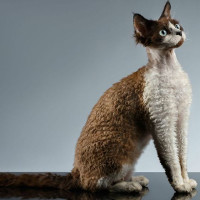
 In the United States, the CFA accepts American shorthair and British shorthair matings until May 1, 2028, while the TICA authorizes American shorthair, British shorthair, European shorthair, American Burmese, Bombay, Sphynx and Siamese.



 English (United Kingdom)

Comments