
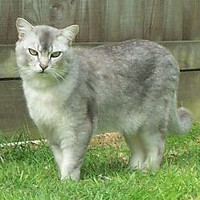
 |
Burmilla |
|
TranslationFrancis Vandersteen |
||
OriginThe Burmilla is a breed of cat originating in England and belonging to the Asian group. |
| Its development began in the 1980s with a chance cross between a lilac Burmese and a Persian chinchilla. |
Standard |
| For the LOOF, English Burmese, Asian and Burmilla standards are identical, except in terms of authorized crosses and colors. |
A brief historical overview |
| The breed was created in 1981 as the result of an accidental cross. Baroness Miranda von Kirchberg, a breeder of Burmeses, owned a male Persian silver chinchilla named Sanquist, purchased for her husband. Shortly before he was due to be castrated, a chance cross was made with a lilac-colored female Burmese called Fabergé. According to the Baroness's testimony, a cleaning lady let Sanquist into the room where Fabergé, in heat, was waiting to be presented with another Burmese. Although the female was covered by another appropriately bred male, four silver shaded black female kittens - a color that leaves no doubt as to Sanquist's paternity - were born on September 11, 1981: Galatea, Gemma, Gabriella and Gisella. These four females are so beautiful that the Baroness refuses to castrate them, as is customary in such accidents, and uses them as the basis for the creation of a new breed. Miranda von Kirchberg and her breeder friend Thérèse Clarke decide to create a new breed based on Gemma and Galatea. The Baroness again crossed her Sanquist Persian with another Burmese from her kennel. In 1982, a male, Jacynth, was born from this union, who, along with his two half-sisters, is at the origin of numerous lines of Burmillas. The two breeders decided that this new breed would resemble the English Burmese, not least because no confusion with other breeds was possible. They based the standard on that of the Burmese. The name chosen for the breed was "Burmilla", a contraction of the terms "Burmese" and "Chinchilla". Inbreeding was carried out to fix certain morphological characteristics, notably the short coat. In fact, the contribution of the Persian brought the recessive gene producing the semi-long coat, which was undesirable. Miranda von Kirchberg founded the Burmilla Association to promote and develop the breed. In 1984, Thérèse Clarke founded the Burmilla Cat Club. The Burmilla Cat Club regularly publishes a magazine, the BCC Mews, and within four years has some 50 members. The two clubs develop two different aspects of the Burmilla: the Burmilla Association focuses on the preservation of morphological type, while the Burmilla Cat Club works on the quality of coat tipping. The combined efforts of the two breed clubs are rapidly establishing the Burmilla as a solid "new breed". Work on breed recognition began in 1983. The Baroness chose to develop other colors, and these cats are now recognized as Asians. Thérèse Clarke continued to work on silver lines, and the Governing Council of the Cat Fancy (GCCF) recognized the breed in 1989, followed by the Fédération Internationale Féline (FIFé) in 1994. The two main American federations, the Cat Fanciers' Association (CFA) and The International Cat Association (TICA), recognize the Burmilla as a "new breed". The breed is rare in the U.S.A. and France. According to statistics from the Livre officiel des origines félines (LOOF), only 343 Burmillas were registered between 2003 and 2013, representing 0.17% of the total number of pedigree cats in France. In 2013, the Burmilla ranked 31st out of 72 breeds in terms of LOOF registrations. It is, however, the most popular Asian breed in France. |
Behavior / characteristics |
| Character traits are not described in the standards and are temperaments generally observed in the breed. Christiane Sacase describes the Burmilla as a sweet-tempered, attention-seeking, meowing cat. Dr. Bruce Fogle describes Asians as "more relaxed than Burmeses, more sociable than Persians". Desmond Morris uses the following terms to describe the Burmilla's character: playful, outgoing, sociable, friendly, attentive, gentle and kind. |
Health |
| Burmillas require no special grooming. Weekly brushing and polishing with a glove is recommended. |
Genetics |
| The tipped coat worn by the Burmilla is a variant of the agouti coat. A classic agouti coat is made up of several alternating bands of color. In tipped coats, the dark stripe is pushed back to the end of the coat. Shell is used when about one eighth of the hair is pigmented, and shaded when one third of the hair is pigmented. |
Head |
||
Cranial region |
||
Head |
The medium-sized head forms a short triangle from the front. The cheekbones are broad, the skull and forehead slightly domed. A flat skull is considered a fault. In profile, the stop is well defined, then the nose ends straight. Busted noses are considered faults. The muzzle is slightly rounded and the chin is fairly thick. | |
Facial region |
||
Eyes |
The eyes are large. Their upper line slopes towards the nose, while the lower line is rounded. The eyes should be set wide apart on the head. Their shape, not their color, is of primary importance. However, the standard specifies that their color should be bright. Oriental or round eyes, too close together on the head or very small eyes are faulty. Permitted colors are yellow and green in all shades, with a preference for green for chinchilla coats. | |
Ears |
Medium-sized, broad at the base with rounded tips. Like the eyes, they should be set wide apart on the head. Viewed in profile, the ears point forward. | |
Body |
||
Generality |
The Burmilla is a medium-sized cat with a semi-foreign, medioline silhouette. Burmillas with too oriental or cobby a silhouette are eliminated from the championship, as are those with thin bones or small stature. The body and neck are well muscled, and the cat is often heavier than it looks. The back is straight and the chest rounded. | |
Tail |
| The tail is of medium length, touching the shoulders when folded along the body. Moderately thick, tapering to a rounded tip. |
Limbs |
| The legs, which should be slender, are well proportioned to the body. | ||
Forequarters |
Hindquarters |
||
Generality |
The hind legs are slightly longer than the front ones. | |
Feet |
| Feet are oval and well defined. |
Coat |
||
Coat and texture |
The Burmilla's coat is short and virtually without undercoat. The coat should be fine, soft, glossy and close to the body. Sepia and traditional patterns are the only ones permitted. All cat coat colors are accepted, with the exception of epistatic white. The coat must show tipping with or without the action of the silver gene and golden polygenes. Burmilla coat nomenclature varies according to the proportion of color to hair length, as well as for historical reasons. "Shaded" means that the color is pushed out over about a third of the hair length, while for a "shell" cat, the color represents about an eighth of the hair. Historically, silver tipped red coats are called "cameos". Chinchilla" refers to a silver shell coat, usually for the black color. Long-haired individuals may be born from crosses between Burmillas. They are registered as Tiffanies with LOOF and are not recognized by FIFé. The Australian Cat Federation (ACF), the Cat Fanciers' Association (CFA), The International Cat Association (TICA) and the World Cat Federation (WCF) authorize a semi-long-haired variety, the Burmilla longhair. |
|
Size and weight |
||
Height at withers |
Male height at withers: between 21 and 23 cm. Female height at withers: between 21 and 23 cm. |
|
Weight |
Average adult male weight: between 4 and 5 kg. Average adult female weight: between 4 and 5 kg. |
|
Tolerances |
 Phantom tabby markings on kittens and non-agouti young adults. Tabby markings on head, legs and tail in non-agouti orange series cats. Phantom tabby markings on kittens and non-agouti young adults. Tabby markings on head, legs and tail in non-agouti orange series cats. |
Penalties |
| Flat top of skull. Pinch in an adult. Busted nose. Nose running forward. Round or oriental eyes, very small or very close. Protruding eyes or chin. Phantom tabby markings in non-agouti adults (except orange series). |
Refusal of any title |
| Medallion or white spots. Oriental or cobby morphology. Green eyes in English Burmese. Small, puny or thin-boned adult. General faults and defects eliminatory in show. |
Authorized marriages |
| Asian x Asian Asian x English Burmese Asian x Burmilla English Burmese x English Burmese English Burmese x Burmilla Burmilla x Burmilla |



 English (United Kingdom)

Comments